Free first chapter
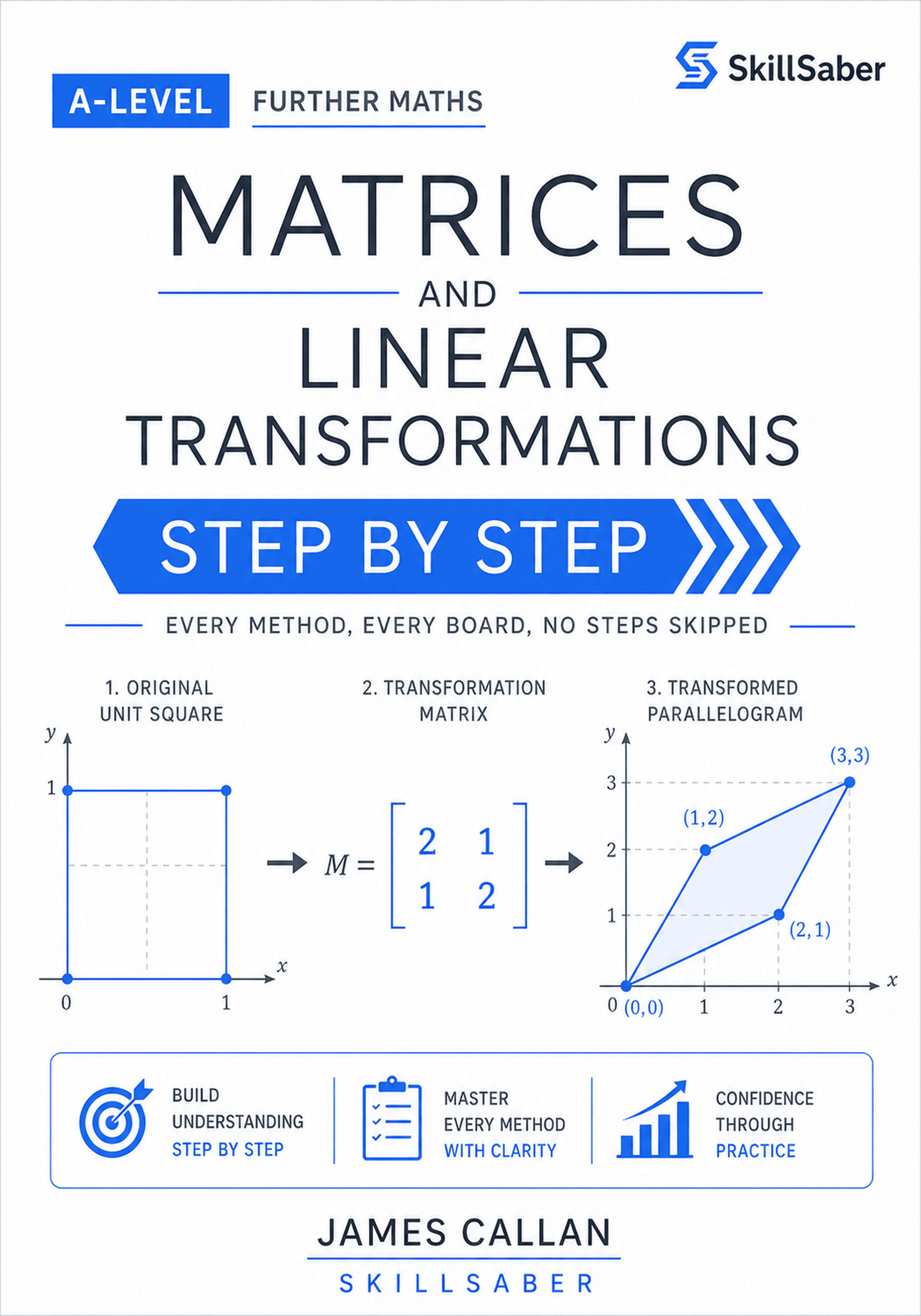
A-Level Further Maths: Matrices and Linear Transformations Step by Step
Every Method, Every Board, No Steps Skipped
Read the first chapter in your browser. It's free, with no account and no email needed.
Free to read. No account required.
About this book
Matrices are the point in Further Maths where a lot of method marks quietly slip away. A determinant is miscalculated, a transformation is applied in the wrong order, or an eigenvector is found but never interpreted.
This book covers matrices and linear transformations for Edexcel, AQA, OCR and CIE, with every intermediate step shown so you can see exactly where your own working goes wrong. It begins with matrix operations and types, determinants and the singularity test, and inverses by both the 2x2 shortcut and the 3x3 cofactor method. It then moves to 2D transformations, successive transformations and the reverse-order rule, and the key distinction between invariant points and invariant lines.
Look inside
This book teaches the matrices and linear transformations content examined across A-Level Further Mathematics specifications, with every intermediate step shown clearly. It is designed to work for Edexcel, AQA, OCR, and CIE learners who need a dependable, exam-focused guide rather than a terse summary.
How to Use This Book
Each chapter follows the same pattern:
- Concept introduction
- Step-by-step method
- Fully worked examples
- Practice questions across increasing difficulty
- A short checklist of what you should now be able to do
The book is intended to be used alongside regular problem practice. If you are weak on a topic, read the chapter in full and then work the questions in order. If you are revising, use the worked examples to diagnose exactly where your method is breaking down.
Who This Book Is For
This text is written for:
- A-Level Further Mathematics students in Years 12 and 13
- self-study learners without a specialist teacher
- retake students rebuilding method accuracy
- first-year university students filling gaps in core linear algebra technique
It assumes basic algebra, simultaneous equations, coordinate geometry, vectors, and trigonometry.
Companion Resources
This book is standalone, but it also connects to the wider SkillSaber pathway:
- the companion course for video walkthroughs and guided practice
- the practice pack for diagnostics, extra questions, and mocks
What Comes Next
Start with Chapter 1 if you want the full progression, or jump directly to the topic you need and use the worked examples as a reference model for exam-standard working.
Matrix Fundamentals — Operations, Types, and Properties
You have two sets of exam scores for three students, stored as tables of numbers. You want to combine them, scale them, and compare them. These tables are matrices, and the rules for working with them are not the same as the rules for ordinary numbers. In particular, the order in which you multiply two matrices changes the result — a fact that will matter in every chapter that follows. This chapter builds the operational fluency you need before any of that can begin.
Quotes to share
Matrices are the point in Further Maths where a lot of method marks quietly slip away.
Free to read. No account required.