Free first chapter
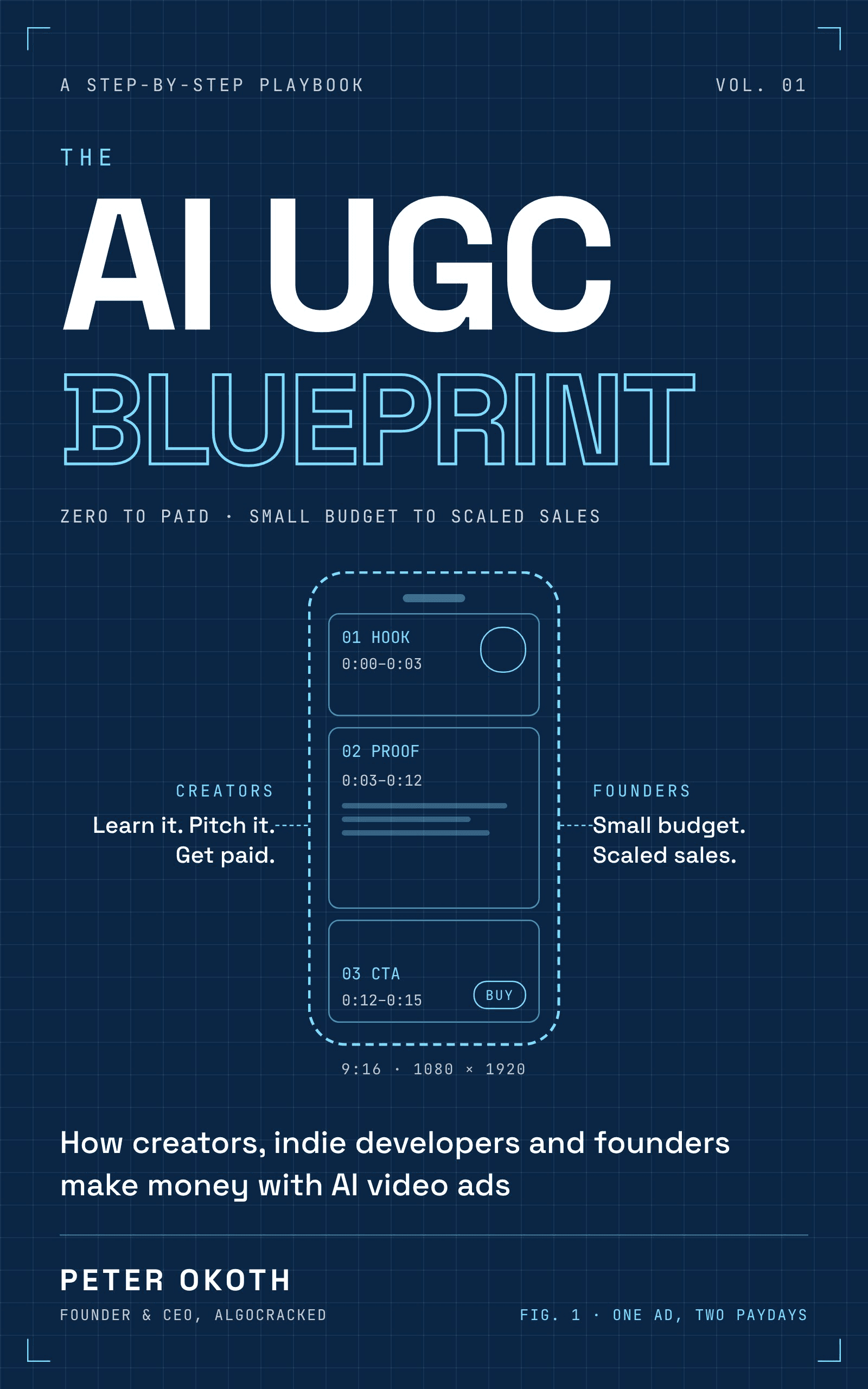
The AI UGC Blueprint
Read the first chapter in your browser. It's free, with no account and no email needed.
Free to read. No account required.
About this book
A step-by-step playbook for making and selling AI video ads: creators learn to find, pitch, price and deliver for founder clients; founders and indie developers learn to run a small weekly AI ad engine and scale what works.
Look inside
A note before we start
I am the founder and CEO of AlgoCracked, an AI product company. We build Sigmora, an AI video agent, along with InterviewCracker, SkillSaber, Talligo and other products, and our imprint, Adrian Wisely, publishes practical books in print and audio. You will see some of them in this book. I want you to know that before you see it, not after.
Here is the promise I make to you. Wherever Sigmora fits a step, I say so, and I label it as the “done-for-you route”. Every one of those steps also shows the “do-it-yourself route” with other tools, many of them free, so you can choose. You do not need Sigmora to use this book, and you do not need to buy anything I sell to make money from what you learn here. When one of our other products makes a good example, I use it and I say it is ours.
No other tool maker paid to be mentioned in this book. Prices, features and platform rules in AI change every few months; Chapter 2 shows you how to stay current.
One more thing. This book teaches you to make AI video ads honestly: AI presenters are labelled as AI, results are real, and nobody pretends to be a customer they are not. That is not only the right thing to do. As you will see in Chapter 7 and Chapter 23, it is also the only way to build something that lasts.
It’s time to invest in learning AI. At skillsaber.org and algocracked.com, we are dedicated to helping people like you master AI and scale their products. I’m happy you picked this book, and I hope you have a fine ride.
Peter Okoth
Founder and CEO, AlgoCracked · algocracked.com
How to use this book
This is a workbook, not a book to read once and put on a shelf. Keep it open next to your phone or laptop, with the tools in front of you, and do each step as you read it.
Pick your path
The book has five parts. Everyone starts with Part 1, then takes the path that fits them.
- A creator who wants clients and income — Part 1, then Part 2, then Part 4 — A portfolio, a daily lead routine, a rate card and your first paying clients
- A founder or indie developer who wants customers — Part 1, then Part 3, then Part 4 — A weekly ad routine, a testing system and ads that pay for themselves
- Curious about both — Straight through — Both sides of the deal, which makes you better at either one
- Ready to scale — Part 5 after your path — The safe way to grow, and the traps to avoid
Creators: do not skip the founder chapters forever. When you understand how a founder reads the numbers, you pitch like someone who gets results, not someone who makes videos. Founders: the creator chapters show you what a good creator looks like, so you hire well when the time comes.
How every chapter works
Most chapters follow the same pattern, so you always know where you are:
- The goal. What you will be able to do by the end, in one sentence.
- The ideas in plain words. Every new term is explained the first time it appears. If you forget one, the glossary in the appendices has it.
- The playbook. Numbered steps. Do them in order.
- The worked example. We follow one product through the whole book: PocketPlan, a budgeting app for young renters in US and UK cities. PocketPlan, built by Jordan from the introduction, is invented for this book, so you can see every step applied without anyone’s real secrets on the page. It is not connected to any real app of the same or a similar name.
- Mistakes to avoid. The traps beginners fall into.
- Checklist. Tick every box before you move on.
- Your task. One concrete thing to do before the next chapter.
What you need
- A phone that records video and a pair of earphones with a microphone.
- A laptop helps, but you can do most of this book on a phone.
- A quiet corner for recording your voice.
- A free account on a few tools (Chapter 2 tells you which).
- About five hours a week.
You do not need a camera, a studio, actors, a marketing degree or a big budget. That is the whole point.
Introduction: One ad, two paydays
Imagine two people in the same city who have never met.
The first is a creator. Call her Maya. She is good with her phone, she understands TikTok better than most marketing managers, and she wants to earn from that skill. But she does not want to dance on camera, she cannot afford a studio, and she has no idea how to find a paying client.
The second is a founder. Call him Jordan. He spent a year building an app that genuinely helps people. It works. The few people who use it love it. But nobody else knows it exists, he has a tiny budget, and every agency he speaks to quotes a price that would finish his savings in a month.
Maya needs clients. Jordan needs customers. What connects them is a 15-second video.
Why short phone-style videos sell
Scroll through TikTok, Reels or YouTube Shorts for one minute and notice which ads you stop for. Very few look like television adverts. The ones that work look like a normal person talking to their phone: a quick problem, a quick demo, a quick reason to try it. Marketers call this style UGC, short for user-generated content, because it looks like something a real user made.
This style works for a simple reason. It looks like the rest of the feed, so people watch it instead of skipping it. And because it is cheap to make, a brand can try many versions and keep the ones that work.
That last part is the real secret. Nobody knows in advance which ad will win. The founders who grow are not the ones with the single best idea. They are the ones who test the most ideas, quickly and cheaply, and put money behind the winners.
What AI changed
Until recently, every version of an ad needed a person on camera, a script, a recording session and an edit. Ten versions meant ten times the work. Small founders could not afford that, and creators could only produce a few videos a week.
AI has changed the cost of each step:
- A chat model can write 10 hooks for an ad in under a minute.
- A generated or cloned voice can read a script in a natural tone, in several languages.
- An AI presenter can deliver the script on camera without anyone setting up a camera.
- Editing tools add captions, cuts and music in minutes.
This does not make good ads automatic. A bad idea made with AI is still a bad ad, just a cheaper one. But it means the people who learn to use these tools well can produce in a weekend what used to take a team a month.
Free to read. No account required.