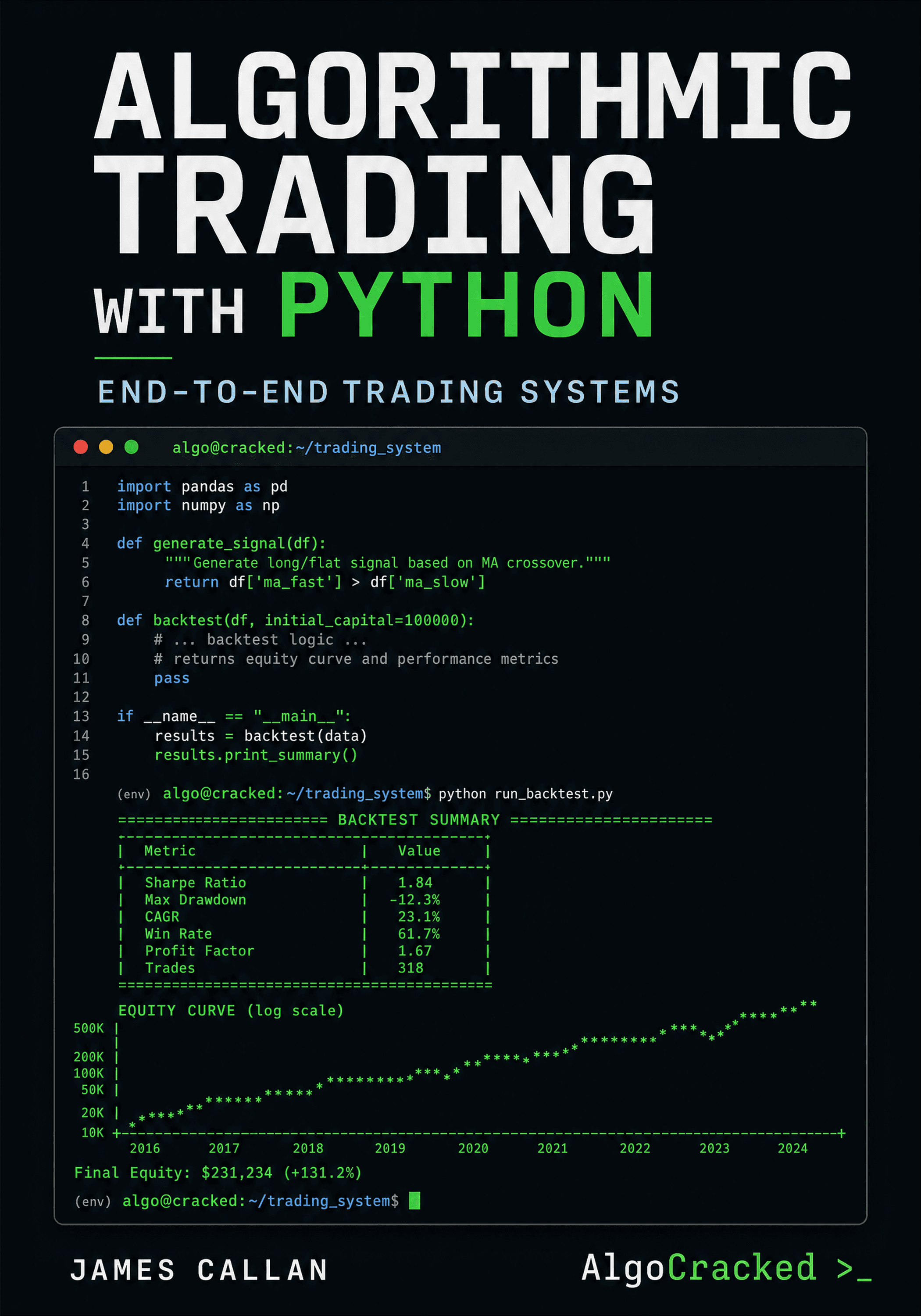
Free first chapter
Algorithmic Trading with Python
From Strategy Design to Live Execution
Read the first chapter in your browser. It's free, with no account and no email needed.
Free to read. No account required.
About this book
Plenty of Python developers have a trading idea that works in a notebook and falls apart the moment it meets real markets. Data arrives messy, costs eat the edge, and nothing is built to run unattended. Turning research into a system you can trust is a different skill.
Algorithmic Trading with Python takes you from strategy design to live execution, one component at a time. You start with the architecture of a trading system, market data engineering, and signal and indicator design. Then you build event-driven and vectorized backtesting, and learn why transaction costs, slippage, and execution reality change the results. Later chapters cover position sizing and portfolio risk, broker connectivity and paper trading, and live execution with logging and monitoring.
Look inside
This book teaches you how to build, test, and operate a complete algorithmic trading system in Python — from data ingestion through execution and monitoring. By the end, you will have a production-oriented trading framework with modular data feeds, a strategy engine, a backtester, risk controls, an execution layer, and a monitoring stack.
Who This Book Is For
You are a Python developer who wants to build real automated trading systems rather than isolated research notebooks. You have intermediate Python skills including classes and async basics, pandas and NumPy proficiency, basic statistics knowledge, and market-structure literacy.
How This Book Is Organized
Chapters 1 through 3 establish the system architecture, data pipeline, and signal layer. Chapters 4 through 6 build the backtesting and evaluation infrastructure with realistic frictions. Chapters 7 through 9 add risk management, broker connectivity, and live execution. Chapter 10 establishes strategy lifecycle governance. Chapters 11 through 13 extend the system into advanced territory: regime-aware backtesting and stress testing, multi-venue execution and smart order routing, and adversarial scenarios with regulatory compliance infrastructure.
Each chapter builds a component that integrates with the prior ones. The system grows incrementally from data to production, then from production to resilience.
How to Use This Book
Read linearly. Each chapter depends on the contracts and vocabulary established by previous chapters. Work through the code examples — they are designed to compose into a working system. The exercises at the end of each chapter reinforce the concepts and extend the implementation.
The Trading System Blueprint
A quant developer named Raj has a momentum strategy that works. He built it in a Jupyter notebook over three weekends: pull historical OHLCV data from a free API, compute a rolling z-score, generate buy and sell signals, and measure the equity curve. The Sharpe ratio looks strong. He decides to trade it live.
He copies the notebook code into a script, adds his broker credentials as hardcoded strings, wraps the signal logic in a while True loop, and launches it on his laptop. It runs for four hours. Then his internet drops for ninety seconds. When the connection returns, the script has no record of its previous state. It re-initializes, reads the current price, and enters a position it already holds — doubling his exposure without knowing it. The next morning he wakes up to a margin call.
Raj's signal logic was fine. His system architecture did not exist. There was no separation between research and execution, no state persistence, no position reconciliation, no risk check before order submission. The notebook was a research tool masquerading as a production system.
This chapter exists so that you build the architecture before you build the strategy. Every component, every boundary, and every contract between subsystems gets defined here — before a single indicator is computed or a single order is placed.
- Identify the core components of a production trading system and state the responsibility of each
- Trace a complete trade lifecycle from raw market data through execution and position update
- Distinguish between research, simulation, paper trading, and live environments and explain why they must be separated
- Map each chapter in this book to the subsystem it builds
- Recognize the architectural failures that cause correct strategies to lose money in production
Why This Matters
Most trading system failures are not strategy failures. They are engineering failures. The signal was reasonable, the backtest was honest, but the system that carried the signal into the market was missing pieces — or the pieces that existed did not communicate through explicit contracts.
A strategy that works in a notebook exists in an environment where every assumption is implicit. The data is already loaded. The execution is instantaneous and cost-free. State lives in memory and disappears when the kernel restarts. There is no concept of partial fills, network timeouts, stale data, or concurrent position updates.
A production trading system exists in an environment where every assumption must be explicit. Data arrives late or not at all. Execution takes time, costs money, and sometimes fails. State must survive process restarts. Multiple subsystems need to agree on what the current position is. Risk limits must be enforced before orders reach the broker, not after.
The gap between these two environments is where money is lost. Not because the strategy was wrong, but because the system around the strategy was never designed.
Consider the cost of this gap. If a strategy has a genuine edge of 20 basis points per trade and your system introduces 30 basis points of hidden costs through poor execution, stale data, and position management errors, you have a system that reliably loses money while running a strategy that genuinely works. The architecture is not decoration around the strategy. The architecture is the strategy's ability to survive contact with real markets.
This chapter defines that system. It establishes the components, their responsibilities, the contracts between them, and the flow from data to action. Every subsequent chapter builds one piece of this architecture. By the end of the book, you will have a working framework. But the framework only coheres if the blueprint is clear from the start.
What a Real Trading System Contains
A trading system is a chain of components with defined inputs, outputs, and failure modes. Each component has a single responsibility. The boundaries between components are contracts — explicit agreements about data formats, timing guarantees, and error handling.
This section defines the minimum set of components required for a system you would trust to run unattended. We will compare this with the notebook approach to make the difference concrete.
Quotes to share
Turning research into a system you can trust is a different skill.
Free to read. No account required.