Free first chapter
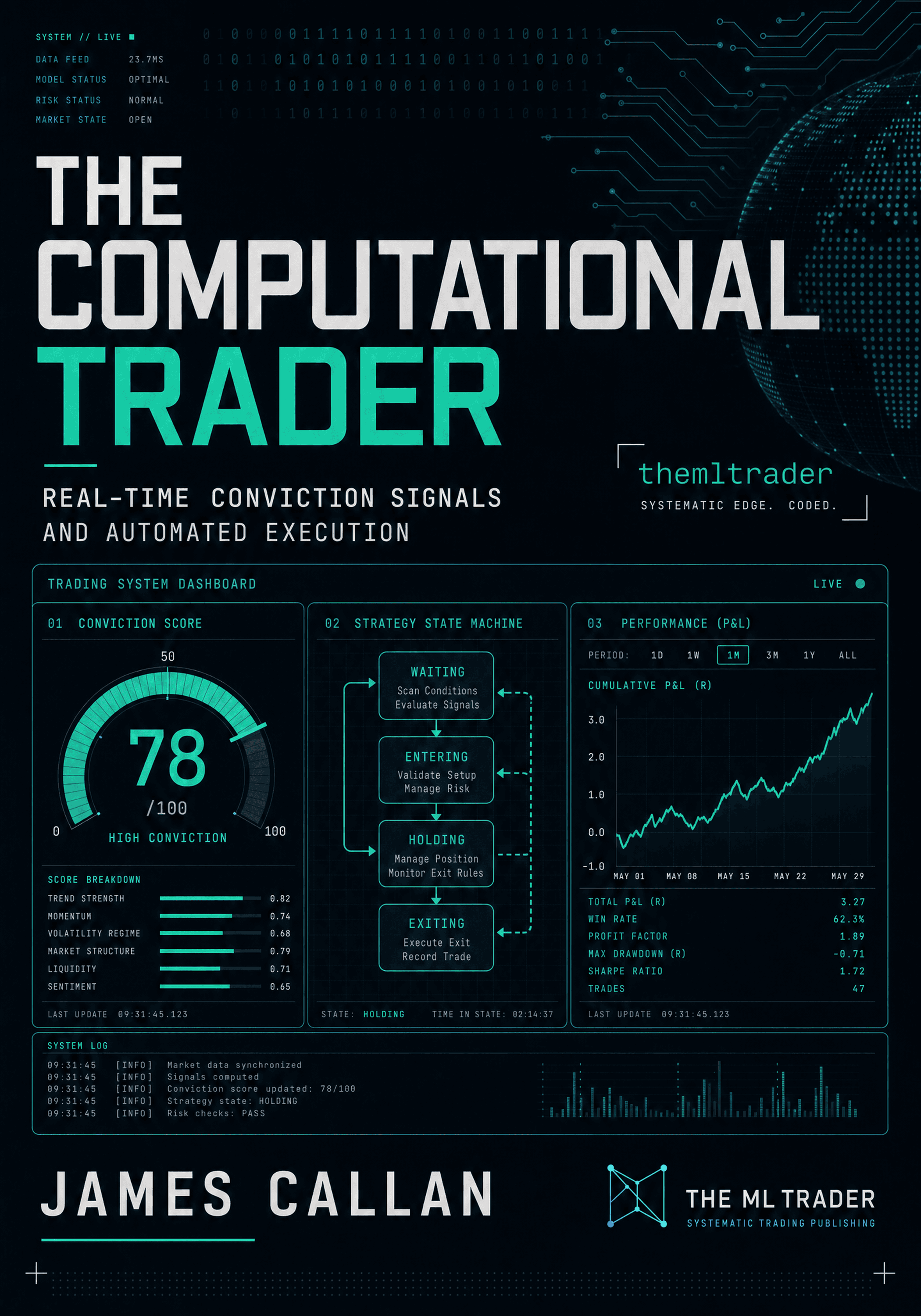
The Computational Trader
Real-Time Conviction Signals and Automated Execution
Read the first chapter in your browser. It's free, with no account and no email needed.
Free to read. No account required.
About this book
Many traders who move from discretionary to systematic trading end up with a pile of disconnected scripts, one for signals, one for backtesting and one for position sizing, none of which talk to each other or leave a record of why a trade happened. This book shows how to build one connected system instead.
The Computational Trader teaches you to assemble a trading stack where signal generation, strategy logic, execution support and performance auditing are designed together from the start. You learn how real-time conviction scoring turns market data into signals, and how the machine learning method framework organizes modular strategies. You then work through automation, execution and auditing so every entry, size and exit can be traced back to specific system outputs.
Look inside
A multi-strategy trading workflow that combines conviction scoring, modular strategy logic, and risk-controlled execution simulation.
How to Use This Book
Most traders who move from discretionary to systematic trading end up with a pile of disconnected scripts — one for signals, one for backtesting, one for position sizing — none of which talk to each other and none of which produce an audit trail. This book fixes that. It teaches you how to assemble a computational trading stack where signal generation, strategy logic, execution support, and performance auditing are designed as one system from the start.
The emphasis is on modular design and auditability. Every component you build should be testable on its own, replaceable without breaking the rest, and traceable after the fact. If you cannot explain why a trade was entered, sized, and exited by pointing to specific system outputs, the workflow is not finished.
Read linearly on the first pass. Each chapter builds a layer of the stack that the next chapter assumes is already defined.
Who This Book Is For
- Traders moving from discretionary execution to systematic and partially automated workflows
- Practitioners with enough Python and backtesting literacy to implement modular systems
- Readers who want clear controls and audit trails, not black-box automation
Prerequisites
- Python data workflows (pandas, numpy, basic scripting)
- Basic backtesting literacy
- Familiarity with technical strategies and risk management
- Comfort reading code and trading dashboards
If these are unfamiliar, start with The ML Trading Bible first.
Environment Setup
Use a Python environment with standard data, visualization, backtesting, and automation-support tooling. Keep dashboards, backtest artifacts, strategy definitions, and audit logs organized so the system can be reviewed as a workflow rather than as disconnected scripts.
- Data — pandas, numpy
- Modeling — scikit-learn, lightgbm
- Visualization — matplotlib, seaborn, plotly
- Backtesting — vectorbt or equivalent
- Statistics — statsmodels, scipy
Chapter Roadmap
- 1. Alpha Pulse and Real-Time Conviction — Conviction layer, signal surfaces, live monitoring — Usable real-time decision support system
- 2. The ML Method Strategy Framework — Modular strategy design, validation, regime sensitivity — Testable multi-strategy framework with explicit rules
- 3. Automation, Execution, and Auditing — Execution support, risk control, performance auditing — Audit-ready automation stack with risk controls
Reading Strategy
Work through examples and design exercises rather than reading the material as abstract architecture. Chapter 1 defines the conviction and monitoring layer. Chapter 2 turns those signals into modular strategies and validation logic. Chapter 3 connects the resulting stack to execution support, risk controls, and audit trails. The gap between understanding a concept and implementing it cleanly is where most computational trading systems fail.
Alpha Pulse and Real-Time Conviction
A trader we will call Reese had four models running on EUR/USD. A trend-following classifier, a mean-reversion detector, a volatility regime filter, and a sentiment scorer built on positioning data. Each model had been validated individually. Each had a respectable out-of-sample track record. On a Tuesday morning in March, three of the four models flashed long. Reese entered a position. Within ninety minutes, the pair dropped sixty pips against him.
The problem was not that the models were wrong. Two of the three bullish signals were stale—they had not updated since the Asian session close. The third was reacting to a data lag that had been masked by the dashboard refresh interval. The volatility filter, the one model that would have flagged caution, was displaying its output on a separate screen that Reese had minimized.
Reese did not have a model problem. He had a conviction problem. He had four separate outputs and no principled way to combine them into a single, time-stamped, interpretable decision. He lacked a conviction layer.
This chapter builds that layer.
- Explain why raw model and indicator outputs require a conviction layer before they support real-time decisions
- Design a conviction score that combines multiple signal sources while preserving uncertainty
- Incorporate regime context so that conviction adjusts to changing market conditions
- Build a streaming dashboard surface that exposes system state in a reviewable format
- Synthesize multiple pulse points into a single trade-or-no-trade workflow with explicit thresholds
- Identify failure modes where a conviction score hides uncertainty instead of clarifying it
The Gap Between Raw Outputs and Usable Conviction
A model output is a number. A conviction layer is a decision context.
Free to read. No account required.