Free first chapter
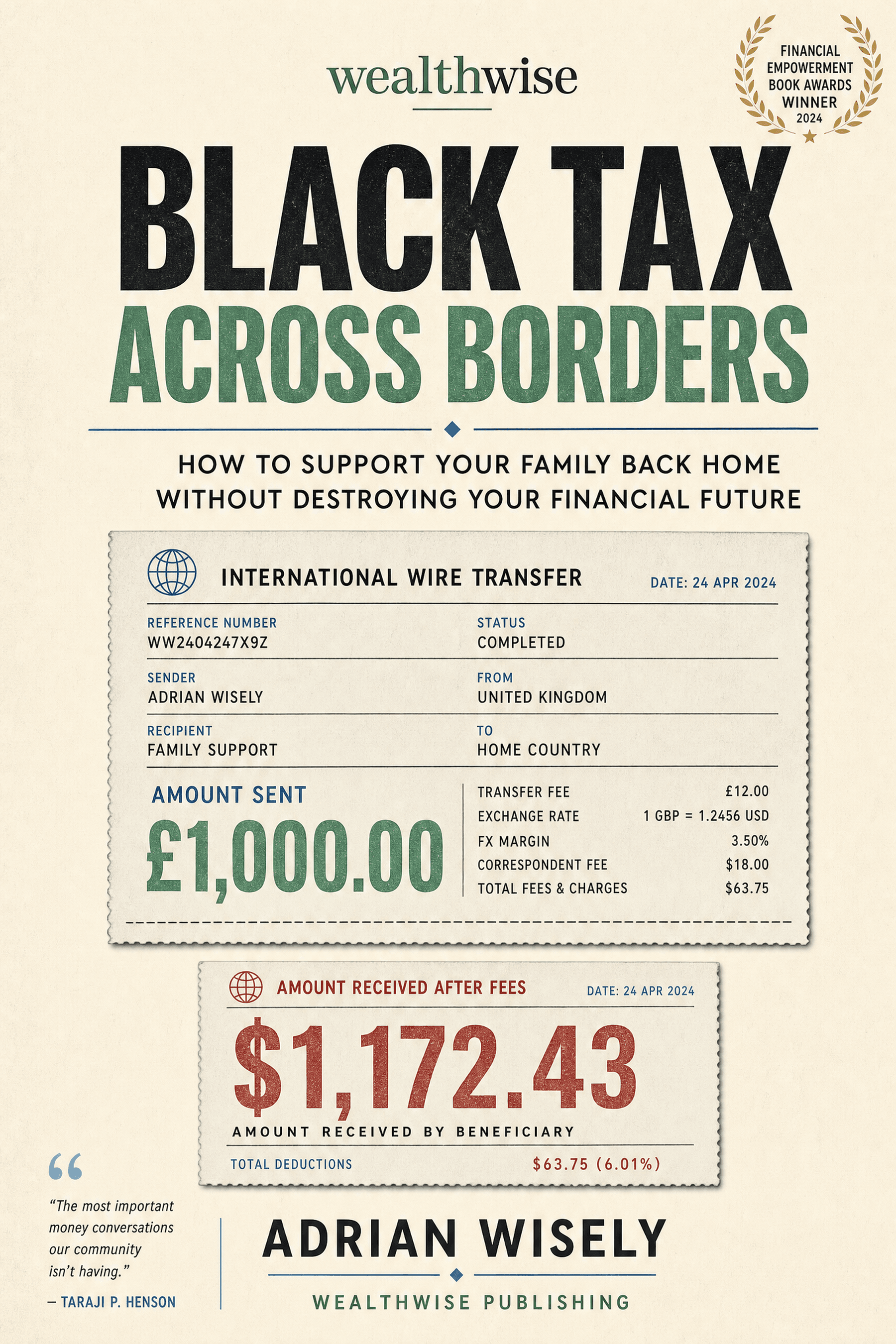
Black Tax Across Borders
How to Support Your Family Back Home Without Destroying Your Financial Future
Read the first chapter in your browser. It's free, with no account and no email needed.
Free to read. No account required.
About this book
Your phone buzzes before your shift starts. A message from home: a family emergency, a school fee, a medicine bill. You send the money because you love them, and because saying no feels impossible. Then it happens again the next month, and the month after, while your own savings quietly shrink.
Black Tax Across Borders is a practical system for people who want to support family back home without sacrificing their own future. You start by naming what black tax really is and why living abroad makes it heavier. Then you build an honest map of every obligation you carry, set a fixed family support budget with its own account, and learn a seven-question framework for deciding on any new request.
You also get words for the hardest conversations: reducing support, declining a request, and talking with a partner about family money. The book shows how to keep building your own wealth alongside your giving, and how to think about the long game.
Look inside
Preface
This book started with a phone call.
Not the phone call in Chapter 1 — Selam's 6:14 AM WhatsApp message from her mother. Before that. The call I had with a friend who was an engineer in Toronto, who had recently sent $4,200 home in a single month to cover a family emergency that turned out to be three overlapping obligations nobody had planned for. He had just checked his savings account: $380. He had not missed a payment to his family in four years. But he had also not made a single retirement contribution in two years, had $6,000 in credit card debt at 19.99%, and had canceled a dental appointment for the third time because he "could not justify the copay right now."
He was not irresponsible. He was not disorganized. He was, by every measure, a high-functioning professional in one of the most expensive cities in the world — who was also quietly destroying his financial future in service of people he loved.
That call sent me down a rabbit hole. How common is this? How much, across the diaspora, are people navigating the space between two financial worlds with no tools for either? The research was not hard to find. The World Bank estimates that Sub-Saharan Africa received over $100 billion in formal remittances in 2023. Financial services researchers consistently find that diaspora Africans contribute between 10 and 40 percent of their discretionary income to family support. Studies on diaspora financial wellbeing show elevated rates of credit card debt, lower retirement savings balances, and delayed homeownership compared to non-diaspora immigrants at equivalent income levels.
The tools to navigate this exist. The problem is that nobody has assembled them for the person in the middle — the person who is genuinely committed to supporting their family AND genuinely committed to building their own financial future, and who needs a system that holds both, not a lecture about which one to prioritize.
This book is that system.
What This Book Will Do
In ten chapters, this book will give you:
- A clear understanding of what black tax actually is — its cultural roots, its diaspora amplifiers, and the four different faces it wears in your financial life.
- A complete Obligation Audit — a tool for mapping every family financial obligation with honesty, categorizing it accurately, and seeing the full picture, probably for the first time.
- A Family Support Budget — a structured system with a fixed monthly total, a separate account, and rules that replace guilt-driven decisions with deliberate ones.
- Scripts for the conversations you have been avoiding — reducing support, declining requests, and setting terms with family members who have never had to accept a limit before.
- A decision framework for incoming requests — seven questions that produce a clear, defensible, emotionally grounded answer in under ten minutes.
- A plan for building personal wealth alongside — not after — family support. The Priority Ladder, the employer match calculation, the emergency fund that protects both you and your family.
- A framework for the partner conversation — whether you are hiding family obligations, navigating an intercultural relationship, or simply trying to build a joint financial plan that acknowledges both partners' family realities.
- A considered approach to legacy — what you pass on to your children, and how you choose between the obligation spectrum positions of Maintain, Restructure, and Opt Out.
Who This Book Is For
This book is for the African in the diaspora who is financially supporting family back home — and who has never had a complete system for doing it sustainably.
More specifically, it is for you if:
- You earn in dollars, pounds, euros, or another hard currency and send a significant portion of your income home.
- You feel the tension between your family's needs and your own financial goals, and the tension shows no sign of resolving on its own.
- You have never added up the full total of what you send home — or you have, and the number frightened you.
- You have avoided conversations with family because you do not know how to set a limit without it sounding like abandonment.
- You are in a relationship with someone who comes from a different cultural background and family money is a source of tension.
- You want to support your family AND build retirement savings AND not die with credit card debt. You are not convinced that is possible. This book will show you it is — and how.
This book is not for you if you are looking for permission to stop supporting your family. That is not what this is. The cultural obligation is real. The love is real. The system in this book assumes both and works within them.
How to Use This Book
Read it in order. The chapters build on each other. The Obligation Audit in Chapter 4 requires the Paycheck 2 calculation from Chapter 3. The Family Fund in Chapter 5 requires the audit from Chapter 4. The boundary conversations in Chapter 6 require the Family Fund amount from Chapter 5. The system is sequential by design.
Each chapter ends with exercises at three difficulty levels: Core, Stretch, and Challenge. Do the Core exercises before moving on. They are not optional — they turn concepts into your actual numbers. The Stretch and Challenge exercises deepen the work and build toward the final chapters.
Each chapter also ends with a checklist and "Your Move" action items. These are the minimum actions required to make the chapter's material functional in your life. Reading without doing produces understanding. Doing produces change.
Prerequisites
This book assumes:
- You are currently earning income in a Western country (US, UK, Canada, Australia, Germany, UAE, or similar).
- You are currently sending money to family in an African country — or you have in the past and are considering resuming.
- You have access to your bank statements and, if applicable, your pay stub. You will need them for the exercises.
This book does not assume:
- Prior knowledge of personal finance beyond basic budgeting.
- Familiarity with retirement accounts, investment vehicles, or financial planning concepts. All required concepts are explained when they first appear.
- A specific country of origin or specific diaspora community. The book draws on Kenyan, Nigerian, Ghanaian, Ethiopian, Somali, and South African examples because the author worked with people from these communities. The patterns are universal across the African diaspora.
A Note on Language
This book uses "black tax" in the expanded sense: the financial obligation that African diaspora professionals carry toward extended family back home, rooted in communal cultural values and amplified by the economic gap between diaspora earnings and home-country costs. The term originated in South Africa but applies broadly — every African diaspora community has its version, even if the name differs.
This book does not use "black tax" as a term of complaint. It uses it as a term of precision — naming something that is real, pervasive, and largely unnamed in standard financial advice literature. Naming it is the first step to managing it.
One more thing. Throughout this book, you will meet Selam, Emeka, Wanjiru, Ama, Tadesse, Thandiwe, Kwame, Njeri, Abdi, Halima, Blessing, Daniel, Thabo, Lindiwe, and others. Their stories are drawn from real experiences — composited and anonymized, but not invented. The specific numbers are real. The emotions are real. The decisions are real.
Free to read. No account required.