Free first chapter
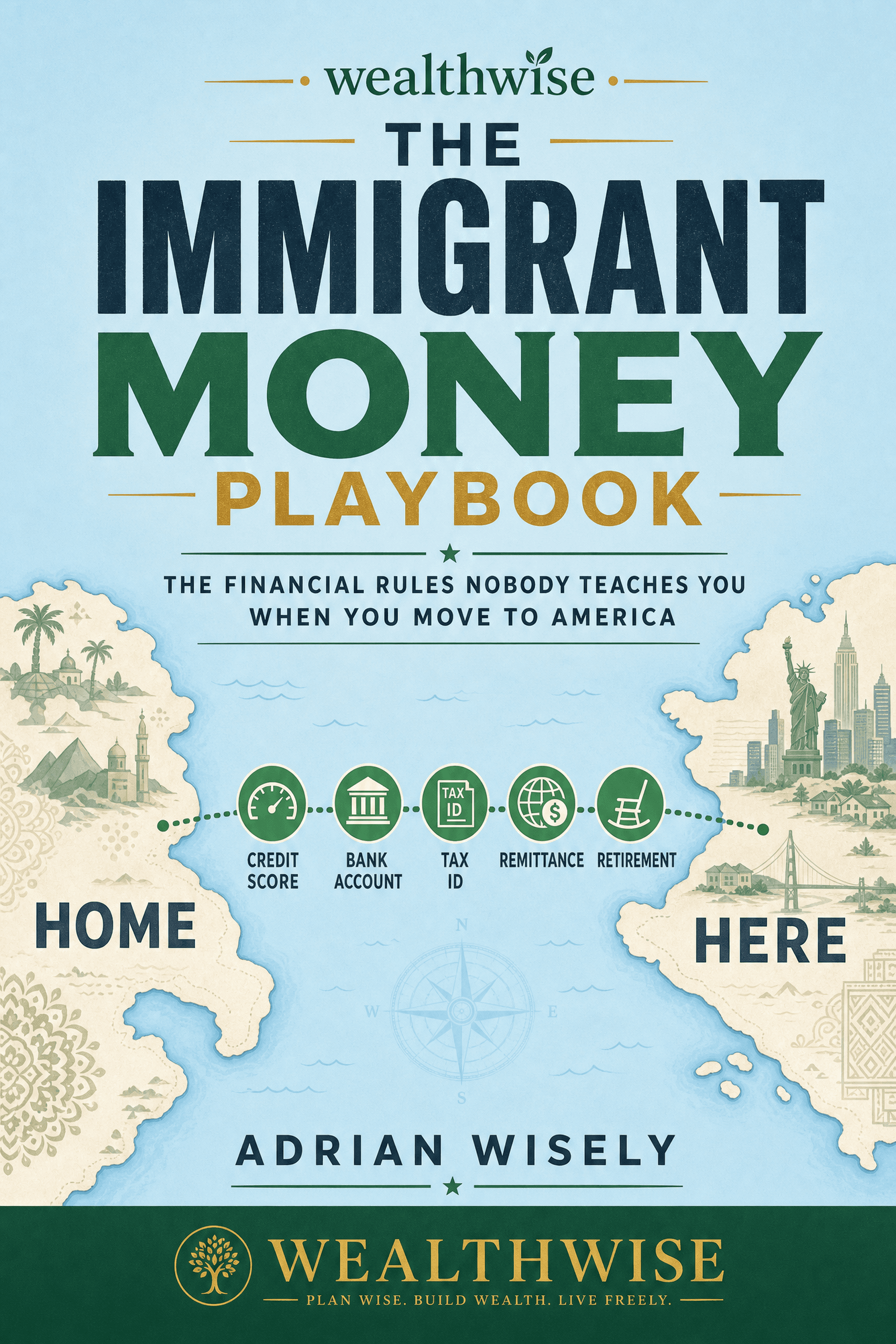
The Immigrant Money Playbook
The Financial Rules Nobody Teaches You When You Move to America
Read the first chapter in your browser. It's free, with no account and no email needed.
Free to read. No account required.
About this book
You can be good with money in the country you came from and still feel lost the first week you try to rent an apartment, open an account or read a pay stub in America. Credit scores, 401(k) matches, W-4 forms and deductibles all assume you already know the rules, and the gaps in that knowledge can quietly cost real money.
The Immigrant Money Playbook translates the American financial system into plain language. You start with the money vocabulary, then see what your Social Security number and the ITIN alternative actually do, and how to protect them from identity theft. From there it walks through banking without getting robbed by fees, building credit from zero, filing taxes as a newcomer, and decoding health insurance.
Later chapters cover saving and investing, buying a home, and pulling it all into a personal financial blueprint. Along the way you get checklists, exercises and a clear sense of which traps to watch for, so you can make decisions with confidence instead of guessing.
Look inside
Introduction: The Manual Nobody Gave You
You passed through immigration. The officer stamped your passport. You picked up your bags. And then — nobody handed you anything.
No orientation on credit scores. No briefing on 401(k) enrollment windows. No warning about the FBAR. No explanation of why that first health insurance form had more boxes than your university entrance exam.
The embassy prepared you for immigration. Nothing prepared you for the American financial system.
This book is that preparation. It covers what every African immigrant needs to know about money in America — not the theory, but the practice. Not what the system is supposed to do, but what it actually does, and exactly how to navigate it from day one.
Who This Book Is For
This book is for you if you are:
- An African immigrant who has arrived in the US within the last five years and is still building your financial foundation
- A longer-term immigrant who has been here for years but suspects you have been leaving money on the table
- Someone who will be arriving soon and wants to get ahead of the learning curve
- A family member or friend of an immigrant who wants to help them navigate the system
You do not need any prior knowledge of American finance. You need only what you already have: intelligence, work ethic, and the discipline to read and implement.
What This Book Covers
The book has ten chapters. Each one covers a specific system that trips up African immigrants:
- They Don't Teach This at the Embassy — The immigrant financial gap: what it is, what it costs, and why smart people fall into it
- The American Money Vocabulary — A complete translation of American financial terms into concepts you already know
- Your SSN Is Your Financial Passport — How to get your Social Security Number, protect it, and use it correctly
- Banking in America Without Getting Robbed — How to choose a bank, set up your accounts, and avoid the services that prey on new arrivals
- Building Credit From Zero — How to go from invisible to 700+ FICO score in 12-18 months
- Taxes for Immigrants — How to file correctly, claim the credits you are owed, and report foreign accounts without penalties
- Health Insurance Decoded — How to choose the right plan, use it correctly, and avoid the ER mistake that costs thousands
- Saving and Investing in America — How to build an emergency fund, capture your employer's 401(k) match, and open a Roth IRA
- Buying a Home in America — How to decide whether and when to buy, and how the mortgage process works for immigrants
- Your American Financial Blueprint — A month-by-month, year-by-year plan that pulls everything together
How to Use This Book
If you just arrived: Read chapters 2-5 first. Getting your vocabulary right (Ch. 2), securing your SSN (Ch. 3), opening a bank account (Ch. 4), and starting credit building (Ch. 5) are the four most urgent tasks in your first three months.
If you have been here 1-3 years: Check your 401(k) enrollment and credit score first. If either is not set up, chapters 5 and 8 are your priorities.
If you have been here more than 3 years: Take the self-assessment in Chapter 1. Your lowest scores tell you which chapters to prioritize.
If you want the complete picture: Read it cover to cover. Each chapter builds on the one before. The investment chapter (Ch. 8) makes more sense after the banking chapter (Ch. 4). The home-buying chapter (Ch. 9) makes more sense after the credit and investment chapters (Ch. 5 and 8).
A Note on Numbers
This book uses 2026 figures for tax brackets, standard deductions, contribution limits, and similar data. These numbers change annually. Wherever a specific number is likely to change, the text notes: "confirm at irs.gov" or "check current figures." The concepts do not change. The specific numbers require annual verification.
A Note on Voice
This book was written by someone who has been through the American financial system as an immigrant — who made some of the mistakes in these pages, who learned from others who made them, and who has sat across a table from immigrants at every stage of this journey.
The voice is direct because there is no time for diplomatic vagueness. You arrived in a system with rules nobody explained. Every chapter in this book gets to the point, gives you the real numbers, and tells you exactly what to do.
The immigrant financial gap is real. It is measurable. And it closes fast once you know what you are dealing with.
Let us close it.
They Don't Teach This at the Embassy
James Mwangi arrived at Logan Airport in Boston on a Tuesday in January with a master's degree in accounting from the University of Nairobi, seven years of experience managing corporate budgets worth KSh 200 million, and $3,000 in a Wells Fargo account his company had helped him open before he flew.
He was, by any reasonable measure, financially literate. He understood compound interest. He could read a balance sheet. He had managed payroll for 300 employees. In Kenya, he was the person other people came to for financial advice.
In America, he could not rent an apartment.
The property manager at the Brookline apartment he wanted ran a credit check. James did not have a credit score. Not a bad score — no score. He had never borrowed money in the United States. He had no credit card, no car loan, no student debt. In Kenya, this would have made him admirable. In America, it made him invisible.
"We need a FICO score of at least 650," the property manager said. "Or a co-signer with US credit history."
James did not have a co-signer. He did not know what FICO stood for. He ended up in a month-to-month sublet in Allston — $200/month more than the Brookline apartment — because the landlord did not run credit checks. That $200/month premium for having no credit history: $2,400 in his first year.
But that was just the beginning.
His employer — a mid-size accounting firm — offered a 401(k) with a 4% employer match. James did not enroll. The enrollment form asked about investment allocations, Roth vs. traditional, beneficiary designations, and contribution percentages. He understood every word individually. Together, they formed a system he had never encountered. In Kenya, NSSF contributions were automatic — your employer handled it. Here, he had to choose. Paralyzed by unfamiliarity, he chose nothing. For eighteen months.
The cost of those eighteen months: his employer would have matched 4% of his $72,000 salary — $2,880 per year. Over 18 months: approximately $4,300 in free money he never collected. Money his employer was willing to give him. Money that would have grown for decades in a retirement account.
His car insurance was $280/month. A colleague with the same car and a similar driving record paid $165/month. The difference: James had no US driving record and no credit score, both of which insurers use to set rates. Premium gap: $115/month, or $1,380/year.
For his first three months, he used a check-cashing service near his apartment to access his paycheck. The fee: 2% of the check amount. On a biweekly paycheck of $2,500 after tax, that was $50 per cash. Six visits: $300 — to access his own money. He did not know that the Wells Fargo account he already had could receive direct deposit, or that walking into a branch with his employment letter would resolve the issue in twenty minutes.
Free to read. No account required.