Free first chapter
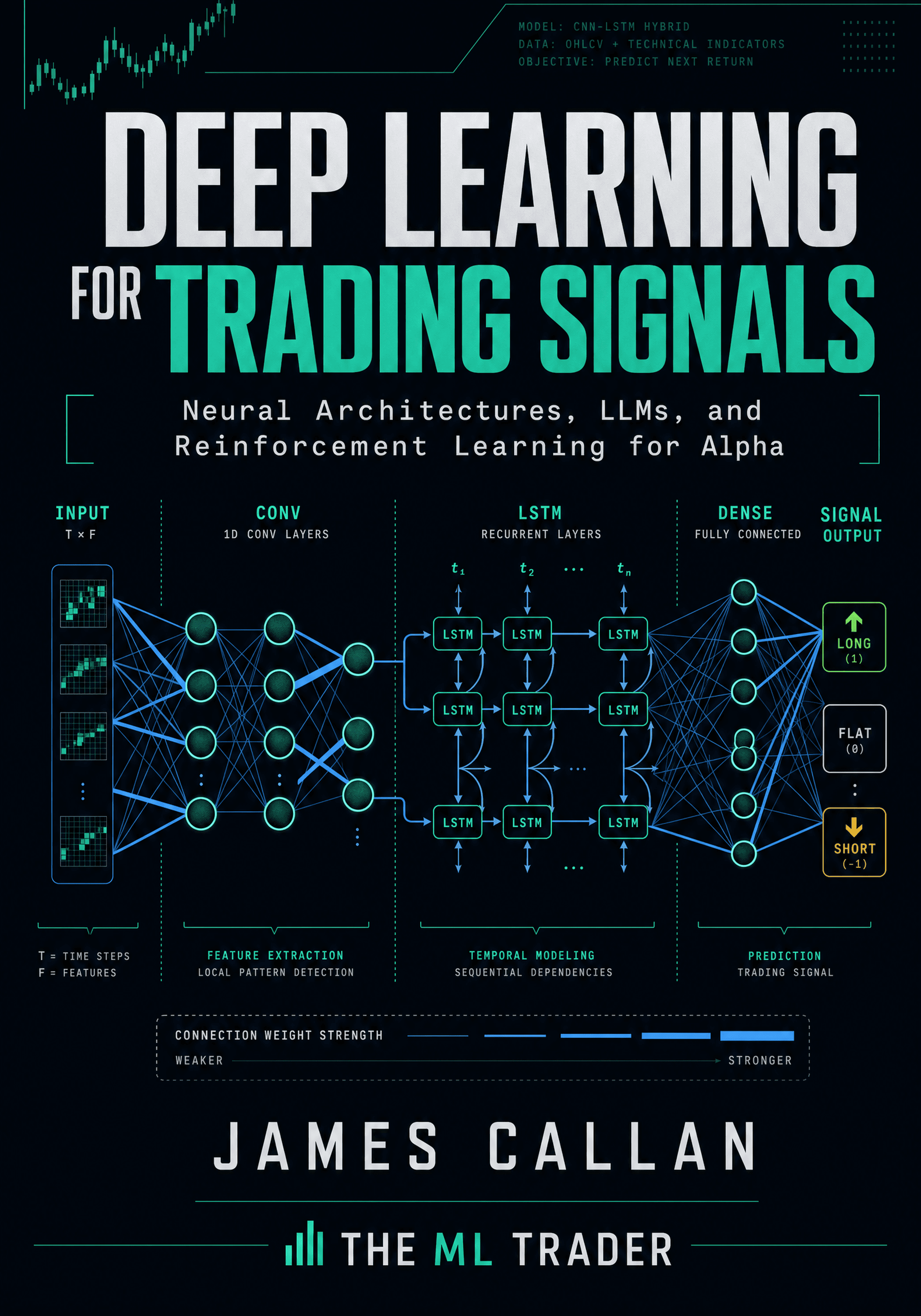
Deep Learning for Trading Signals
Neural Architectures, LLMs, and Reinforcement Learning for Alpha
Read the first chapter in your browser. It's free, with no account and no email needed.
Free to read. No account required.
About this book
Deep learning for trading has a credibility problem. Many published models look impressive in a diagram and fall apart on honest market data. If you know Python and basic machine learning, this book is about telling the difference between a good architecture and a good signal.
You build a complete deep signal pipeline, evaluating every step against one question: does it improve trading decisions when tested honestly? You start with the institutional signal substrate, including data preprocessing and denoising. Next you compare advanced network architectures for markets, then look at post-signal engineering and deployment.
Later chapters bring in large language models for financial signal generation and reinforcement learning for signal optimisation.
Look inside
A neural signal stack that includes feature extraction, model comparison, robustness checks, and a deployment-ready inference path.
How to Use This Book
Deep learning applied to trading has a credibility problem. Most published work optimizes for impressive architecture diagrams rather than signal quality under realistic market conditions. This book takes the opposite approach: every architecture, every training procedure, and every signal fusion step is evaluated against the question of whether it actually improves trading decisions when tested honestly.
You will build a complete deep signal pipeline — from raw data preprocessing and denoising through architecture selection, post-signal engineering, text-derived feature integration, and RL-based optimization. The result is not a single model but a workflow for producing, evaluating, and deploying deep signals that can survive contact with real market data.
Read linearly on the first pass. Later chapters assume you already understand the signal substrate, architecture tradeoffs, and evaluation boundaries established earlier.
Who This Book Is For
- Advanced practitioners who already know Python and basic machine learning
- Traders and researchers who want deep-learning-driven trading signals, not just model demos
- Readers comfortable with PyTorch, time-series data, and reproducible experimentation
Prerequisites
- Strong Python and deep learning fundamentals (PyTorch or equivalent)
- Time-series modeling basics
- Basic probability, optimization, and backtesting knowledge
- GPU access recommended for serious implementation work
Environment Setup
Use a Python environment with deep learning, data, visualization, and evaluation libraries suitable for reproducible experiments.
- Deep Learning — PyTorch, transformers
- Data — pandas, numpy, polars (optional)
- Modeling — scikit-learn, lightgbm
- Visualization — matplotlib, seaborn
- NLP / LLM — huggingface transformers, sentence-transformers
- RL — stable-baselines3 or equivalent
- Statistics — statsmodels, scipy
Keep datasets, preprocessing transforms, checkpoints, feature stores, and benchmark reports organized so every result can be rebuilt and challenged.
Chapter Roadmap
- 1. The Institutional Signal Substrate — Preprocessing, denoising, signal representations — Clean, usable signal layer for deep models
- 2. Advanced Network Architectures for Markets — Architecture comparison for financial time series — Evidence-based architecture selection framework
- 3. Post-Signal Engineering and Deployment — Stacking, robustness checks, inference controls — Production-minded signal system
- 4. LLMs for Financial Signal Generation — Text-derived features fused into the signal stack — Text-signal integration without narrative confusion
- 5. Reinforcement Learning for Signal Optimization — RL as optimization layer for signal consumption — Honest RL-based portfolio action workflow
Reading Strategy
Work through examples and exercises rather than treating the book as a static architecture catalog. Chapter 1 establishes the signal substrate and denoising logic. Chapter 2 compares architecture families. Chapter 3 turns model outputs into production-minded signal systems. Chapters 4 and 5 extend the stack with text-derived signals and RL-based optimization. The exercises are designed to reveal where deep models add genuine value and where they add only complexity.
The Institutional Signal Substrate
In 2019, a quantitative hedge fund deployed a deep learning model trained on two years of equity data. The model performed well in backtests — capturing regime shifts, mean-reversion patterns, and momentum breakdowns with apparent precision. Within three weeks of live trading, the model's Sharpe ratio collapsed from 2.1 to negative territory. The post-mortem revealed that the model had memorized volatility artifacts in the raw price series rather than learning the structural patterns the team believed it had found. The inputs were never preprocessed for the model's actual learning dynamics. The architecture was fine. The signal substrate was not.
This chapter is about the layer that sits between raw market data and the neural network. The goal is to build a signal substrate: a preprocessing and representation-learning system that removes noise the model cannot learn from, normalizes structure the model needs to compare across regimes, and compresses the input into a form that downstream architectures can use efficiently. Without this layer, every architecture choice made later in the book rests on unstable ground.
- Explain why raw financial data is hostile to deep learning models and identify the specific failure modes
- Implement volatility-aware normalization that preserves cross-regime comparability
- Build a denoising autoencoder that separates structural signal from microstructural noise
- Evaluate whether a learned latent representation improves downstream decision quality
- Design a preprocessing pipeline that serves as a stable input layer for deeper architectures
Why Standard Indicators Leave Structure on the Table
Most trading systems begin with hand-crafted indicators: moving averages, RSI, MACD, Bollinger Bands. These indicators compress price history into a small number of derived features. That compression is useful when the relationship between indicator and outcome is stable and well-understood. But it comes with a cost.
Hand-crafted indicators impose a fixed transformation on the data. A 20-period moving average treats every 20-bar window identically, regardless of whether the market is in a low-volatility grind or a post-crash recovery. RSI uses a fixed lookback and a fixed formula. These choices were designed for human pattern recognition, not for a neural network's capacity to learn nonlinear relationships from data.
The problem is not that these indicators are wrong. The problem is that they throw away information before the model has a chance to decide what matters. When you feed a deep model a 14-period RSI instead of the raw returns and volume over that window, you have already decided which features of those 14 bars are relevant. The model never sees the information you discarded.
Free to read. No account required.