Free first chapter
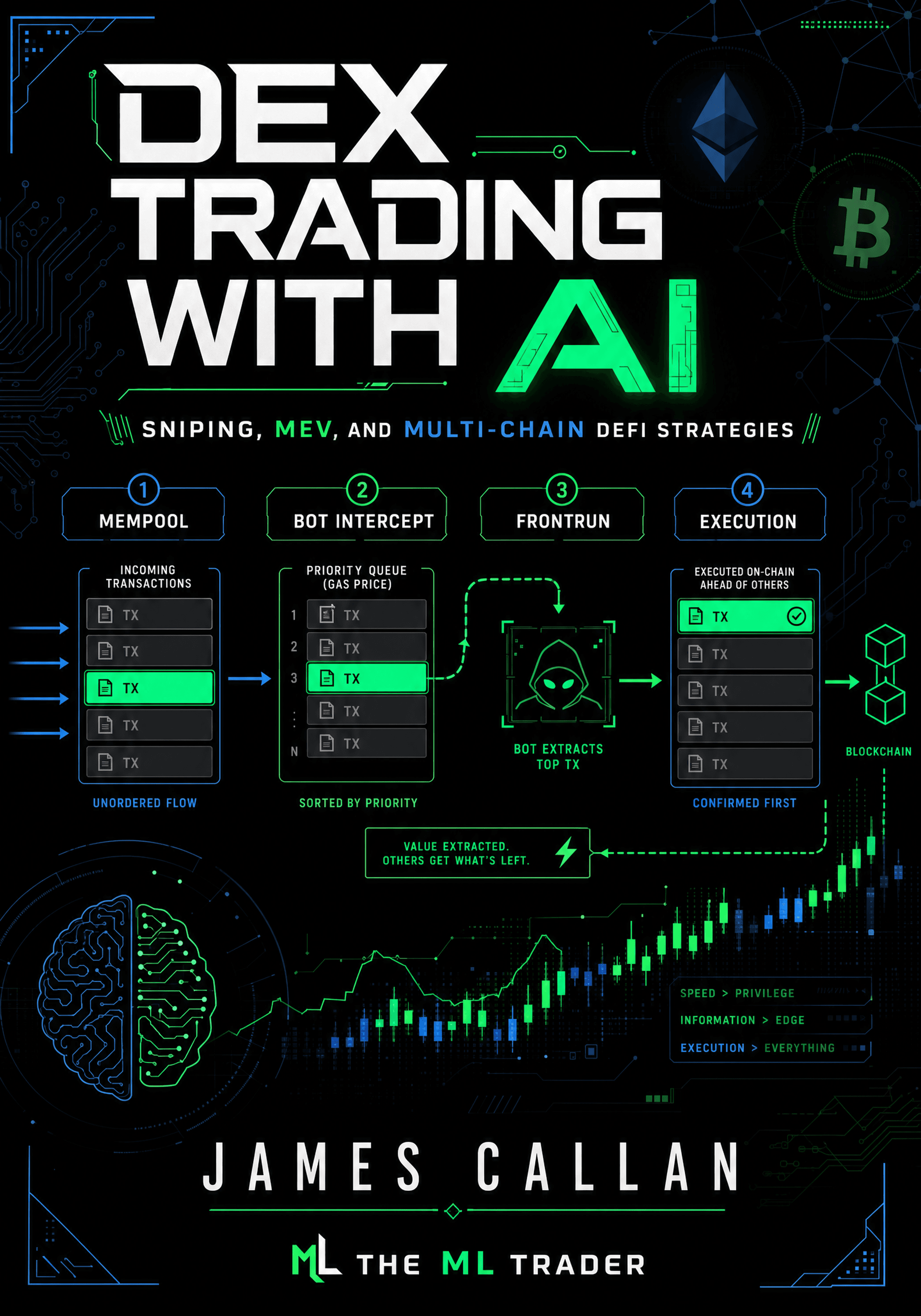
DEX Trading with AI
Sniping, MEV, and Multi-Chain DeFi Strategies
Read the first chapter in your browser. It's free, with no account and no email needed.
Free to read. No account required.
About this book
On-chain trading is fast, permissionless, and unforgiving. Many participants lose money not because they lack speed but because they have no process: no security check before entering a position, no way to judge wallet signals, no grip on execution costs, and no portfolio-level limits.
DEX Trading with AI treats decentralized trading as a systems problem. You will learn how sniper bots and execution speed work, how to approach copy trading and automation, and how smart-money wallet tracking can feed your decisions. The book covers Solana-specific DEX mechanics, MEV extraction and protection, and strategies across Ethereum layer-2s, BSC, and other low-cost chains. You will examine CEX-DEX arbitrage and spend a full chapter on security and rug pull prevention.
Look inside
A production-oriented DEX trading infrastructure that supports wallet tracking, launch detection, MEV-aware execution, multi-chain opportunity filtering, and portfolio-level safety controls.
How to Use This Book
On-chain trading is fast, permissionless, and unforgiving. Most participants lose money not because they lack speed but because they lack process — no security review before entering a position, no framework for evaluating wallet signals, no systematic approach to execution costs, and no portfolio-level risk controls. This book treats DEX trading as a systems problem. You will build infrastructure that handles routing, wallet intelligence, execution, and security as connected layers rather than isolated scripts.
The scope is broad by design. The book covers Ethereum, Solana, BSC, and L2 ecosystems because real DEX trading requires understanding when and why to operate on each chain. It also covers MEV, arbitrage, copy trading, and rug-pull prevention because these are not optional topics — they are constraints that shape every execution decision.
Read linearly on the first pass. Later chapters depend on a clear mental model of routing, wallet intelligence, execution, security screening, and portfolio control.
Who This Book Is For
- Technically capable crypto traders or builders who already understand wallets, tokens, and swaps
- Readers moving from ad hoc on-chain chasing to systematic DEX workflows
- Practitioners who treat security, latency, and verification as first-class design constraints
Prerequisites
- Basic Python scripting
- Comfort with wallets, tokens, swaps, and DEX execution concepts
- Familiarity with on-chain data tools and crypto market risk
- Willingness to treat security and verification as non-negotiable
Environment Setup
Use a Python environment with access to chain RPC endpoints, DEX and wallet analytics APIs, and a reproducible configuration layer for keys, contracts, route filters, and alerts.
- Chain Access — RPC endpoints (Ethereum, Solana, BSC, L2s)
- Data — pandas, numpy, web3.py, solana-py
- Analytics — DEX aggregator APIs, wallet tracking services
- Security — Contract verification tools, token safety checkers
- Automation — Scheduling, alerting, kill-switch infrastructure
Keep transaction samples, wallet watchlists, security checks, and execution logs organized so every workflow can be replayed and reviewed.
Chapter Roadmap
- 1. The DEX Trading Bible — Market structure, aggregator logic, wallet intelligence, security posture — Foundation for all DEX workflows
- 2. Sniper Bots and Execution Speed — Launch detection, RPC architecture, fee logic, anti-MEV routing — Disciplined execution system
- 3. Copy Trading and Automation — Wallet tracking, conviction scoring, sizing, exits — Controlled automation loop
- 4. Solana-Specific DEX Mastery — Chain-specific execution, routing, infrastructure — Solana-optimized trading stack
- 5. MEV Extraction and Protection — Transaction ordering, extraction mechanics — MEV-aware execution decisions
- 6. Ethereum L2 and Multi-Chain DEX Strategies — Cross-chain routing, gas, bridging constraints — Multi-chain opportunity framework
- 7. CEX-DEX Arbitrage Mastery — Cross-venue opportunity detection and risk control — Disciplined arbitrage workflow
- 8. Smart Money Wallet Tracking Deep-Dive — Wallet attribution, clustering, monitoring — Systematic wallet-signal pipeline
- 9. BSC DeFi and Low-Cost Chain Strategies — Low-fee infrastructure and strategy economics — Chain-specific strategy adaptation
- 10. Advanced DEX Security and Rug Pull Prevention — Contract, position, and portfolio-level security — Hardened security layer
Reading Strategy
Work through the exercises because the weak point in DEX systems is usually the gap between a fast idea and a defensible process. Chapters 1 through 3 establish the core stack. Chapters 4 through 6 deepen execution across Solana, MEV, and multi-chain routing. Chapters 7 through 10 extend into arbitrage, wallet forensics, low-fee chain specialization, and portfolio-wide security controls.
The DEX Trading Bible
A trader with three years of centralized exchange experience decides to move part of his workflow on-chain. He has traded spot crypto on Binance and Coinbase, knows how to read order books, and understands basic risk sizing. He finds a new token on Ethereum with visible social momentum, opens a DEX interface, connects his wallet, and swaps $8,000 of ETH for the token. The swap executes. He checks the block explorer. The token is in his wallet.
Forty seconds later, he realizes the price he received was 11% worse than the quote he saw. A sandwich bot detected his pending transaction in the public mempool, pushed the price up before his swap executed, and sold immediately after. He lost $880 in a single transaction to an adversary he never saw. He checks the token contract and discovers that the deployer holds 40% of supply in a single wallet, the liquidity pool was created six hours ago, and the contract contains a transfer-fee function that silently takes 5% of every sell. He is now holding a token he cannot exit profitably, bought at a price that was manipulated, inside a contract designed to extract value from exactly the kind of trader he just was.
Nothing about his CEX experience prepared him for this. The order book model he understood does not exist here. The counterparty protections he relied on do not exist here. The assumption that a quoted price is the price you will receive does not hold here. DEX trading operates on a different substrate, and the traders who survive on it are the ones who understand that substrate before they let any execution system act on their behalf.
This chapter builds that understanding. Before you write a single line of bot code, before you track a single wallet, before you route a single swap, you need a precise mental model of how DEX markets work, where the edge comes from, where the traps are, and what must be verified before any trade is eligible for execution. Everything else in this book depends on this foundation being solid.
- Compare DEX and CEX execution models and identify the failure modes unique to pool-based trading
- Explain how automated market makers price swaps and why concentrated liquidity changes routing decisions
- Evaluate aggregator routing as execution infrastructure and trace how path selection affects trade quality
- Assess wallet-tracking signals critically and identify where attribution, timing, and survivorship bias make them unreliable
- Apply a baseline security checklist to a candidate token before it reaches any execution logic
- Assemble a complete DEX decision stack from signal discovery through post-trade review
DEX Versus CEX: Why Venue Design Changes Trader Behavior
The structural difference between a centralized exchange and a decentralized exchange is not cosmetic. It changes what information you have, what risks you face, who your counterparties are, and how your orders interact with the market. A trader who moves from CEX to DEX without understanding these differences will misapply every instinct developed in the order-book world.
The order book model
On a centralized exchange, price formation happens through a central limit order book (CLOB). Buyers post bids, sellers post asks, and the matching engine pairs them. The exchange operates the matching engine, holds custody of assets, enforces rules about order priority, and publishes market data. As a trader, you see the order book depth, you know your order will execute at the price shown (within the limits of available liquidity), and you trust the exchange to handle settlement.
The CLOB model gives you several guarantees that DEX traders do not receive: price-time priority, a single view of available liquidity, protection against adversarial transaction ordering, and custodial settlement that hides the mechanics of asset transfer. These are not minor conveniences. They are structural properties that simplify every decision a CEX trader makes.
The pool model
On a DEX, there is no order book and no matching engine. Instead, trades execute against liquidity pools — smart contracts that hold reserves of two or more tokens and price swaps algorithmically. When you swap token A for token B, you are not matching with another trader. You are interacting with a mathematical function embedded in a contract. The function determines the price, and the price changes with every swap because the reserve ratios change.
Free to read. No account required.