Free first chapter
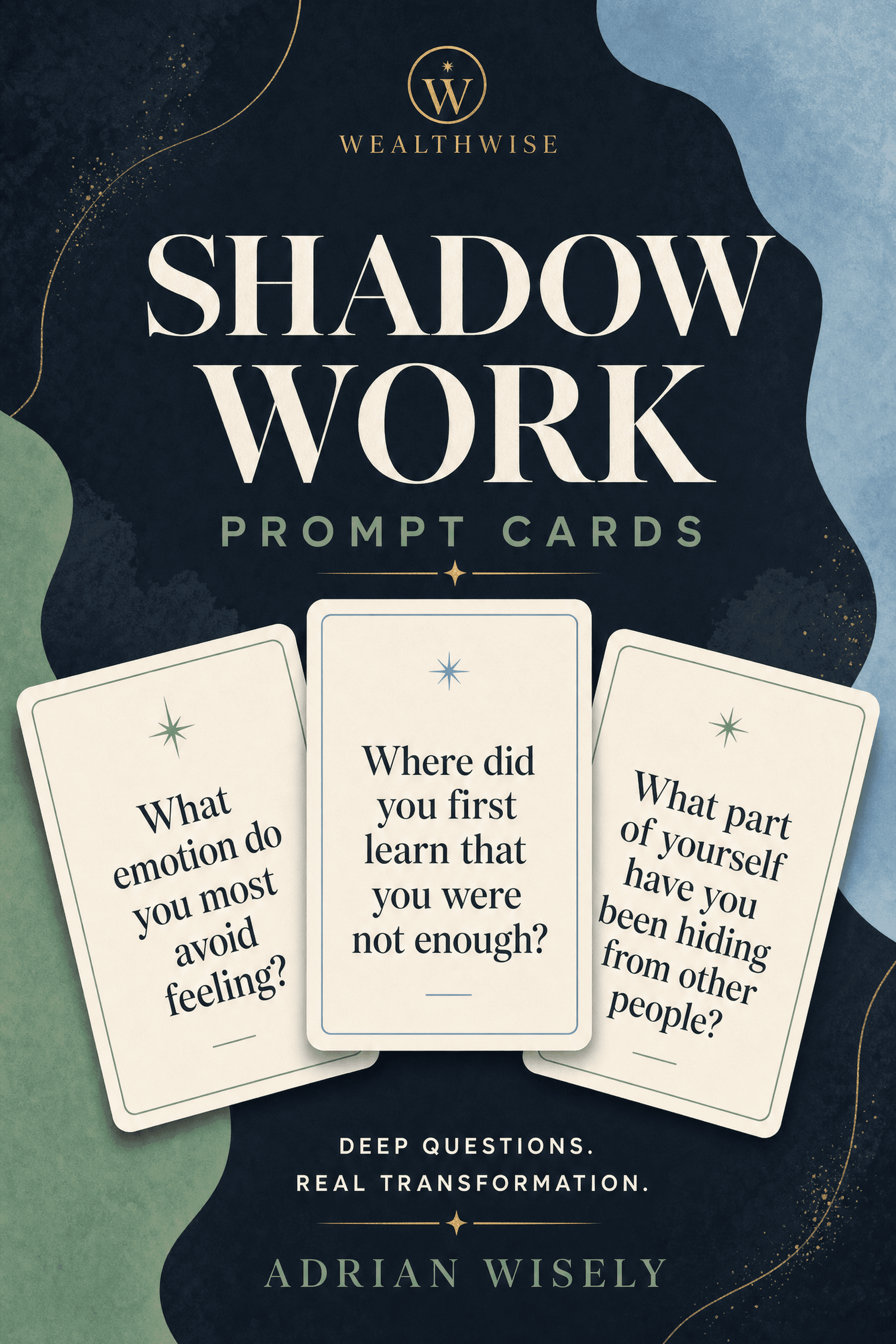
Shadow Work Prompt Cards
Digital Product
Read the first chapter in your browser. It's free, with no account and no email needed.
Free to read. No account required.
About this book
Some patterns in how you react, relate and judge yourself can be hard to explain, and they often trace back to parts of yourself you learned to hide. These prompt cards give you a structured way to look at them.
The deck has 52 cards, each with a question on the front and a follow-up reflection on the back. They are grouped into five categories: family and childhood, self-image and identity, relationships, fear and control, and growth and integration. A typical prompt asks what you were not allowed to feel at home, or what your family taught you about love, money or conflict.
The instructions suggest pulling one card a week and journaling for ten to thirty minutes in a private space. They also state that the cards are a self-reflection tool, not therapy. A worked example shows one card in use.
Look inside
Card Design
- Front: Prompt text centered on card
- Back: Brief journaling guidance (2-3 lines)
- Size: 3.5" x 5" (prints 4 per letter page)
- Design: Minimal, dark background with light text (or inverted for printing ease)
Instructions Page
What is shadow work? Shadow work is the practice of exploring the parts of yourself you have pushed away, denied, or hidden — not because they are bad, but because they were too painful, shameful, or inconvenient to acknowledge. Carl Jung called this the "shadow self." These prompts help you gently examine these hidden parts through journaling.
How to use these cards:
- Pull one card per week (or whenever you feel ready)
- Find a quiet, private space
- Journal for 10-30 minutes on the prompt
- There are no right or wrong answers
- If a card triggers a strong emotional response, that is information — not a sign to stop
- If you find yourself in emotional distress, reach out to a therapist or counselor
Important: Shadow work can surface difficult emotions. These cards are a self-reflection tool, not therapy. If you are working through trauma, please do this work alongside a qualified mental health professional.
All 52 Cards
Category: Family & Childhood (Cards 1-10)
Card 1 — Front: "What did you need to hear as a child that you never heard?" Card 1 — Back: Sit with this. What would have changed if you had heard it? Do you still need to hear it now?
Card 2 — Front: "What role did you play in your family? The responsible one? The peacekeeper? The invisible one?" Card 2 — Back: How does that role show up in your adult relationships and work?
Card 3 — Front: "What is one thing you were punished for as a child that you now realize was not wrong?" Card 3 — Back: How has that punishment shaped what you allow yourself to do or feel today?
Card 4 — Front: "What emotion was not allowed in your household growing up?" Card 4 — Back: How do you handle that emotion now? Do you suppress it, explode, or something else?
Card 5 — Front: "What is the most painful thing a parent or caregiver said to you that you have internalized as truth?" Card 5 — Back: Write the statement. Then write why it is not true — or at least not the whole truth.
Card 6 — Front: "What did your parents model about money, love, or conflict that you have unconsciously repeated?" Card 6 — Back: Which pattern do you most want to break? What would breaking it look like?
Card 7 — Front: "Who in your family are you most afraid of becoming? Why?" Card 7 — Back: What specific traits are you afraid of? Do you already see them in yourself?
Card 8 — Front: "What is a family secret or unspoken rule that still affects your behavior?" Card 8 — Back: What would happen if you stopped following that unspoken rule?
Card 9 — Front: "What did you lose too early in childhood?" Card 9 — Back: Innocence, safety, a person, a home? How do you protect yourself from that kind of loss now?
Card 10 — Front: "What would you say to your 10-year-old self right now?" Card 10 — Back: Write the letter. Be specific. Be kind.
Category: Self-Image & Identity (Cards 11-20)
Card 11 — Front: "What compliment do you have the hardest time accepting? Why?" Card 11 — Back: What belief about yourself does that compliment threaten?
Card 12 — Front: "What are you most afraid people will find out about you?" Card 12 — Back: Is this fear based on something real, or on shame that was taught to you?
Card 13 — Front: "When do you perform a version of yourself that is not authentic? Who is that performance for?" Card 13 — Back: What would happen if you stopped performing?
Card 14 — Front: "What do you judge most harshly in other people? Where does that same trait live in you?" Card 14 — Back: Jung said: everything that irritates us about others can lead us to an understanding of ourselves.
Card 15 — Front: "What is the lie you tell yourself most often?" Card 15 — Back: Write the lie. Then write what you are afraid would happen if you stopped believing it.
Card 16 — Front: "What part of yourself have you abandoned to be accepted by others?" Card 16 — Back: Is that acceptance worth the cost? Could you reclaim that part now?
Card 17 — Front: "Describe the version of yourself you are most ashamed of." Card 17 — Back: Can you find compassion for that version? What were they surviving?
Card 18 — Front: "What would you do with your life if you knew nobody would judge you?" Card 18 — Back: Whose judgment are you most afraid of? Are they even paying attention?
Card 19 — Front: "What achievement are you chasing to prove something to someone who may never notice?" Card 19 — Back: What would "enough" look like if no one was watching?
Card 20 — Front: "What are you overcompensating for?" Card 20 — Back: What is the wound underneath the overcompensation?
Category: Relationships (Cards 21-30)
Card 21 — Front: "What pattern keeps repeating in your relationships?" Card 21 — Back: What is the common denominator? (Hint: it is you. That is not an insult — it is the way out.)
Card 22 — Front: "What do you tolerate from others that you would never tolerate from yourself?" Card 22 — Back: Why is their behavior more acceptable than yours would be? Where did you learn that?
Card 23 — Front: "Who have you not forgiven — and what is that unforgiveness costing you?" Card 23 — Back: Forgiveness is not about them. What would you gain by releasing it?
Card 24 — Front: "What kind of love did you receive that taught you love has conditions?" Card 24 — Back: What conditions do you unconsciously place on love now — for others or yourself?
Card 25 — Front: "When was the last time you were deeply honest with someone about how you feel? What stopped you (or what made it possible)?" Card 25 — Back: What would radical honesty cost you? What might it give you?
Card 26 — Front: "What boundary do you need to set that you have been avoiding?" Card 26 — Back: Name the boundary. Name the fear. Which is more dangerous — the boundary or the lack of one?
Card 27 — Front: "Who do you keep trying to save? What does that rescue attempt give you?" Card 27 — Back: Is helping them a way to avoid looking at yourself?
Card 28 — Front: "What are you afraid will happen if someone truly sees all of you?" Card 28 — Back: Has anyone ever come close? What happened?
Card 29 — Front: "What did your first heartbreak teach you about love — and is that lesson actually true?" Card 29 — Back: Some lessons from pain are wisdom. Some are walls. Which is this?
Card 30 — Front: "Who do you owe an apology that you have never given?" Card 30 — Back: What stops you? Pride, shame, fear, or the belief that it is too late?
Category: Fear & Control (Cards 31-40)
Card 31 — Front: "What are you most afraid of losing? What does that fear control?" Card 31 — Back: How would your daily life change if you were not afraid of this loss?
Card 32 — Front: "What do you control tightly because you feel out of control inside?" Card 32 — Back: Food, schedule, relationships, appearance, money? Name it honestly.
Card 33 — Front: "What is a failure you have never fully processed?" Card 33 — Back: Write what happened. Then write what you made it mean about yourself. Are those the same thing?
Free to read. No account required.