Free first chapter
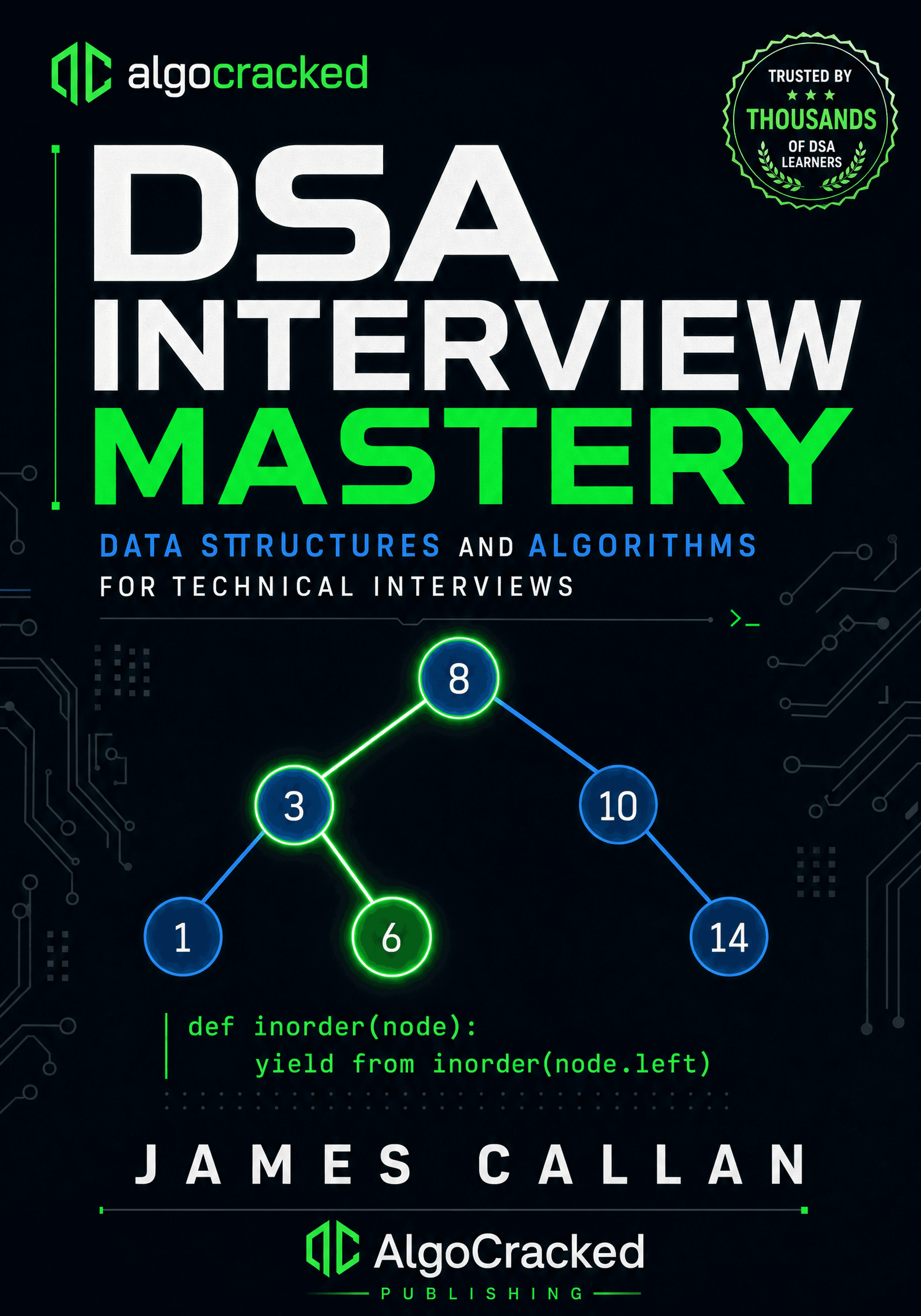
DSA Interview Mastery
Data Structures and Algorithms for Top-Tier Tech Interviews
Read the first chapter in your browser. It's free, with no account and no email needed.
Free to read. No account required.
About this book
You can code, but a whiteboard interview at a top tech company asks for something different: spotting the right approach quickly, reasoning about complexity out loud, and staying clear under pressure. Grinding hundreds of memorised problems does not get you there.
DSA Interview Mastery teaches you to solve problems through reusable patterns. You start with the interview mindset and complexity reasoning, then build through arrays, strings and hashmaps, two pointers and sliding window, linked lists, stacks and queues, trees and recursion, and graphs with BFS, DFS and union-find. From there you move to heaps, greedy methods and intervals, backtracking and dynamic programming, and tries, bit tricks and custom data structures.
Look inside
This book teaches you to solve technical interview problems through reusable patterns, precise complexity reasoning, and strong communication under pressure. By the end, you will have a personal interview playbook covering core patterns, explanation templates, debugging checklists, and graded practice sets.
Who This Book Is For
You are a software engineer preparing for algorithm interviews at top-tier tech companies. You want a systematic, pattern-based approach rather than memorizing hundreds of problems. You have working proficiency in at least one programming language, a basic understanding of time and space complexity, and familiarity with arrays, strings, and loops.
How This Book Is Organized
The book follows a deliberate progression. Chapters 1 through 3 build foundational patterns and complexity reasoning. Chapters 4 through 7 cover intermediate patterns that build on foundational structures. Chapters 8 and 9 tackle advanced patterns. Chapter 10 converts your pattern knowledge into interview performance through mock interviews and review loops. Chapter 11 is a bonus chapter covering amortized analysis, advanced DP optimizations, and geometric algorithms for candidates targeting elite quant and top-tier tech interviews.
Each chapter introduces a pattern family, teaches recognition triggers, works through concrete problems, and closes with graded exercises. Read Chapters 1 through 10 linearly on the first pass so the vocabulary and frameworks stay consistent. Chapter 11 can be studied independently after completing the core sequence or used as reference material during advanced preparation.
How to Use This Book
Treat each chapter as a build step. Read the explanation, work the required examples, and finish the exercises before moving on. Keep an error log so each chapter feeds a cumulative preparation system rather than one-off study. Revisit earlier chapters when later material exposes a weakness in reasoning or terminology.
All code examples use Python with type hints. You can adapt them to your preferred interview language.
Interview Mindset and Complexity Reasoning
A candidate walks into a 45-minute technical interview. She knows binary search, hash maps, and dynamic programming. The interviewer presents a problem: given a list of meeting intervals, find the minimum number of conference rooms required. The candidate stares at her screen for two minutes, then starts writing a brute-force nested loop. Twelve minutes later, the code works for the sample input. She announces she is done.
The interviewer asks: "What is the time complexity?" She pauses. "O of n squared, I think." The interviewer asks: "Can you do better?" She starts over from scratch, discards her working solution, and runs out of time halfway through a second attempt.
She knew enough data structures to solve the problem. She failed because she had no process. She did not clarify the constraints, did not reason about complexity before coding, did not communicate her thinking, and did not iterate on a working solution. This chapter gives you that process.
- Explain what interviewers evaluate beyond correct code
- Analyze the time and space complexity of a solution using asymptotic notation
- Apply a six-step problem-solving loop to decompose unfamiliar interview problems
- Communicate your reasoning process aloud in a structured, interviewer-friendly way
Why This Matters
Most candidates who fail technical interviews do not fail because they lack knowledge. They fail because they lack process. They jump into code too early, misread constraints, optimize the wrong bottleneck, or stay silent while the interviewer wonders what they are thinking.
Interviewers at top-tier companies have seen thousands of candidates. They can distinguish between someone who memorized a solution and someone who can reason through an unfamiliar problem. The difference is visible in the first five minutes: how the candidate reads the problem, what clarifying questions they ask, whether they consider edge cases before writing code, and how they talk about tradeoffs.
This chapter builds the foundation that every subsequent chapter depends on. The patterns in Chapters 2 through 9 are powerful, but they are only useful if you can recognize when to apply them, reason about their cost, and communicate your decisions under time pressure. The problem-solving loop and complexity reasoning introduced here will appear in every worked example throughout the book.
What Interviewers Actually Evaluate
Before you can perform well in an interview, you need to understand what performance means. Correct code matters, but it is not the only thing that matters — and in many cases, it is not even the most important thing.
Intuition
Think of a technical interview as a compressed version of a real engineering collaboration. Your interviewer is not a grading machine. They are a future colleague evaluating whether they want to work with you. They are watching how you think, not just what you produce.
A candidate who writes correct code in silence tells the interviewer almost nothing. A candidate who thinks aloud, identifies tradeoffs, catches their own errors, and iterates toward a better solution demonstrates engineering judgment — the thing that is hardest to teach on the job.
The Evaluation Rubric
Most large tech companies evaluate candidates on four to five axes. The specifics vary, but the pattern is consistent:
- Problem solving — Do you break the problem down? Do you consider multiple approaches before committing?
- Technical communication — Can you explain your reasoning? Do you name your assumptions?
- Code quality — Is the code readable, correct, and reasonably efficient?
- Complexity analysis — Can you state the time and space cost and justify it?
- Testing and edge cases — Do you verify your solution? Do you anticipate failure modes?
The key insight is that problem solving and communication are weighted at least as heavily as code correctness. A candidate who writes a working brute-force solution while clearly explaining their thinking, acknowledging the tradeoff, and proposing an optimization path will often score higher than a candidate who silently produces an optimal solution with no explanation.
Worked Example: Two Candidates, Same Problem
Consider this problem: Given an array of integers, return true if any value appears at least twice.
Quotes to share
Grinding hundreds of memorised problems does not get you there.
Free to read. No account required.