Free first chapter
Institutional-Grade Indicators
Alpha Pulse Signals, Ensemble Backtesting, and Production Toolkits
Read the first chapter in your browser. It's free, with no account and no email needed.
Free to read. No account required.
About this book
Having a good model is not enough. Many systematic traders who build usable prediction systems still struggle with the last mile: turning model outputs into indicators they can monitor, trust and act on in real time.
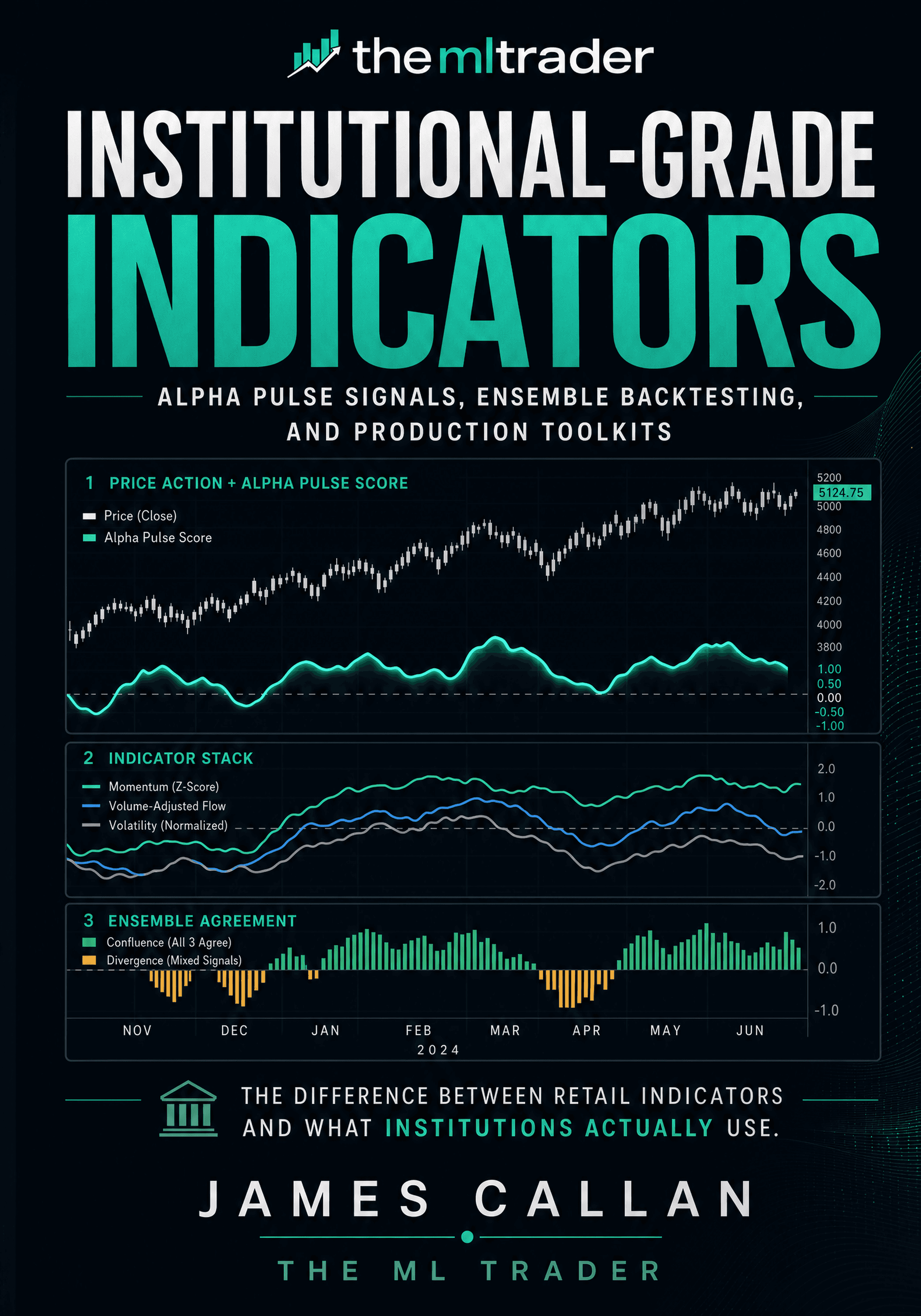
Institutional-Grade Indicators bridges that gap. This is not another modeling book. It assumes you already have signals or strategy outputs and need better tools around them. You will build the Alpha Pulse indicator pack to express conviction in a form you can read at a glance. You will then work through an ensemble backtesting framework designed to stress-test those indicators honestly rather than flatter them. Finally you will assemble a production toolkit with monitoring, auditing and execution support, the infrastructure that separates a research notebook from a system you can run.
Look inside
A trader toolkit containing conviction indicators, robustness-testing utilities, and audit-ready deployment components.
How to Use This Book
Having a good model is not enough. Most systematic traders who build usable prediction systems still struggle with the last mile: turning model outputs into indicators they can actually monitor, trust, and act on in real time. This book bridges that gap. It teaches you how to build conviction indicators, stress-test them honestly, and wire them into a production-oriented toolchain with monitoring, auditing, and execution support.
This is not another modeling book. It assumes you already have signals or strategy outputs and need better tools for interpretation, validation, and operational support. The focus is on the indicator layer, the testing layer, and the production layer — the infrastructure that separates a research notebook from a tradeable system.
Read linearly on the first pass because each chapter builds the tooling stack that the next chapter assumes.
Who This Book Is For
- Systematic traders who need practical tooling around signals, monitoring, and robustness checks
- Practitioners who already have model outputs and need the infrastructure to use them
- Readers who want audit-ready deployment, not just backtested results
Prerequisites
- Python and dashboarding basics (matplotlib, plotly, or equivalent)
- Familiarity with backtesting concepts
- Basic understanding of signal generation and risk control
- Comfort with performance logging and evaluation workflows
Environment Setup
Use a Python environment with visualization, analytics, and reporting libraries suitable for local dashboards and reproducible testing.
- Data — pandas, numpy
- Visualization — matplotlib, seaborn, plotly
- Modeling — scikit-learn, lightgbm
- Statistics — statsmodels, scipy
- Dashboarding — streamlit, dash, or equivalent
Keep indicator definitions, test results, and audit logs organized so every visual or alert can be traced back to the exact inputs that produced it.
Chapter Roadmap
- 1. Alpha Pulse Indicator Pack — Conviction layer, real-time indicators, dashboards — Usable indicator surface with signal visualization
- 2. The Ensemble Backtesting Framework — Validation, stress testing, robustness methodology — Testing toolkit that prevents indicator-driven overconfidence
- 3. The Production Toolkit — Production monitoring, execution support, audit logging — Audit-ready deployment with execution bridges
Reading Strategy
Work through examples and design exercises rather than treating the book as a list of tools. Chapter 1 defines the indicator and dashboard layer. Chapter 2 stress-tests that layer through ensemble backtesting and robustness methods. Chapter 3 connects both layers to production monitoring, auditing, and execution support. The exercises are designed to reveal the specific ways that indicator systems fail when moved from research into daily use.
Alpha Pulse Indicator Pack
A quantitative trader at a mid-sized prop firm built a gradient-boosted model that predicted short-term FX returns with respectable out-of-sample accuracy. The model produced a probability between zero and one for each five-minute bar. The trader piped that probability straight into a dashboard, drew a horizontal line at 0.65, and told the execution system to enter whenever the number crossed the line.
For two weeks, the system looked brilliant. Then a slow volatility regime shift began. The model's raw output drifted upward across all pairs — not because conviction had increased, but because the feature distributions had shifted in a way that inflated the probabilities. The threshold at 0.65 was still being crossed, but the crossings no longer meant what they had meant before. By the time the trader noticed, the account had absorbed three weeks of losses from trades that the dashboard had labeled "high conviction."
The model was not broken. The failure was in everything between the model and the human. There was no normalization, no context layer, no explicit definition of what "high conviction" meant in operational terms. The raw output was treated as if it were an indicator. It was not.
This chapter builds the layer that was missing: a conviction indicator that turns model output into a structured, reviewable, operationally useful signal surface. By the end, you will have the math, the code, and the design principles to avoid the mistake that cost that trader a quarter of unnecessary drawdown.
- Explain why raw model output requires a conviction layer before it is operationally useful
- Construct a conviction score that combines multiple evidence sources without false precision
- Design dashboard surfaces that support real-time interpretation and decision-making
- Implement trigger logic with explicit, reviewable thresholds and alert zones
- Scale the same indicator language across a multi-asset monitoring surface
Why a Model Output Is Not Yet an Indicator
A model produces a number. An indicator produces a decision-relevant signal. The gap between those two things is where most operational failures begin.
Quotes to share
Having a good model is not enough.
Free to read. No account required.