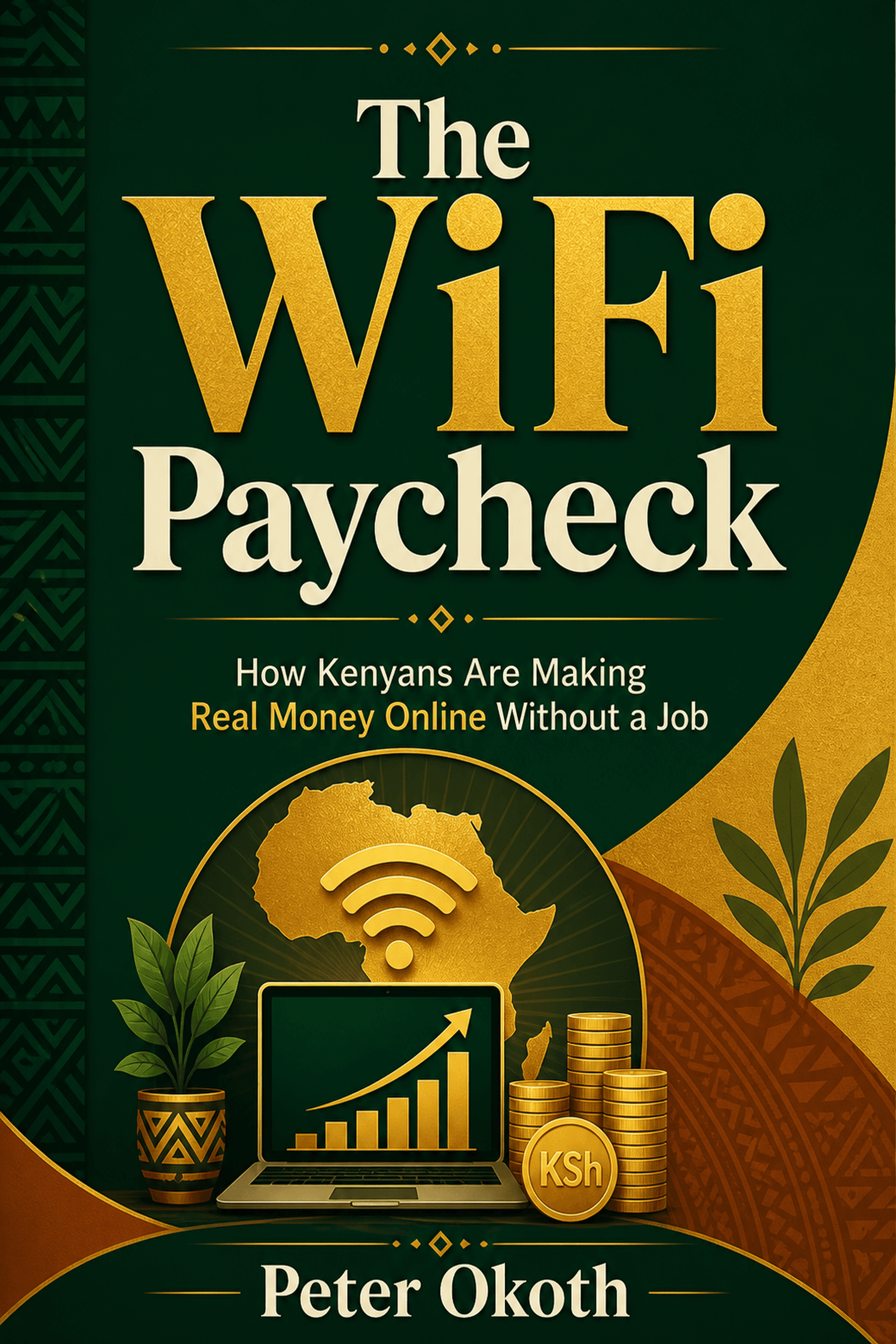
Free first chapter
The WiFi Paycheck
How Kenyans Are Making Real Money Online Without a Job
Read the first chapter in your browser. It's free, with no account and no email needed.
Free to read. No account required.
About this book
You have heard both sides. Make money online, say the promoters. It is all a scam, say the skeptics. You would like to see actual Kenyans, with actual starting points, and decide for yourself.
The WiFi Paycheck introduces you to people earning online in Kenya, one income category at a time. You meet a teacher who became a freelance writer, a virtual assistant from Kibera, a phone-only reseller, an unexpected content creator, a tutor who teaches students around the world, and a builder of digital products. Each profile shows where they started, how they landed their first earnings, which tools they use, and the mistakes they made along the way.
The book then steps back to show what these people have in common, how the money infrastructure works for getting paid, and how to design your own proof of concept. It offers evidence and honest timelines rather than motivational speeches or overnight-riches promises.
Look inside
Preface
You have heard the promises. "Make money online." "Earn from your phone." "Financial freedom in 30 days." You have probably also heard the warnings. "It is a scam." "Nobody actually makes money." "Those people on Twitter are lying."
This book does not make promises and it does not issue warnings. It introduces you to real Kenyans who are earning real money online — documented amounts, verified methods, honest timelines — and lets you decide for yourself.
Every person in this book exists. Their earning ranges are real. Their struggles are real. Their methods are repeatable. None of them got rich overnight. All of them started with nothing more than what you probably have right now: a phone, internet access, and the willingness to work.
Who This Book Is For
- Skeptics who have heard about online income but do not believe it works in Kenya
- Curious starters who want proof before they invest time and effort
- People who tried and failed and need evidence that it can work before trying again
- Anyone who learns best from stories — real examples rather than abstract instructions
- Parents, friends, or mentors who want to understand what "working online" actually looks like
What Makes This Book Different
Book 1 in this series (Degree but No Job?) gives you the how-to. Book 2 (Exit the Queue) gives you the mindset shift. This book gives you proof.
Each chapter profiles a real income category through the lens of a Kenyan who is actually doing it. You will see their starting point, their first earning, their current income, their tools, their mistakes, and their honest assessment of what it takes. No inflated numbers. No motivational speeches. Just evidence.
The WiFi paycheck is not a fantasy. It is a Tuesday morning in a bedsitter in Juja, a Sunday evening in a one-bedroom in Kisumu, a weekday afternoon in a cybercafe in Eldoret. Ordinary Kenyans, doing real work, getting paid real money.
Here is the proof.
Real Money, Real People
Gathoni was at a wedding in Limuru when she met the woman who ruined her excuses.
It was a Saturday afternoon, one of those long Kenyan weddings where you end up sitting next to strangers during the reception. The woman beside Gathoni was about her age — 29, maybe 30 — and they started talking the way Kenyan women do at weddings: politely, then honestly, then deeply.
The woman mentioned she worked from home. Gathoni assumed she meant she was unemployed — a polite way of saying "still looking." Then the woman said something specific: "I write articles for companies in the UK and the US. They pay me through Payoneer, and I withdraw to M-Pesa."
Gathoni laughed. She had heard this before. Telegram groups promising KSh 5,000 per day. Twitter threads about "passive income." Her cousin had lost KSh 8,000 to a fake investment scheme on Telegram three months earlier. A classmate had been scammed by someone impersonating an Upwork recruiter.
"How much do you actually earn?" Gathoni asked — direct, the way you ask when you think someone is exaggerating.
The woman pulled out her phone and showed Gathoni her Payoneer dashboard. Last month: USD 540. The month before: USD 620. She showed the M-Pesa withdrawal history — deposits of KSh 35,000, KSh 42,000, KSh 28,000 over the past three months.
Gathoni did not say anything for a moment. Then she asked: "How long have you been doing this?"
"Eighteen months."
"And before that?"
"I was sending CVs. Like you."
Gathoni went home that evening and could not sleep. Not because of excitement. Because of anger. She had spent two years assuming online income was a lie — while someone her age, from her county, with the same degree, was earning KSh 50,000-70,000 per month from a laptop.
Here is what Gathoni needed and did not have: proof. Not promises. Not motivation. Not a PDF selling a dream. Proof that ordinary Kenyans — not tech geniuses, not privileged Nairobi kids, not people with foreign connections — are earning real money online.
That is what this book provides.
What You Will Learn
- Meet six Kenyans earning real money online — names, locations, income categories, and real amounts
- Apply the "Real Money" test to any online income claim you encounter
- Understand the difference between evidence and hype
- Identify which income categories match your current situation
- Decide which case study chapters to read based on your interests
Why This Matters
Skepticism is healthy. Kenya has earned its skepticism about online money. The country has seen wave after wave of digital scams — from pyramid schemes dressed as forex trading to Telegram "investment" groups that vanish overnight with members' money.
But skepticism becomes expensive when it prevents you from seeing real opportunities. The person who dismisses all online income because some of it is fake is making the same mistake as the person who trusts all of it. Both end up with nothing.
This book exists to solve the evidence problem. You do not have to believe motivational speakers. You do not have to trust Twitter threads. You do not have to take my word for it. You need to look at real people, real amounts, and real timelines — and then decide for yourself.
Six Kenyans, Six Paths, Real Money
Here are the six people you will meet in detail in this book. Each has their own chapter. For now, here are the snapshots.
Grace — Freelance Writer, Nakuru
Grace, 28, taught English at a private primary school for KSh 15,000/month. She started freelance writing on Upwork as a side project after a colleague mentioned it during lunch break. Her first client paid her USD 10 for a 500-word blog post. Within 8 months, her freelance income exceeded her teaching salary. She quit teaching at month 12.
Current monthly income: KSh 60,000 – 85,000 Time doing this: 20 months Startup cost: KSh 0 (started on the school's computer, bought a laptop at month 3 for KSh 28,000) Primary tool: Laptop, Upwork, Google Docs
Victor — Virtual Assistant, Kibera
Victor, 24, has an IT diploma from a polytechnic. No university degree. He found a virtual assistant opportunity in a Facebook group for remote workers. His first client was a startup founder in Austin, Texas who needed email management and calendar scheduling. Victor did not own a laptop — he worked from a friend's phone for the first two months.
Current monthly income: KSh 35,000 – 50,000 Time doing this: 14 months Startup cost: KSh 0 (used a friend's phone initially; bought a second-hand laptop for KSh 18,000 at month 2) Primary tool: Phone → laptop, Gmail, Google Calendar, Zoom
Amina — Phone-Only Reseller, Eastleigh
Amina, 22, completed Form Four. No degree, no diploma, no laptop. She runs a reselling business entirely from a Samsung phone. She sources products from Instagram wholesalers, photographs them on her bed using natural light, and sells through WhatsApp Status and Instagram Stories. Her first investment was KSh 2,000 for a batch of phone cases.
Current monthly income: KSh 25,000 – 40,000 Time doing this: 11 months Startup cost: KSh 2,000 (first inventory batch) Primary tool: Samsung phone, WhatsApp Business, Instagram, M-Pesa
Barasa — Content Creator, Bungoma
Barasa, 26, makes short comedy videos about rural Kenyan life on TikTok. He started with zero followers and no equipment beyond his phone. He posted consistently for 3 months with minimal views and zero income. Month 4: a video went semi-viral (180,000 views). A local brand DM'd him offering KSh 3,000 for a branded skit.
Free to read. No account required.