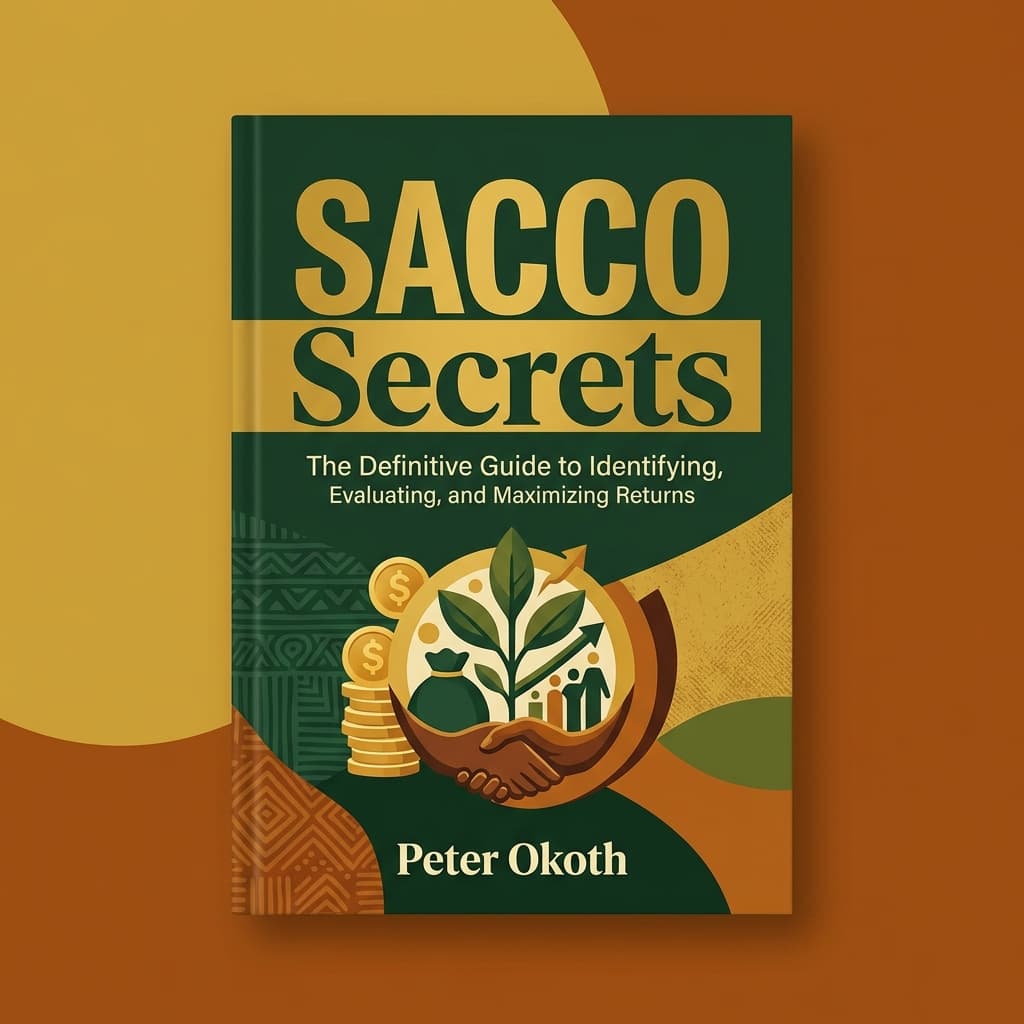
Free first chapter
SACCO Secrets
How to Pick the Right One, Maximize Returns, and Avoid the Ones That Collapse
Read the first chapter in your browser. It's free, with no account and no email needed.
Free to read. No account required.
About this book
You pay into your SACCO every month, but do you know whether your money is safe? Kenya has thousands of SACCOs, and the gap between a well-run one and one headed for trouble is easy to miss from the brochure.
SACCO Secrets shows you how to look beneath the surface. You will learn how SACCOs actually work, what SASRA regulation does and does not cover, and how to evaluate a SACCO before you join. The book teaches you to analyze dividends so you can see what your SACCO is really paying you, and to borrow from it strategically rather than desperately.
You will study the warning signs of a failing SACCO, learn from the KUSCCO case, and weigh whether digital SACCOs are a smart option or a new kind of trap. It also covers when and how to switch, and how to build a portfolio of SACCOs that fits your goals. If you are a member, a prospective member, or a Kenyan abroad, this gives you the questions to ask.
Look inside
Preface
In 2023, members of SACCOs affiliated with the Kenya Union of Savings and Credit Co-operatives (KUSCCO) discovered that KSh 13.3 billion of their money was unaccounted for. A PricewaterhouseCoopers forensic audit confirmed what many had feared: years of mismanagement, questionable investments, and governance failures at the very body that was supposed to protect SACCO interests.
That same year, SACCO members across Kenya withdrew KSh 30.8 billion more than the previous year. Trust had cracked.
But here is the other side of the story. Kenya has over 22,000 registered SACCOs. More than 7.4 million Kenyans are members. The deposit-taking SACCOs regulated by SASRA (the SACCO Societies Regulatory Authority) hold over KSh 700 billion in assets. Well-run SACCOs consistently pay dividends of 8% to 14% on share capital — returns that beat most bank savings accounts, money market funds, and even some Treasury bill rates.
SACCOs are not the problem. Bad SACCOs are the problem. And the difference between a good SACCO and a collapsing one is knowable — if you know what to look for.
This book teaches you what to look for.
Who This Book Is For
- Current SACCO members who have never read their SACCO's audited financial statements — and want to know if their money is safe
- Prospective members trying to choose between SACCOs and overwhelmed by the options — employer-based, community-based, digital, transport, agriculture
- Young professionals and hustlers who have heard SACCOs pay good dividends but do not know how to evaluate whether that is actually true
- Women and youth — you make up over 60% of SACCO membership in Kenya, and yet SACCO products are rarely designed with your needs in mind
- Diaspora Kenyans who want to join a SACCO from abroad but are terrified of sending money into something they cannot monitor
- Anyone who lost money in a SACCO collapse or knows someone who did — and wants to make sure it never happens again
What You Will Walk Away With
By the last page, you will know how SACCOs actually work (not the brochure version), how to tell a SASRA-regulated SACCO from an unregulated one, how to read a SACCO's financial statements for the numbers that matter, how to calculate your real dividend return, how to use SACCO loans strategically instead of desperately, the red flags that signal a SACCO is about to collapse, and how to build a SACCO portfolio that maximizes your returns while managing risk.
Every number in this book is sourced. Every strategy is grounded in how Kenyan SACCOs actually operate. Where regulations or rates change, we tell you exactly where to check for updates.
How This Book Connects
This book goes deep on SACCOs. For the broader picture of Kenyan wealth-building — including money market funds, T-bills, NSE stocks, and land — see Money Wise Kenya in the Kenyan Wealth Series (S6). For the tax implications of SACCO dividends and interest income, see KRA vs. You in the Kenyan Tax Series (S1).
Let us get into it.
How SACCOs Actually Work
Kamau is 29. He writes code for a fintech company in Westlands. Three years ago, during onboarding, HR handed him a form for the company SACCO. "Everyone joins," the HR manager said. Kamau signed. He has been contributing KSh 5,000 per month ever since.
Last March, he received a dividend cheque for KSh 18,400. He smiled, deposited it, and moved on.
Here is what Kamau does not know. He does not know how that KSh 18,400 was calculated. He does not know the difference between his share capital and his deposits. He does not know his loan-to-share ratio — meaning he has no idea how much he can borrow. He cannot name a single person on his SACCO's board. He has never attended an Annual General Meeting. He has never read a financial statement from his SACCO.
Kamau is not unusual. He is the norm. An estimated 80% of SACCO members in Kenya cannot explain how their SACCO makes money. They contribute, they occasionally borrow, they receive a dividend, and they assume everything is fine — until it is not.
This chapter changes that. By the end, you will understand how SACCOs work from the inside out.
What You Will Learn
- Explain how a SACCO generates income and distributes it as dividends
- Distinguish between share capital, deposits, and savings — and why it matters for your returns
- Describe the difference between BOSA and FOSA operations
- Identify the type of SACCO you belong to (or want to join)
- Calculate how dividends are determined from the SACCO's surplus
What a SACCO Actually Is
A SACCO — Savings and Credit Cooperative Society — is a financial cooperative owned by its members. That last part is the key. When you join a SACCO, you are not opening an account at a bank. You are becoming a part-owner of a financial institution.
Banks have shareholders — often large corporations or wealthy individuals. Banks exist to make profit for those shareholders. You are a customer. Your deposits are a raw material.
A SACCO has no external shareholders. The members are the shareholders. When the SACCO earns a surplus, it distributes that surplus back to the people who created it — the members. That distribution is what you receive as a dividend.
This is the fundamental difference. At a bank, profits flow to owners. At a SACCO, profits flow to members — because the members are the owners.
Kenya has over 22,000 registered SACCOs. More than 7.4 million Kenyans are members. The deposit-taking SACCOs alone hold over KSh 700 billion in assets. To put that in perspective, that is larger than many commercial banks in the region.
SACCOs are not a niche product. They are one of the largest pools of savings in Kenya.
How Money Flows Through a SACCO
To understand your SACCO, you need to follow the money. Here is the circuit, step by step.
Step 1: Members Contribute
When you join a SACCO, you make regular contributions. These go into your member share capital — your ownership stake in the cooperative. The more shares you hold, the larger your stake, the bigger your dividend, and the more you can borrow.
Some SACCOs also accept deposits — money you save with the SACCO that is separate from your share capital. Deposits earn a different return (usually lower) and have different withdrawal rules.
Step 2: The SACCO Lends to Members
The SACCO pools all member contributions and lends that money back to members who need loans. This is the core business. A SACCO is, at its heart, a lending operation funded by its own members.
Loan interest rates vary by SACCO but typically range from 10% to 14% per annum on a reducing balance — significantly cheaper than most bank personal loans or digital lending apps.
Step 3: Interest Income Creates a Surplus
The interest members pay on their loans is the SACCO's primary income. After the SACCO pays its operating costs — staff salaries, rent, IT systems, audit fees, insurance — whatever remains is the surplus.
The SACCO may also earn income from investments. Many SACCOs invest a portion of their funds in government securities (Treasury bills and bonds), fixed deposits, and other approved instruments. This investment income adds to the surplus.
Step 4: The Surplus Is Distributed
At the Annual General Meeting (AGM), the board presents audited financial statements showing how much surplus the SACCO earned. The AGM votes on how to distribute it.
The typical distribution:
- Dividends on share capital — Paid to members as a percentage of their shares
- Interest on deposits — Paid to members on their deposit balances
- Interest rebate on loans — A partial refund of loan interest to borrowers
- Statutory reserves — Required by law — retained for the SACCO's financial stability
- Development fund — Retained for SACCO growth (new branches, technology, etc.)
Free to read. No account required.