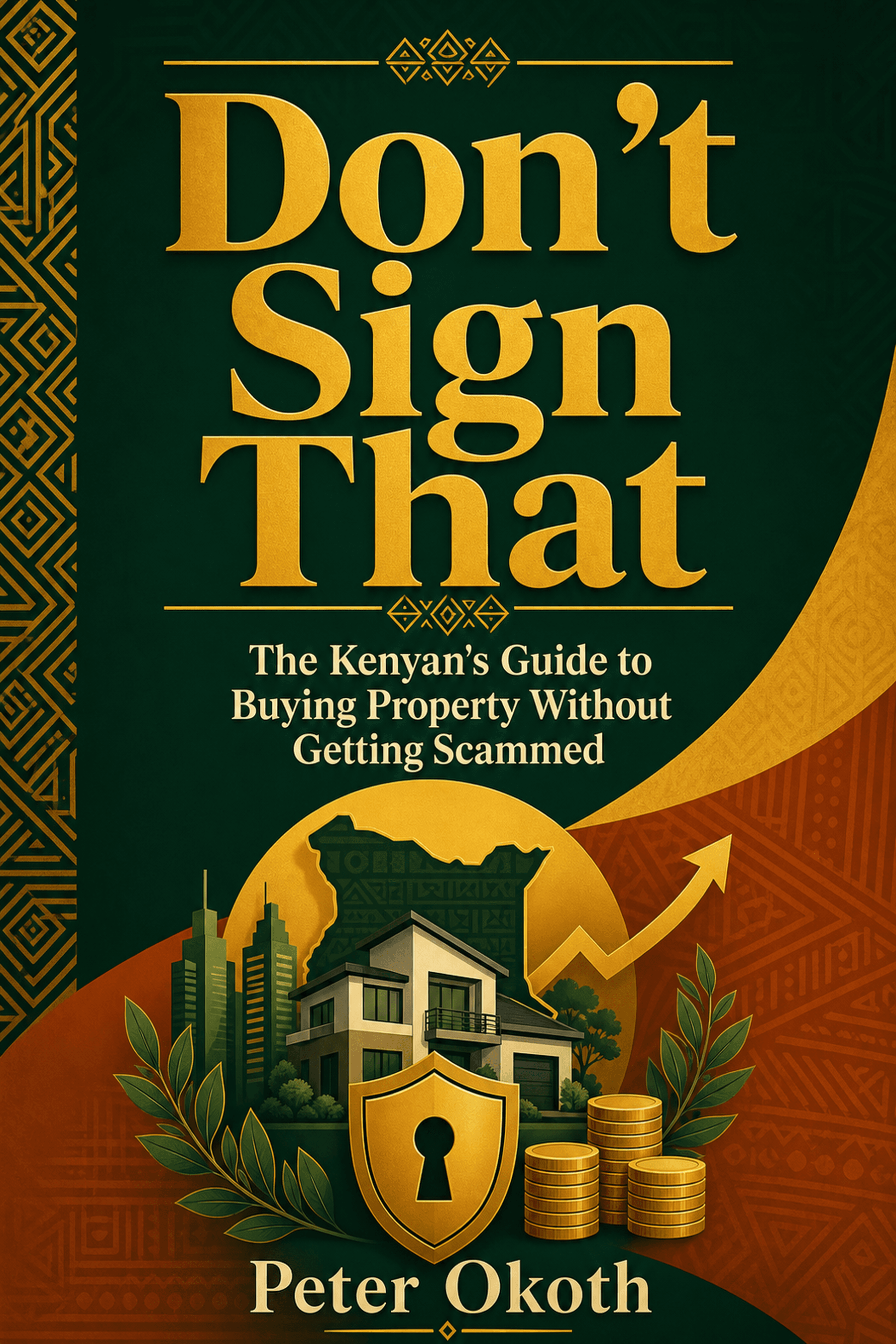
Free first chapter
Don't Sign That
The Kenyan's Guide to Buying Property Without Getting Scammed
Read the first chapter in your browser. It's free, with no account and no email needed.
Free to read. No account required.
About this book
Almost everyone in Kenya knows someone who lost money on land. A plot sold to several buyers, a developer who vanished with deposits, a title that did not match the registry. Once you sign and pay, your options shrink fast.
Don't Sign That teaches you to spot the patterns before it is too late. You will learn the difference between a title deed, a green card, and a certificate of lease, and how to do a proper title search. The book explains why you need your own surveyor and walks through the common scam patterns, the risks of off-plan developments, and the dangers of buying from family and friends.
It gives special attention to the diaspora land trap for buyers abroad. Then it moves to the money side, covering property taxes, the real cost of buying, and investment strategy around location, yield, and funding. It closes with a buying war plan you can follow, step by step.
Look inside
Preface
Someone you know has lost money on land. Maybe it was a relative who bought a plot in Ruiru that turned out to have been sold to three other people. Maybe it was a colleague who put KSh 2 million into an off-plan apartment in Athi River and watched the developer vanish. Maybe it was you.
This book exists because the biggest purchase most Kenyans will ever make — land or property — is also the one with the least protection. There is no cooling-off period. There is no consumer protection hotline that actually works. Once you sign that sale agreement and send the money, your options shrink to a courtroom and a prayer.
But here is the thing: most property scams in Kenya follow patterns. The fake title deed that does not match the registry. The plot with a succession dispute buried in the file. The developer who starts collecting deposits before breaking ground. The relative who sells family land without all the signatures. These are not random misfortunes. They are predictable, detectable, and avoidable — if you know what to look for.
This book teaches you what to look for.
Who This Book Is For
- First-time buyers saving up for a plot or house and terrified of losing everything
- Diaspora Kenyans buying land from abroad and relying on agents, relatives, or lawyers they cannot supervise in person
- Property investors evaluating plots, rental properties, or off-plan developments
- Anyone who has been asked to sign a sale agreement and felt that knot in their stomach
- People who have already been scammed and want to understand what went wrong and what to do next
What You Will Walk Away With
By the last page, you will know how to verify a title deed at the Ministry of Lands. You will know the difference between a title deed, a green card, and a certificate of lease — and which one actually protects you. You will know how to hire a surveyor, how to spot a fake one, and why the seller's surveyor should never be your surveyor. You will know the exact cost of buying property in Kenya — stamp duty, legal fees, land rates clearance, and every other charge that "surprises" buyers who did not read this book.
You will know the scam patterns. You will know the red flags. And you will know when to walk away.
Every process in this book follows the actual steps at the Ministry of Lands, the county government offices, and the Lands Registry as of 2026. Where fees and processes change, we tell you where to check for updates.
A Note on Stories
The stories in this book — Kamau, Njeri, David, and others — are composites based on patterns widely reported in Kenyan media and court records. Names and specific details have been changed, but the scam patterns are real. If a story sounds familiar, that is because these patterns repeat across Kenya every day.
Before you sign anything, read this.
The Plot That Was Not There
Kamau had done what every financial advisor tells you to do. He saved. For six years, he put money aside — first in his SACCO (Savings and Credit Cooperative Organisation) account, then in a fixed deposit at KCB. He did not take Fuliza loans. He did not chase crypto tips on Telegram. He did the boring, disciplined thing. By 2023, he had KSh 3.5 million. Enough, he thought, to buy a quarter-acre plot in Juja and start building the house his family needed.
He found the plot through a broker — a man introduced by a workmate as "the guy who handles land in Juja." The broker showed him a plot off the Juja-Gatundu road. Nice location. Quiet. Near a school. The broker showed him a photocopy of a title deed — the legal document proving ownership of land, issued by the Ministry of Lands. The name on the title was a woman's. The broker said she was his aunt, relocating to Mombasa. Quick sale. Good price.
Kamau visited the plot twice. He saw the beacons. He met the "aunt." She signed the sale agreement. Kamau paid KSh 3.5 million by cheque — KSh 500,000 deposit, the balance two weeks later.
Three months after payment, Kamau went to the plot with a fundi to discuss the foundation. He was planning a three-bedroom bungalow — the kind you see going up in every corner of Juja and Ruiru, the starter home that represents a family's transition from tenant to owner. He had already talked to a materials supplier. He had sketches on his phone.
There was already a foundation there. Someone else was building on his land.
It took four days of phone calls to piece together what had happened. The plot had been sold to three different buyers in the same month. The "aunt" was not the registered owner. The title deed photocopy was real — it just belonged to someone who had no idea her land was being sold. The broker's phone was switched off. The "aunt" had moved. Not to Mombasa. She had disappeared.
Kamau lost KSh 3.5 million. Six years of saving. Gone in a transaction that took less than three weeks. He filed a police report. He hired a lawyer. As of the time of writing, the case is still open. The broker has not been found. The "aunt" has not been found. The other two buyers are in the same position — three families, over KSh 10 million gone, and a plot that still belongs to its original owner who never authorized any sale.
Here is what Kamau did not know — and what this chapter will teach you.
What You Will Learn
- Recognize why Kenya's property market is uniquely dangerous for buyers
- Identify the five main ways Kenyans lose money on property
- Understand the single step that would have protected Kamau — and will protect you
- Map the rest of this book to your specific buying situation
Why This Matters
Every year, thousands of Kenyans lose money on property transactions. Not hundreds. Thousands. The exact number is impossible to pin down because most victims never report — they are too ashamed, too confused about their legal options, or too convinced that the courts will not help them.
The Environment and Land Court handles thousands of active land cases at any given time — and that is just the formal court system. Multiply across 47 counties, and the picture becomes clear: land disputes are not rare events that happen to careless people. They are a systemic feature of Kenya's property market.
The money involved is staggering. A single double-sold plot in Juja costs someone KSh 2-5 million. A collapsed off-plan development in Athi River or Syokimau can wipe out KSh 50-100 million from dozens of families. Diaspora Kenyans send an estimated KSh 670 billion home annually (Central Bank of Kenya, 2024 data), and a significant portion goes into land — making them the single most targeted group for property fraud.
And here is the part that should make you angry: the people who profit from this are not criminal masterminds. They are opportunists who exploit the same gaps over and over — gaps that are completely avoidable if the buyer knows what to look for. The broker who sold Kamau's plot had probably done it before. The fake aunt had probably posed as a seller before. The playbook does not change because it does not need to. New buyers walk in uninformed every day.
Free to read. No account required.