Free first chapter
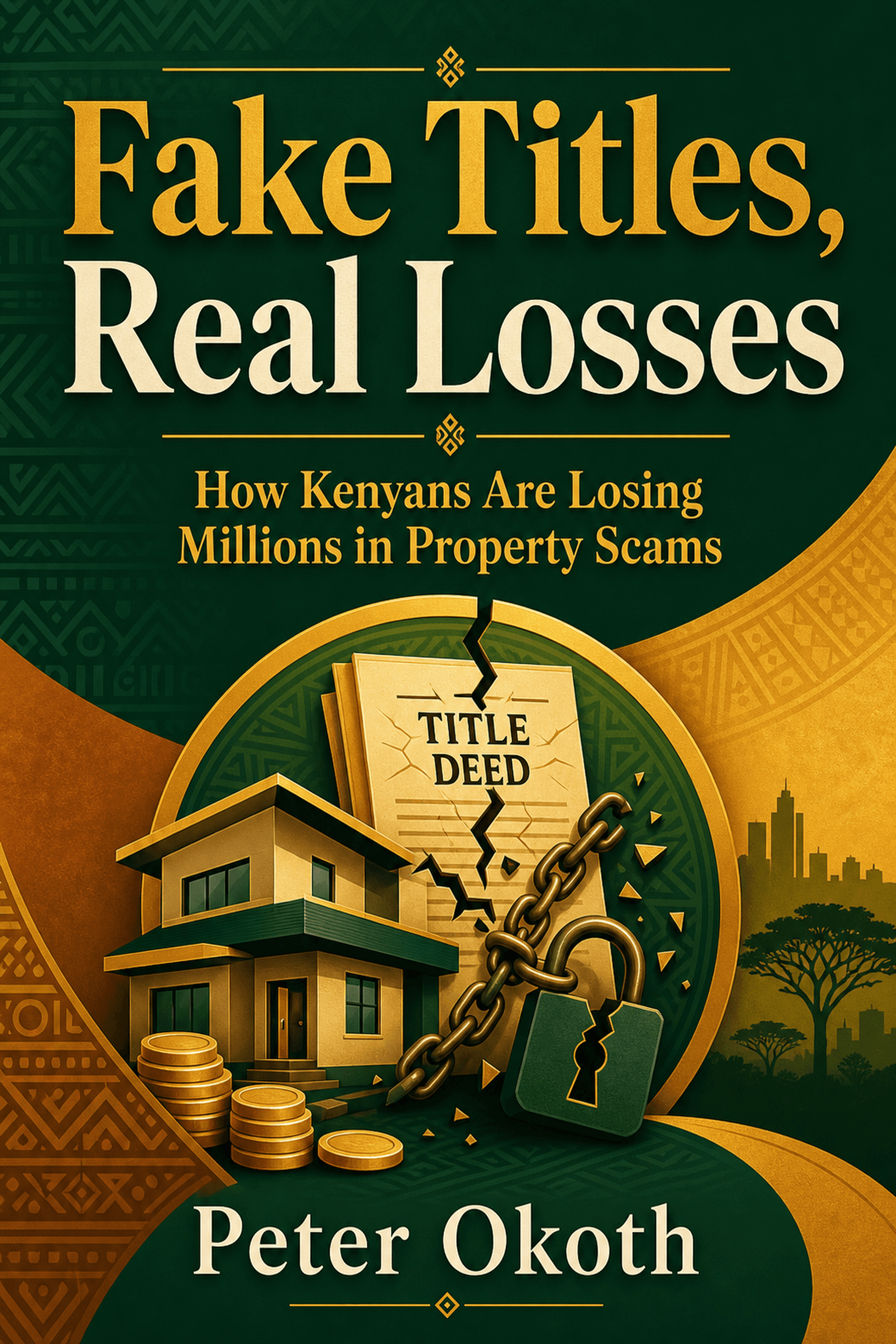
Fake Titles, Real Losses
How Kenyans Are Losing Millions in Property Scams
Read the first chapter in your browser. It's free, with no account and no email needed.
Free to read. No account required.
About this book
A forged title deed, a rented office in Nairobi CBD, actors posing as landowners, and one parcel sold to many buyers. By the time victims realise, the sellers are long gone.
Fake Titles, Real Losses is an investigation written as a guide. Each chapter takes apart a specific kind of property scam, shows how it works from the inside, and gives you the verification steps that would have stopped it. You will see the anatomy of a fake title, how a web of brokers keeps the fraud moving, how grabbed public land gets sold as private, and how succession scams target grieving families. Further chapters look at why the diaspora is such a valuable target, developers who vanish with deposits, and plots sold through social media. You will also learn exactly what to do if you have already been scammed.
It closes with a verification toolkit for anyone buying, advising on or recovering from a property deal in Kenya.
Look inside
Preface
In 2023, a single syndicate in Ruai sold the same five-acre parcel to seventeen different buyers. Total collected: over KSh 85 million. Total recovered by victims: zero. The syndicate used forged title deeds, rented an office in Nairobi CBD for three months, hired actors to pose as landowners, and disappeared.
This is not an unusual story. It is an unremarkable one. Land fraud in Kenya is so common that the Environment and Land Court processes thousands of cases every year, most of which will never be resolved in the victim's favour. The money is gone. The sellers are gone. The system that should have caught it shrugs and moves on.
This book does not shrug. This book names the scams — the methods, the patterns, the amounts, and the people who enable them. It is an investigation disguised as a guide. Every chapter dissects a specific type of property fraud, shows you how it works from the inside, and gives you the exact verification steps that would have stopped it.
Who This Book Is For
- Anyone buying property in Kenya who wants to understand the scam landscape before entering it
- People who have been scammed and want to understand what happened and what options remain
- Property professionals — lawyers, agents, and surveyors — who want to better protect their clients
- Diaspora Kenyans who are the highest-value targets for property fraud
- Journalists, researchers, and policymakers working on land reform
What This Book Does Differently
Don't Sign That (Book 1 in this series) teaches you how to buy property safely. This book teaches you how the scams actually work. The difference matters. Knowing the steps of due diligence is protection. Understanding the criminal's playbook is armour.
Every case pattern in this book is drawn from public reporting — court records, news investigations, and documented complaints. The names of victims have been changed or composited. The methods are real.
How To Use This Book
Read it alongside Don't Sign That for the full picture. This book exposes the threats. That book gives you the defence. Together, they are the most complete property protection a Kenyan buyer can carry.
Before you sign anything — before you even start looking — read this.
The Woman Who Sold Nairobi Twice
Akinyi wore a navy blue suit, carried a leather briefcase, and spoke with the steady confidence of someone who had sold property for twenty years. She operated from a rented office on the fourth floor of a building on Koinange Street, Nairobi CBD. The office had a glass desk, a water dispenser, and framed certificates on the wall. She had business cards. She had a company name — registered on eCitizen three months earlier.
Over four months in 2023, Akinyi and her team sold the same five-acre parcel of land in Ruai to seventeen different buyers. The price varied — KSh 4.5 million to KSh 6.2 million per buyer, depending on how much they could pay. Total collected: approximately KSh 85 million. The title deed — the legal document proving land ownership, issued by the Ministry of Lands — was forged. The witnesses who accompanied buyers to "view the land" were actors. The beacons they pointed to belonged to someone else's plot.
The actual owner of the Ruai parcel was a retired headmaster living in Kisumu. He discovered his land had been sold when a buyer showed up with a survey team and a construction crew. He had never met Akinyi. He had never authorised any sale. His genuine title deed was sitting in a safe deposit box at Kenya Commercial Bank.
By the time the first buyer filed a police report, Akinyi's office was empty. The lease had been paid in cash for three months. The phone numbers were dead. The company she had registered had no assets — it was a shell, created for this purpose, dissolved by its purpose.
Seventeen families. KSh 85 million. One forged title deed. Zero arrests as of the time of writing.
Here is what none of those seventeen buyers did — and what this chapter will teach you to understand before you spend a single shilling.
What You Will Learn
- Understand the scale of property fraud in Kenya — the money, the victims, the system that enables it
- Identify who gets targeted for property scams and why
- Explain the structural gaps in Kenya's property system that make fraud possible
- Map this book's investigation to the specific scam types you are most likely to encounter
Why This Matters
Property fraud in Kenya is not a series of isolated incidents. It is an industry.
The Environment and Land Court (ELC) — the specialised court handling land and environment disputes — processes over 5,000 active cases in Nairobi alone at any given time. Multiply that across 47 counties, add the cases that never reach court, and the picture becomes staggering. The National Land Commission has received thousands of complaints about irregular land allocations. The Directorate of Criminal Investigations (DCI) handles hundreds of property fraud reports annually. And these are only the cases where victims actually report — most do not.
The money is enormous. Conservative estimates from court records and media investigations suggest Kenyans lose tens of billions of shillings to property fraud every year. A single syndicate operation — like Akinyi's — can extract KSh 50-100 million before disappearing. Off-plan developer collapses have cost individual schemes KSh 200 million or more. Diaspora remittance fraud diverts billions from family investments into criminal pockets.
And here is the part that should disturb you: the methods are not sophisticated. Akinyi rented an office, printed business cards, forged one title deed, and hired a few actors. That is it. The technology of property fraud in Kenya has not changed significantly in decades. What has changed is the scale — social media, WhatsApp groups, and M-Pesa have made it faster to find victims and collect money.
The system does not protect you. The Lands Registry — the office that maintains records of land ownership — holds the truth about who owns what. But it does not proactively warn buyers. There is no mandatory pre-sale verification. There is no regulated broker licensing system. There is no consumer protection body that intervenes before money changes hands. The tools exist to verify ownership — a title search costs KSh 500 to KSh 1,000 and takes one to three days. But the system relies entirely on the buyer to use them.
This book exists because the criminals know how the system works. It is time the buyers did too.
The Numbers Behind the Scams
How Much Are Kenyans Losing?
Exact figures are impossible because most victims never report. But the evidence we have paints a grim picture:
- The Environment and Land Court in Nairobi has over 5,000 active cases at any time. Each case represents at least one victim, often dozens.
- In documented cases from media investigations between 2020 and 2025, individual syndicate operations have extracted between KSh 30 million and KSh 200 million before disappearing.
- Off-plan development collapses in Nairobi, Kiambu, and Machakos counties have affected thousands of buyers, with total losses in individual schemes ranging from KSh 50 million to over KSh 1 billion.
- Diaspora Kenyans — who send an estimated KSh 670 billion home annually (Central Bank of Kenya, 2024 data), a significant portion into property — are the highest-value individual targets. Documented cases show individual diaspora losses of KSh 5 million to KSh 20 million per victim.
Free to read. No account required.