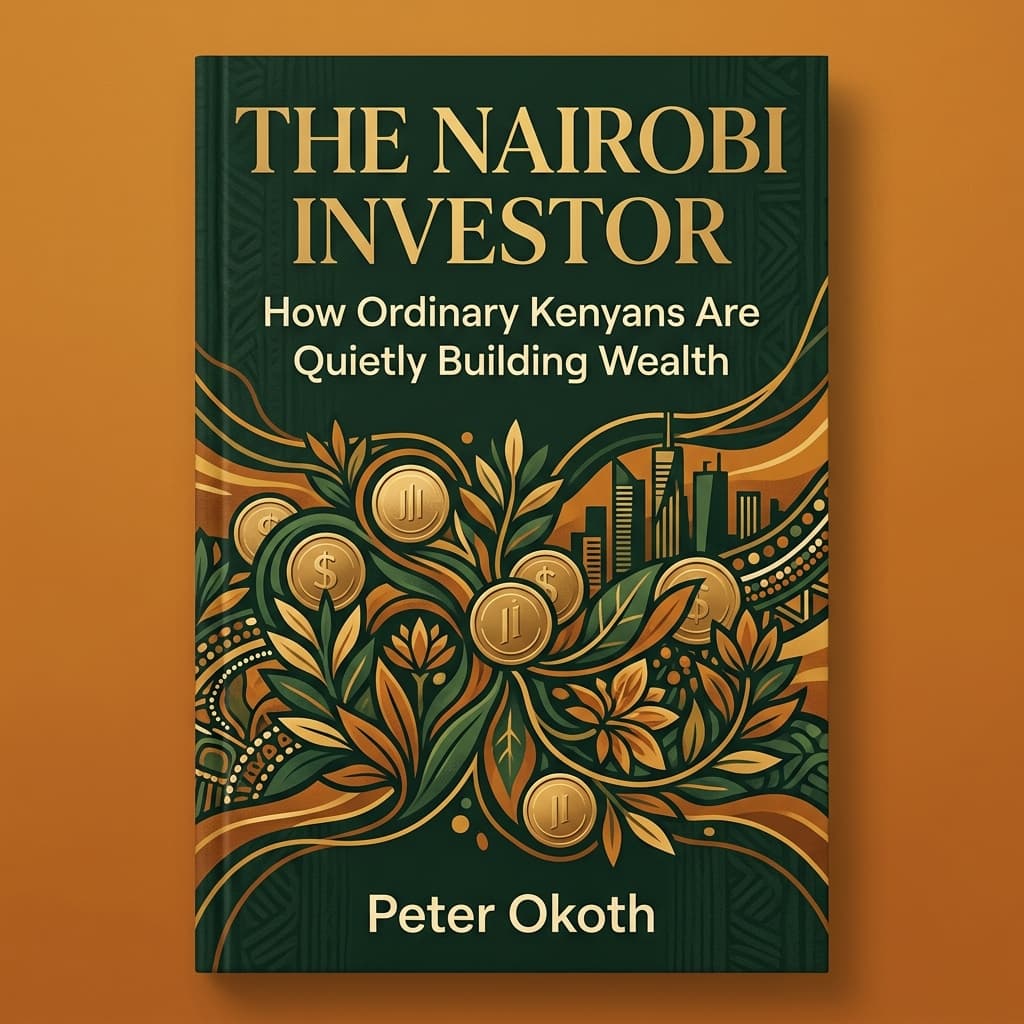
Free first chapter
The Nairobi Investor
How Ordinary Kenyans Are Quietly Building Wealth
Read the first chapter in your browser. It's free, with no account and no email needed.
Free to read. No account required.
About this book
The wealth you see on social media is mostly staged. The real story in Kenya is quieter: people who started small, stayed consistent, and let ordinary months do the work. If you have wondered whether investing is only for the rich, this book answers with people instead of theory.
The Nairobi Investor follows eight investor profiles, each built around a different path. You meet the SACCO millionaire, the money market fund strategist, the NSE faithful, the land hunter, the chama builder, the diaspora investor, and the side hustle investor. Each profile shows what the person did, what went wrong along the way, and the lesson you can borrow.
A chapter on what every successful investor has in common pulls the threads together, and the final chapter helps you work out your own investor identity. It is written for Kenyan readers, with Kenyan examples, and meant to leave you with enough proof and clarity to choose a path and begin.
Look inside
Preface
There is a version of the Kenyan wealth story that lives on social media. Flashy cars. Runda mansions. "Passive income" captions under photos of someone's feet at the beach. That version is mostly fiction.
The real wealth story in Kenya is quieter. It is the procurement officer in Thika who has been buying one NSE stock per quarter for eleven years. It is the teacher in Nakuru whose SACCO dividends now exceed her salary. It is the mama mboga in Gikomba who owns three rental units because she understood compound interest before she could spell it. It is the boda boda rider in Kisumu who turned a chama merry-go-round into a fleet of seven motorcycles.
These are real people. Their strategies are not complicated. Their starting amounts were not large. But they were consistent, they were disciplined, and they understood something most Kenyans miss: wealth is built in the ordinary months, not the extraordinary ones.
Who This Book Is For
- The skeptic who thinks investing is for rich people and wants proof that ordinary Kenyans are doing it
- The curious who has heard about SACCOs, MMFs, or the NSE but wants to see what real results look like before committing
- The intermediate investor looking for strategies from people who started where they are
- Anyone who needs motivation grounded in reality, not imported from a Western self-help book
What You Will Walk Away With
Eight detailed investor profiles – real strategies, real numbers, real timelines. Each profile breaks down exactly what the person did, what they earned, what went wrong along the way, and the lesson you can steal for your own wealth plan. By the last page, you will have seen enough proof to pick your own path and start.
Every figure in this book reflects Kenyan market conditions as of 2026.
The proof is in the profiles. Let us meet them.
The Millionaires You Pass on the Street
Let me introduce you to two people.
Barasa is 36. He drives a 2024 Toyota Prado. He lives in a two-bedroom apartment in Kilimani – KSh 85,000/month rent. His Instagram is a highlight reel: beach holidays in Diani, steaks at Carnivore, weekend getaways in Nanyuki. His suits are sharp. His watch is noticeable. If you passed him in a Westlands coffee shop, you would think: this man is doing well.
Here is what you would not know. The Prado is financed – KSh 4.2 million loan, KSh 110,000/month payments, three years remaining. The credit card balance is KSh 380,000. He took a salary advance last month to cover rent. His M-Pesa savings: KSh 12,000. His SACCO balance: KSh 0 – he withdrew it all for a trip last December. His total investments: zero.
Barasa's net worth – total assets minus total liabilities – is negative KSh 2.3 million. He owes more than he owns. By any financial measure, Barasa is broke. He just does not look it.
Now meet Wambui.
Wambui is 38. She drives a 2016 Toyota Vitz. She lives in a one-bedroom apartment in Kahawa West – KSh 15,000/month rent. She has never posted a financial flex on social media. She buys her clothes at Gikomba. She eats at home most nights. If you passed her on Thika Road, you would not look twice.
Here is what you would not know. Wambui has been investing since she was 24. Her SACCO balance: KSh 1.8 million. Her money market fund: KSh 950,000. Her NSE portfolio: KSh 2.4 million – accumulated over 14 years of buying one or two stocks per quarter. A rental unit in Ruiru generating KSh 22,000/month. Total debt: KSh 0.
Wambui's net worth: KSh 6.8 million. She is a millionaire several times over. She built it on a salary that never exceeded KSh 120,000/month.
One of these people looks wealthy. The other one is wealthy.
Sound familiar?
Here is what this chapter – and this entire book – will teach you.
What You Will Learn
- Distinguish between looking wealthy and being wealthy – and calculate your own net worth
- Understand where real Kenyan wealth is built (it is not where social media tells you)
- Meet the eight ordinary investors whose profiles form the core of this book
- Use a framework for extracting actionable lessons from each investor's story
Why This Matters
There is a wealth gap in Kenya that nobody talks about. Not the gap between rich and poor – everyone talks about that. The gap between people who earn the same amount but end up in completely different financial positions.
Two colleagues at the same company, same salary grade, same number of years working. One has KSh 3 million in investments. The other has KSh 30,000 in M-Pesa and a Fuliza balance. Same income. Opposite outcomes.
The difference is not intelligence. It is not luck. It is not connections. It is what they did with the money between payday and the end of the month. The choices that nobody sees. The deposits that nobody posts about. The discipline that has no Instagram filter.
This book is about those invisible choices. It profiles eight Kenyans who made them – and breaks down exactly what they did so you can do the same.
The Wealth Illusion
The Reality
Kenya has a consumption culture dressed up as a wealth culture. The signals we use to judge financial success – the car, the neighbourhood, the restaurant, the phone – are almost always signals of spending, not wealth. And spending and wealth are often inversely related.
The person driving the newest car on the road is frequently the person with the least money in the bank. Because the car payment is eating everything.
How It Actually Works
Let us define some terms, because the confusion between them is where the illusion lives.
Income is what comes in. Your salary, your business revenue, your side hustle earnings. Most people think high income equals wealth. It does not. Income is a flow. It comes and it goes. A person earning KSh 300,000/month with no savings is not wealthy. They are highly paid and highly vulnerable.
Spending is what goes out. Rent, food, transport, lifestyle, family support. The higher your spending relative to your income, the less capacity you have to build wealth. Spending is visible. It is what other people see and judge you by.
Net worth is what you actually have. Total assets – everything you own that has financial value (savings, investments, property, business value) – minus total liabilities – everything you owe (loans, Fuliza, credit cards, debts). Net worth is invisible. Nobody can see it by looking at you. And it is the only number that actually measures whether you are building wealth.
Barasa's income is high. His spending is higher. His net worth is negative.
Wambui's income is moderate. Her spending is low. Her net worth is KSh 6.8 million.
The question this book answers is: what did Wambui do? And can you do it too?
Where Real Kenyan Wealth Lives
The Reality
If you asked most Kenyans "where do wealthy people keep their money?", they would probably say real estate and bank accounts. And they would be partly right about real estate. But the full picture is more interesting – and more accessible.
How It Actually Works
Real Kenyan wealth – the kind built by ordinary people on ordinary incomes – lives in five places:
1. SACCOs. The quiet backbone of Kenyan wealth. Over KSh 1 trillion in member deposits across 20,000+ SACCOs. The teacher who has been contributing KSh 5,000/month for 15 years and now has KSh 4 million. The civil servant whose SACCO dividends exceed his bonus. SACCOs do not make headlines, but they make millionaires.
Quotes to share
The wealth you see on social media is mostly staged.
Free to read. No account required.