Free first chapter
The Burnout Recovery Journal
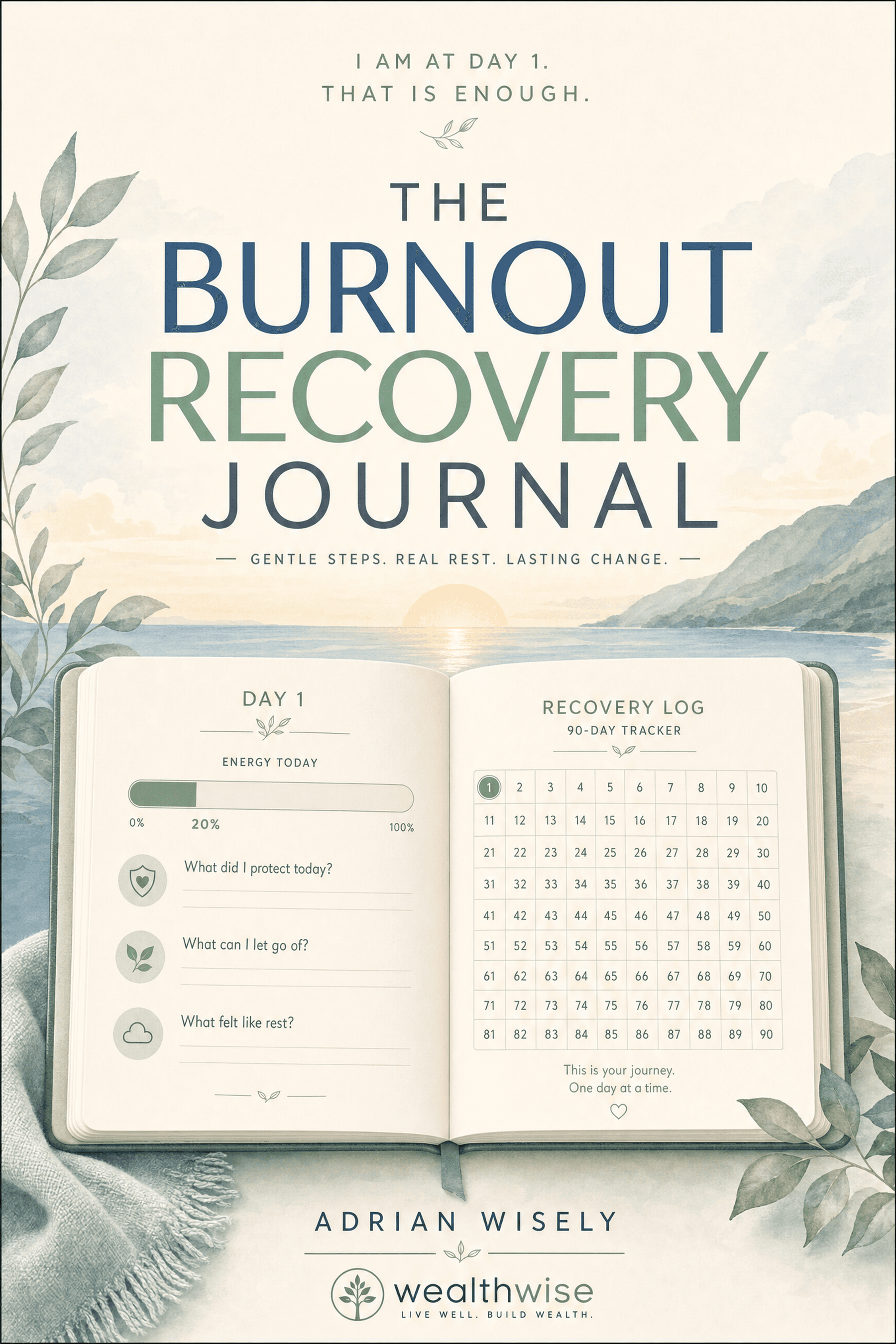
90 Days of Rebuilding After You Hit the Wall
Read the first chapter in your browser. It's free, with no account and no email needed.
Free to read. No account required.
About this book
If you have hit the wall and the usual advice to relax or practise self-care sounds hollow, you may need a gentler structure for getting better. This journal gives you 90 days of it, without a comeback story or pressure to be productive.
The days are split into three phases. Rest, in days 1 to 30, is deliberately gentle and includes bare minimum day pages that ask only for an energy rating and one body sensation. Reflect, in days 31 to 60, looks at what led to the burnout and what was and was not in your control. Rebuild, in days 61 to 90, helps you set boundaries and redefine what a sustainable life looks like. Each phase closes with a reflection page.
You can skip prompts and stay in a phase as long as you need. The journal is not a substitute for professional support, and it encourages you to seek help if you need it.
Look inside
You Hit the Wall. Now What?
If you're holding this journal, something broke. Maybe it was sudden – one day you just couldn't get out of bed. Maybe it was slow – months of pushing through until pushing through stopped working. Maybe you're not even sure it's burnout. You just know that the engine is empty and the fumes ran out a while ago.
I'm not a therapist. I'm not going to tell you to take a bubble bath and practice self-care. (If you hear "self-care" one more time without anyone addressing the systemic reasons you burned out in the first place, you are allowed to throw this journal across the room. Then pick it up. We still have work to do – gently.)
This journal is for the recovery. Not the bounce-back, not the comeback story, not the "I'm stronger now" narrative. Just the slow, unglamorous process of rebuilding after you hit the wall.
Why 90 Days
Burnout recovery isn't linear, and it doesn't have a fixed timeline. But your brain needs structure right now – especially because burnout has probably fried your ability to make decisions and plan ahead. Ninety days gives you a container. Something to follow when you can't figure out what to do next.
The 90 days are split into three phases:
- Phase 1: Rest (Days 1-30) – These prompts are deliberately gentle. You are not going to set goals or make plans. You are going to rest, notice, and slowly reconnect with yourself. If even these feel like too much, there are "bare minimum day" pages scattered throughout.
- Phase 2: Reflect (Days 31-60) – Now that the fog is starting to lift, these prompts help you understand what happened. What led to the burnout. What patterns were at play. What was in your control and what wasn't.
- Phase 3: Rebuild (Days 61-90) – Not back to what you were doing before. Something different. These prompts help you build boundaries, redefine success, and figure out what a sustainable life actually looks like for you.
How to Use This Journal
Phase 1 (Rest): Go slow. One prompt per day, or less. If a prompt feels like too much, turn to a bare minimum day page instead. Those pages ask almost nothing of you: rate your energy, name one sensation in your body, done. No shame in using them for the entire first month.
Phase 2 (Reflect): You might feel the urge to rush through this phase because it feels productive. Resist that urge – it's the same pattern that burned you out. One prompt per day. Sit with what comes up.
Phase 3 (Rebuild): These prompts ask you to make small plans and set gentle boundaries. If you're not ready, stay in Phase 2 longer. There is no deadline.
For all phases:
- Skip any prompt that doesn't fit. Circle back later or don't.
- Write as little or as much as you need.
- This journal is not a to-do list. Completing it is not the goal. Using it is.
If you're neurodivergent: Burnout hits neurodivergent people harder and more often. This journal accounts for that. Prompts are short. Pages are uncluttered. Executive function demands are minimal, especially in Phase 1. If you can't do the prompt, just open the journal and write today's date. That counts.
What I Need You to Hear
Your burnout is not a personal failure. It might be the result of an impossible workload, a toxic environment, caregiving without support, systemic inequality, or a dozen other things that were never yours to fix alone.
This journal won't tell you to hustle harder, optimize your morning routine, or grind through it. It will ask you to rest without earning it. To take up space without producing anything. To be a person and not a productivity machine.
That might feel uncomfortable. That's okay. We'll go slow.
If at any point during these 90 days you feel like you need more support than a journal can provide, please reach out to a mental health professional. Burnout can overlap with depression, and you deserve real help – not just prompts on a page.
You don't have to be ready. You just have to be here.
Let's start.
Free to read. No account required.