Free first chapter
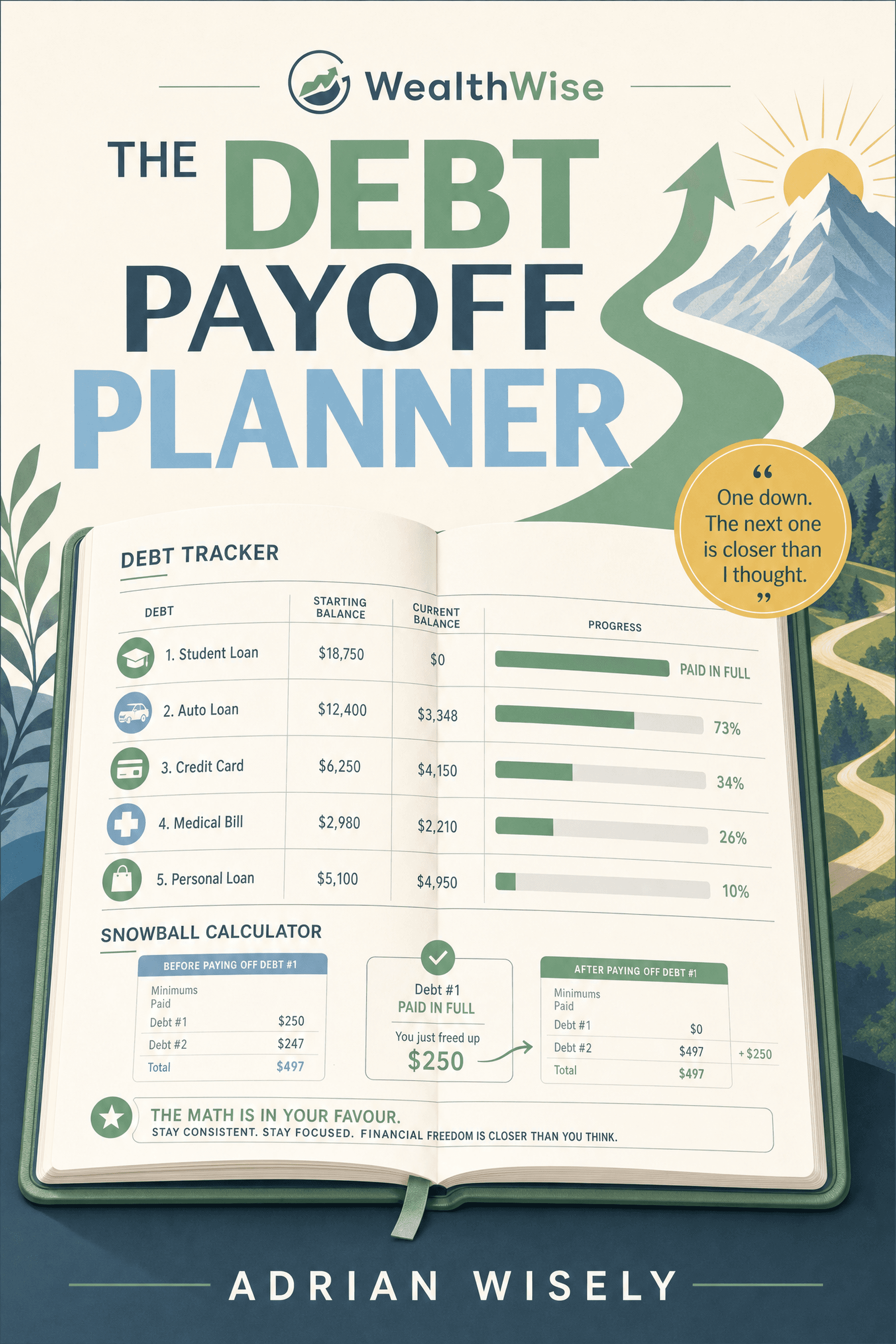
The Debt Payoff Planner
Track Every Payment and Watch Your Balance Hit Zero
Read the first chapter in your browser. It's free, with no account and no email needed.
Free to read. No account required.
About this book
Debt can sit in the back of your mind for years, especially if you glance at a balance and then close the app. This planner replaces that cycle with a simple habit: write down every payment and watch the number go down.
It starts with debt overview pages where you list each creditor, balance, interest rate and minimum payment. The core is the monthly payment tracker, where you record the date, amount and new balance for every payment, minimum or extra. Monthly summary pages total what you paid and how much went to interest and principal. A milestone tracker marks 25, 50, 75 and 100 percent payoff, and a debt-free date projection shows how extra payments could shorten your timeline.
It works with the snowball method, the avalanche method or neither, and it needs only a pen and a few minutes after each payment.
Look inside
You Already Know You Have Debt. This Book Helps You Do Something About It.
The average American household carries roughly $104,000 in total debt. That number includes mortgages, student loans, credit cards, car payments, and medical bills. If you're holding some of that weight, you're not unusual. You're normal.
But "normal" doesn't mean comfortable. Debt has a way of sitting in the back of your mind — not always loud, but always there. You check your balance, feel a knot in your stomach, close the app, and move on. That cycle can go on for years.
This planner exists to interrupt that cycle. Not with motivation speeches or complicated strategies, but with a simple, physical act: writing down every payment you make and watching the number drop.
Who This Is For
This book is for anyone paying off debt who wants a clear, tangible record of progress. It works whether you owe $2,000 on a credit card or $80,000 in student loans. It works whether you're using the snowball method, the avalanche method, or no particular method at all.
You don't need to be a spreadsheet person. You don't need to understand amortization tables. You just need a pen and five minutes after each payment.
How It Works
The planner is organized into a few simple sections:
Debt Overview Pages. Start by listing each debt you owe — the creditor, the balance, the interest rate, and the minimum payment. This gives you one honest snapshot of where you stand. For many people, just completing this page is the hardest part. It's also the most important.
Monthly Payment Tracker. This is the core of the book. Every time you make a payment — minimum or extra — you log the date, the amount, and your new balance. One row per payment. Fifteen rows per page. Over time, you'll fill pages with evidence that the balance is shrinking.
Monthly Summary Pages. At the end of each month, add up what you paid, how much went to interest, and how much went to principal. This is where you start to see patterns and momentum.
Milestone Tracker. When you hit 25%, 50%, 75%, and 100% payoff on any account, you record it here. These pages exist because progress deserves a timestamp.
Debt-Free Date Projection. A simple table that shows how extra payments accelerate your timeline. If you pay $50 extra per month, how much sooner are you done? The math is straightforward, and seeing the answer on paper can change how you think about that next payment.
A Note on Shame
Debt is not a character flaw. It's a financial situation. Some of it came from choices you'd make again (education, a car that gets you to work, medical care you needed). Some of it came from circumstances you didn't choose. And some of it, honestly, came from spending that felt right at the time and doesn't anymore.
None of that matters for the purpose of this book. What matters is that you're paying it down, one entry at a time. This planner doesn't judge what got you here. It just tracks where you're going.
One More Thing
There's a specific kind of satisfaction that comes from drawing a line through a debt account and writing "PAID OFF" next to it. It's quiet and personal and surprisingly powerful.
This book gives you a place to do that as many times as you need to.
Pick up a pen. Turn to the first Debt Overview page. Start writing.
Free to read. No account required.