Free first chapter
The Deep Work Planner
Block Your Time, Protect Your Focus, Get Things Done
Read the first chapter in your browser. It's free, with no account and no email needed.
Free to read. No account required.
About this book
Knowing you should focus and actually protecting your focus are two different things, especially when email, meetings and notifications fill the day. This planner helps you decide in advance what each block of your time is for.
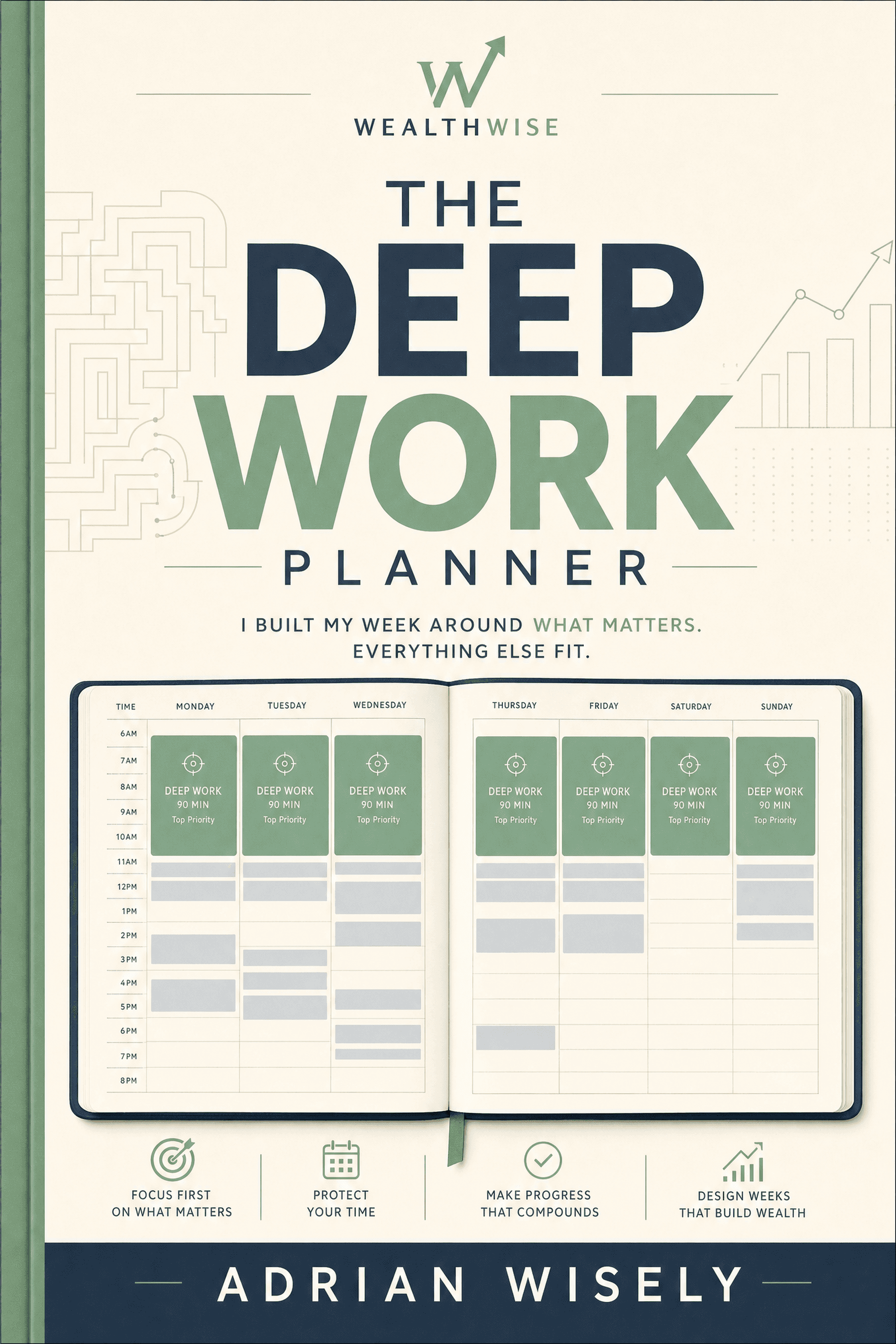
The daily page is a time-block grid in 30-minute increments, where you give every block a specific task before the day begins. A focus session tracker logs the duration, intensity and quality of each deep work session. A distraction log captures what pulled you out, so patterns show up quickly. A weekly deep work audit totals your focused hours, and a quarterly review shows whether they are trending up and whether your important projects are moving.
Filled-in sample pages show each layout in use, and a two-minute end-of-day review helps you adjust the plan for tomorrow.
Look inside
Introduction
The ability to perform deep work is becoming increasingly rare at exactly the same time it is becoming increasingly valuable in our economy. If you can master this skill, you will achieve extraordinary results.
This planner exists because knowing you should focus and actually structuring your day to protect focus are two very different things. Most productivity systems fail knowledge workers because they treat all tasks as equal. They are not. Answering emails is not the same as writing a chapter, designing an architecture, or solving a proof. One is shallow. The other is deep. The shallow work will happily consume your entire day if you let it.
The Method
This planner is built on one core principle: every minute of your workday should be assigned a job before it begins.
That does not mean rigidity. Plans change. Meetings get added. Emergencies happen. But a person who starts the day with a time-blocked plan and adapts it three times still outperforms the person who "wings it" every single time.
Here is what you will find inside:
- Daily Time-Block Grid – Your day in 30-minute increments. Assign every block a task before you begin.
- Focus Session Tracker – Log each deep work session: duration, intensity, and output quality. What gets measured gets improved.
- Distraction Log – Every time something pulls you out of a focus block, write it down. Patterns will emerge fast.
- Weekly Deep Work Audit – Total up your deep work hours. Most people are shocked by how few they actually log.
- Quarterly Review – Zoom out. Are your deep work hours trending up? Are your high-impact projects moving?
How to Use This Planner
Each morning – or better, the evening before – fill in your time-block grid. Be specific. Not "work on project" but "draft Section 3 of the proposal, pages 4-7." Block your deep work sessions first, then fit shallow work around them.
At the end of each day, spend two minutes reviewing: How many deep work hours did you actually achieve? What interrupted you? What will you protect tomorrow?
The goal is not perfection. The goal is awareness, then improvement, then habit.
Let's get to work.
Free to read. No account required.