Free first chapter
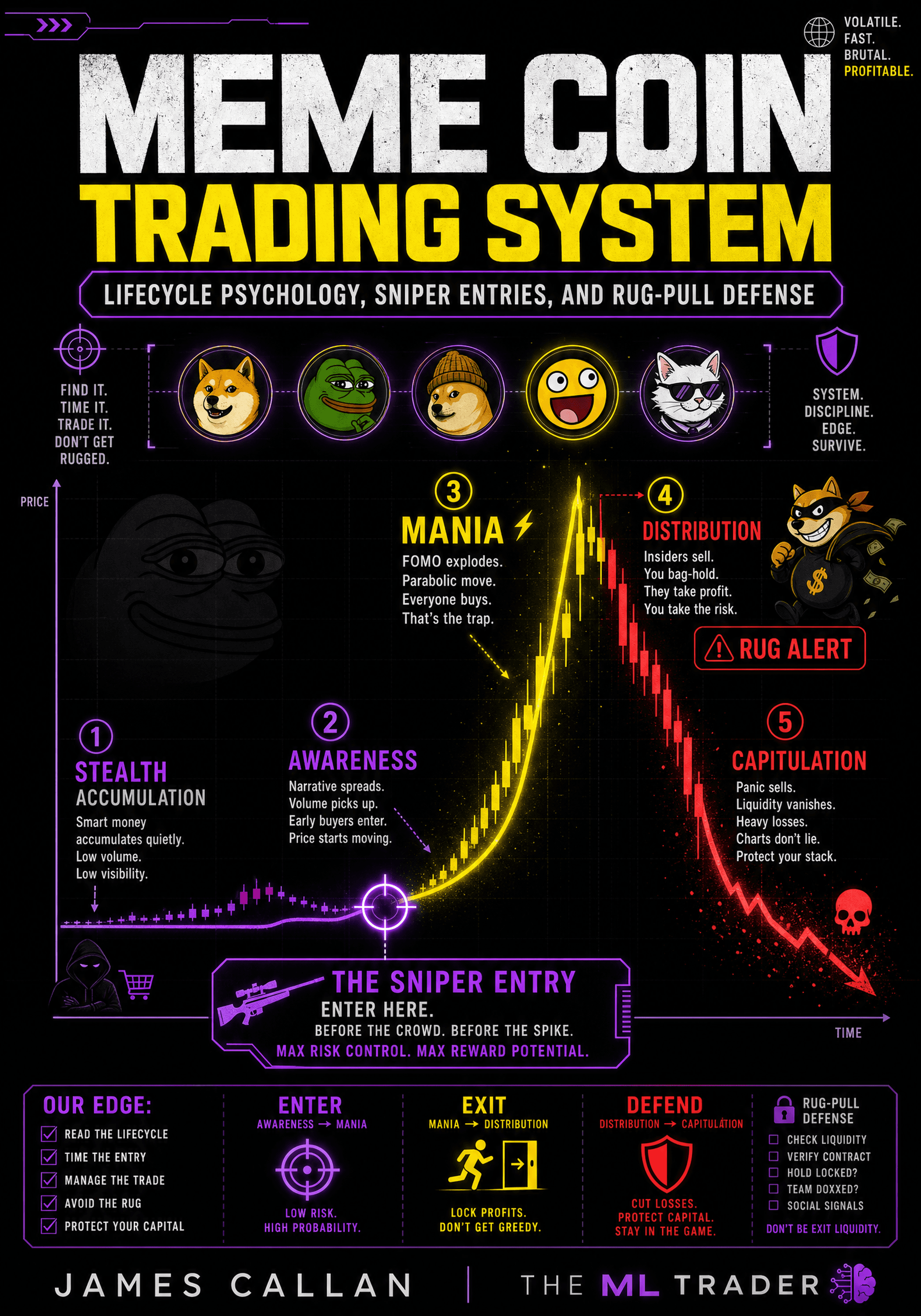
Meme Coin Trading System
Lifecycle Psychology, Sniper Entries, and Rug-Pull Defense
Read the first chapter in your browser. It's free, with no account and no email needed.
Free to read. No account required.
About this book
Meme coin markets are fast, noisy and full of fraud. Many people chase narratives with no safety process, while others stay away because it all looks like gambling. This book takes a third path, constrained speculation built on explicit rules and risk limits.
Meme Coin Trading System shows you how to assemble a workflow where launch monitoring, safety screening, sentiment analysis and disciplined entries and exits work together. You start with the meme lifecycle and the psychology that drives it, then study systematic entry and sniping, and exit liquidity and profit taking. A dedicated chapter covers Solana meme coin sniping, and another gives a deep dive into rug pull detection and safety.
Later chapters cover social sentiment and narrative trading, portfolio management for highly speculative positions, and more advanced strategies.
Look inside
A meme-trading infrastructure that monitors launches, scores token safety, tracks narrative momentum, and manages entries, exits, and portfolio exposure with explicit controls.
How to Use This Book
Meme coin markets are fast, noisy, and full of fraud. Most participants either chase narratives without any safety process or avoid the space entirely because it looks like pure gambling. Neither approach is useful. This book teaches you to build a systematic meme-trading workflow where launch monitoring, safety screening, sentiment analysis, and disciplined entry and exit logic work as one integrated system.
The emphasis throughout is on constrained speculation rather than hype chasing. Every entry filter, exit rule, and portfolio control is designed to keep you in the game during the inevitable periods when most tokens go to zero. If a position cannot survive your safety checks and sizing rules, it does not get taken.
Read linearly on the first pass. Later chapters depend on a precise understanding of lifecycle stages, safety review, entry logic, exit logic, and portfolio controls.
Who This Book Is For
- Crypto-native readers who already understand wallets, token contracts, and basic DEX workflows
- Traders who want a more defensible process for trading highly speculative meme markets
- Practitioners willing to prioritize safety and risk limits over upside narratives
Prerequisites
- Basic Python scripting
- Familiarity with wallets, DEX workflows, and token contracts
- Comfort with fast-moving social and on-chain data sources
- Willingness to prioritize safety and risk limits over upside narratives
Environment Setup
Use a Python environment with access to chain RPC endpoints, launch-monitoring feeds, social APIs or exports, and reproducible storage for watchlists, safety scores, sentiment histories, and execution logs.
- Chain Access — RPC endpoints (Solana, Ethereum, BSC)
- Data — pandas, numpy, web3.py, solana-py
- Social — Twitter/X API, Telegram scrapers, sentiment libraries
- Security — Contract verification, token safety scoring tools
- Automation — Alerting, scheduling, kill-switch infrastructure
Keep every alert, trade decision, and override traceable so the workflow can be reviewed after periods of market stress.
Chapter Roadmap
- 1. The Meme Lifecycle and Psychology — Lifecycle stages, attention dynamics, baseline fraud filters — Market-structure foundation before any trade logic
- 2. Systematic Entry and Sniping — Launch detection, entry filters, execution rules — Controlled entry workflow
- 3. Exit Liquidity and Profit Taking — Position reduction, rotation, exit before liquidity collapse — Disciplined exit system
- 4. Solana Meme Coin Sniper Mastery — Chain-specific speed, execution, operational assumptions — Solana-optimized meme execution
- 5. Rug Pull Detection and Safety Deep-Dive — Contract, distribution, and behavioral red flags — Repeatable safety-check system
- 6. Social Sentiment and Narrative Trading — Noisy social signals transformed into explicit inputs — Sentiment integration without false confidence
- 7. Meme Coin Portfolio Management — Position sizing, diversification, risk governance — Portfolio-level control across volatile positions
- 8. Advanced Meme Trading Strategies — Copying, ML screening, cross-chain comparison, MEV-aware execution — Integrated advanced strategy system
Reading Strategy
Work through the exercises because meme markets punish vague reasoning faster than most other trading domains. Chapters 1 through 3 define the market lifecycle, safety-first entry filters, and exit discipline. Chapters 4 through 6 deepen Solana execution, rug-pull analysis, and social-signal modeling. Chapters 7 and 8 turn those layers into portfolio management and advanced strategy integration under strict risk controls.
The Meme Lifecycle and Psychology
In February 2024, a trader spotted a new token on Pump.fun within ninety seconds of launch. The ticker referenced a trending meme on Crypto Twitter. The bonding curve was climbing. Social mentions were accelerating. He bought $2,000 worth inside the first five minutes. Within an hour, the token had a $4 million market cap, his position was worth $28,000, and the Telegram group had 1,200 members posting rocket emojis. Two hours later the developer wallet drained the liquidity pool. The token dropped 98%. His $28,000 was now $180, and even that was theoretical — the remaining liquidity was too thin to exit without losing most of the residual value.
The trader was not stupid. He was fast, technically literate, and paying attention. What he lacked was a framework. He could not distinguish between a token that was early in a real attention cycle and a token that was manufactured to look that way. He had no safety filter, no lifecycle model, and no rule for when trending attention is a signal versus when it is the product itself — a lure designed to attract exactly the kind of fast-moving buyer he was.
This chapter builds that framework. Before you write a single entry rule, before you build a sniper bot or connect to a social feed, you need a structural understanding of how meme markets work. Not how they should work, or how they are marketed, but how attention, liquidity, fraud, and crowd behavior actually interact in a market where most tokens go to zero and the ones that do not still follow a predictable arc from launch through hype through decay. The rest of this book will teach you to trade these markets with discipline and speed. This chapter teaches you what you are trading, and why most participants lose.
- Explain why meme markets are structurally different from traditional token markets and why standard valuation frameworks do not apply
- Classify a token into one of four lifecycle stages — launch, hype, rotation, decay — and describe what each stage implies for entry and exit timing
- Distinguish between social attention that confirms a tradable setup and social attention that functions as a trap
- Run a baseline safety screen on a candidate token covering contract permissions, liquidity structure, and holder distribution
- Design a first-pass meme-trading dashboard that combines lifecycle state, safety score, and social signal before any capital is committed
Attention, Identity, and Reflexivity in Meme Trading
Most token markets have at least a nominal connection to some underlying value proposition. A DeFi protocol generates fees. A Layer-2 chain processes transactions. The token price may not track that value closely, but the value proposition exists as an anchor, something that analysts can model and that constrains how far price can diverge from reality before participants recalibrate.
Meme tokens have no such anchor. There is no revenue, no protocol, no product roadmap that constrains price. The entire value proposition is attention. When enough people pay attention to a token, its price rises. When attention leaves, the price falls. This is not a bug in meme markets — it is the design. The token is a coordination mechanism for speculative attention, and understanding that mechanism is the first prerequisite for trading it.
Why attention creates temporary liquidity
When a meme token begins to trend — on Twitter, Telegram, or a launch platform leaderboard — a cascade of events follows. New buyers arrive. Liquidity deepens as the bonding curve or pool absorbs inflows. The rising price attracts more attention, which attracts more buyers, which produces more price movement. This is a reflexive loop: price drives attention, and attention drives price. The loop is self-reinforcing on the way up and self-reinforcing on the way down.
The key insight is that this liquidity is temporary. It exists only while the attention loop is active. The moment attention shifts to a newer, more exciting token — or the moment insiders begin selling — the loop reverses. Buyers disappear. Sellers cannot exit. Liquidity evaporates. A token that had $500,000 in pool liquidity during peak hype may have $8,000 two hours later.
This means that any trading strategy for meme tokens must treat liquidity as a function of attention state, not as a static property. A token is not "liquid" or "illiquid" in absolute terms. It is liquid while attention is active and illiquid when attention decays. Your ability to exit depends on timing, not on the pool size you observed at entry.
Quotes to share
Meme coin markets are fast, noisy and full of fraud.
Free to read. No account required.