Free first chapter
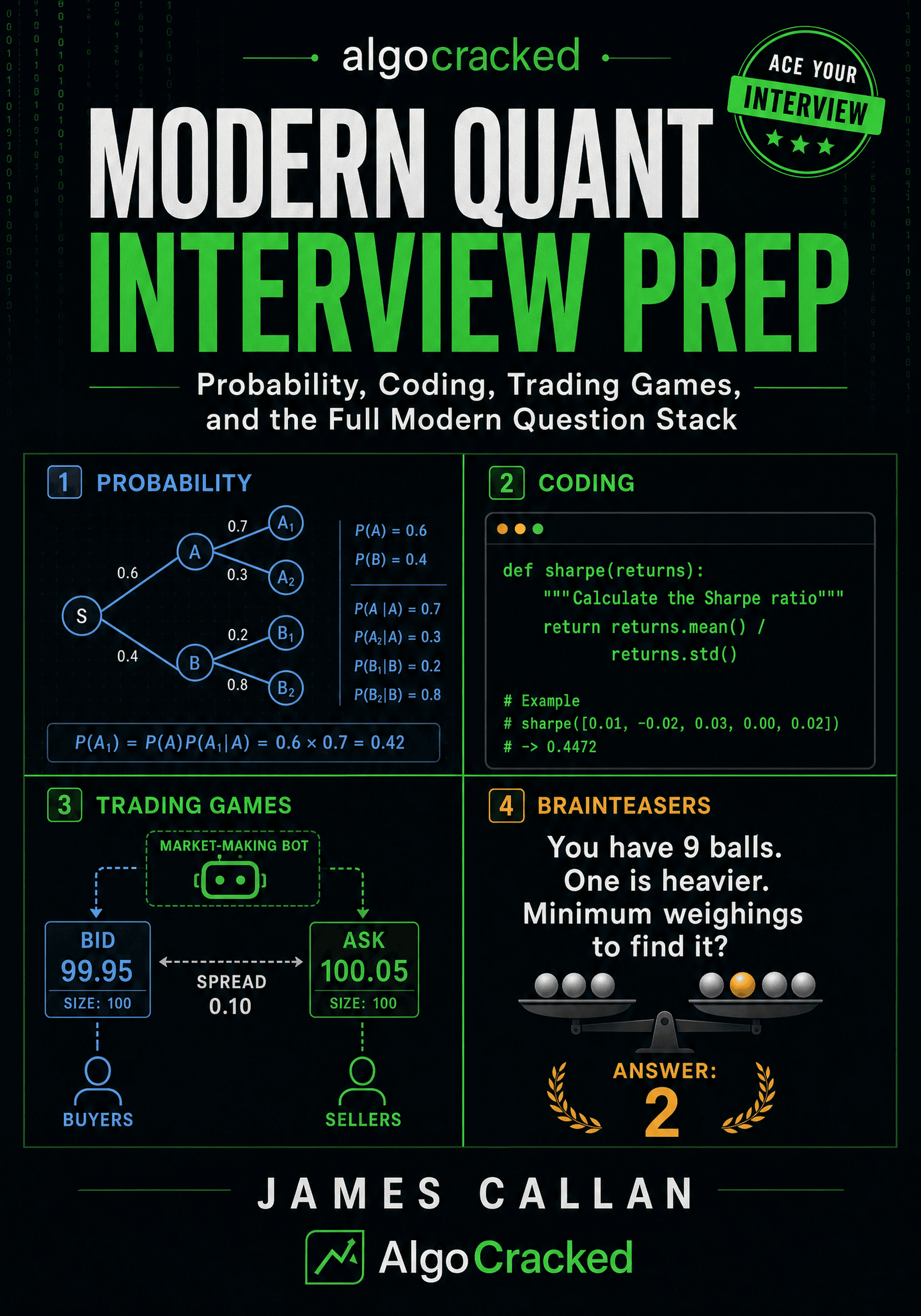
Modern Quant Interview Prep
Probability, Coding, Trading Games, and the Full Modern Question Stack
Read the first chapter in your browser. It's free, with no account and no email needed.
Free to read. No account required.
About this book
You can do the maths and write the Python, but a quant interview is a different test. Questions come fast, the interviewer wants your reasoning out loud, and strong raw knowledge can still crack under pressure. This book is built to convert what you know into interview-grade speed, precision and judgment.
Modern Quant Interview Prep covers the full modern question stack for trader, researcher and developer tracks. You start with how quant interviews actually work, then move through probability foundations, expected value and variance, and the puzzles and brainteasers that interviewers favor. Further chapters cover Python for interviews, mental math, market making and trading games, statistics, stochastic processes, game theory, machine learning fundamentals and stochastic calculus essentials.
Look inside
This book is a structured preparation system for modern quantitative finance interviews across trader, researcher, and developer tracks. It is designed to sharpen probability, coding, trading games, mental math, statistics, stochastic processes, machine learning fundamentals, and interview communication under real interview pressure.
Who This Book Is For
You are targeting quantitative trading firms, prop shops, or hedge funds and already have solid foundations in mathematics and Python. The goal here is not introductory teaching. The goal is to convert strong raw knowledge into interview-grade speed, precision, and judgment.
How This Book Is Organized
The opening material defines the scope, prerequisites, notation, and role-specific reading paths. The core chapters then move from probability and expected value into puzzles, coding, statistics, market making, stochastic processes, machine learning, and stochastic calculus. The final sections cover interview execution, role targeting, firm-specific preparation, and post-readiness planning.
How to Use This Book
Read the front matter carefully, then follow the track most relevant to your target role. Use the chapter dependency map and reading paths to focus your effort, but do not skip the interview-execution and firm-targeting chapters at the end. Those sections turn technical preparation into actual interview performance.
How to Use This Book
What This Book Covers
This book is a structured preparation system for quantitative finance interviews at top prop-trading firms and quantitative hedge funds. It covers probability, Python coding, brainteasers, mental math, market making, statistics, machine learning fundamentals, game theory, stochastic processes, and interview communication technique.
It is not a gentle introduction to any of these subjects. It assumes you have strong but potentially rusty foundations in probability, calculus, linear algebra, and Python programming. If those foundations are in place, this book will sharpen them to interview intensity and fill the gaps that legacy prep resources miss.
The Three Role Tracks
Quant interviews differ by role. This book organizes material around three tracks:
- Trader track. Emphasis on speed, mental math, market making, probability puzzles, and quick expected value reasoning under pressure.
- Researcher track. Emphasis on statistics, machine learning, stochastic processes, deeper mathematical reasoning, and the ability to discuss modeling decisions.
- Developer track. Emphasis on Python coding depth, systems thinking, simulation, and enough quantitative fluency to collaborate with traders and researchers.
Every chapter is tagged by relevance to each track. Some chapters are essential for all three tracks. Others are essential for one track and supplementary or skippable for the others.
Role-Specific Reading Paths
Trader Reading Path
The trader path prioritizes speed, probabilistic reasoning, and market intuition.
- Essential — Ch 1, 2, 3, 4, 6, 7, 10, 13, 14, 15 — Probability, expected value, puzzles, mental math, market making, game theory, interview technique, role and firm guides
- Supplementary — Ch 5, 8 — Python simulation (useful for verification), statistics (surface level)
- Skip — Ch 9, 11, 12 — Stochastic processes, ML fundamentals, stochastic calculus
Start with Chapters 1-4 in order, then work Chapter 6 (mental math) in parallel with Chapter 7 (market making). Finish with Chapter 10 (game theory), then Chapters 13-15.
Researcher Reading Path
The researcher path prioritizes mathematical depth, statistical reasoning, and modeling fluency.
- Essential — Ch 1, 2, 3, 4, 5, 8, 9, 11, 12, 13, 14, 15 — Full probability sequence, Python, statistics, stochastic processes, ML, stochastic calculus, interview technique, role and firm guides
- Supplementary — Ch 6, 7, 10 — Mental math (some firms test it), market making (useful context), game theory (useful context)
- Skip — None — Researchers benefit from breadth across the full stack
Work Chapters 1-5 in order, then Chapters 8-9, then Chapters 11-12. Chapter 6 can be worked in parallel at any point. Finish with Chapters 13-15.
Developer Reading Path
The developer path prioritizes coding fluency, simulation skill, and quantitative literacy.
- Essential — Ch 1, 2, 3, 5, 8, 13, 14, 15 — Probability, expected value, Python coding, statistics, interview technique, role and firm guides
- Supplementary — Ch 4, 6, 7, 9, 10, 11 — Puzzles, mental math, market making, stochastic processes, game theory, ML (all useful but not the core of developer interviews)
- Skip — Ch 12 — Stochastic calculus (researcher-track material)
Start with Chapters 1-3, then Chapter 5 (Python), then Chapter 8 (statistics). Add supplementary chapters based on your target firm's known emphases. Finish with Chapters 13-15.
Prerequisite Checklist
Before starting this book, confirm that each item below is solidly in place. If you find gaps, address them first. The book does not teach these from scratch.
Free to read. No account required.