Free first chapter
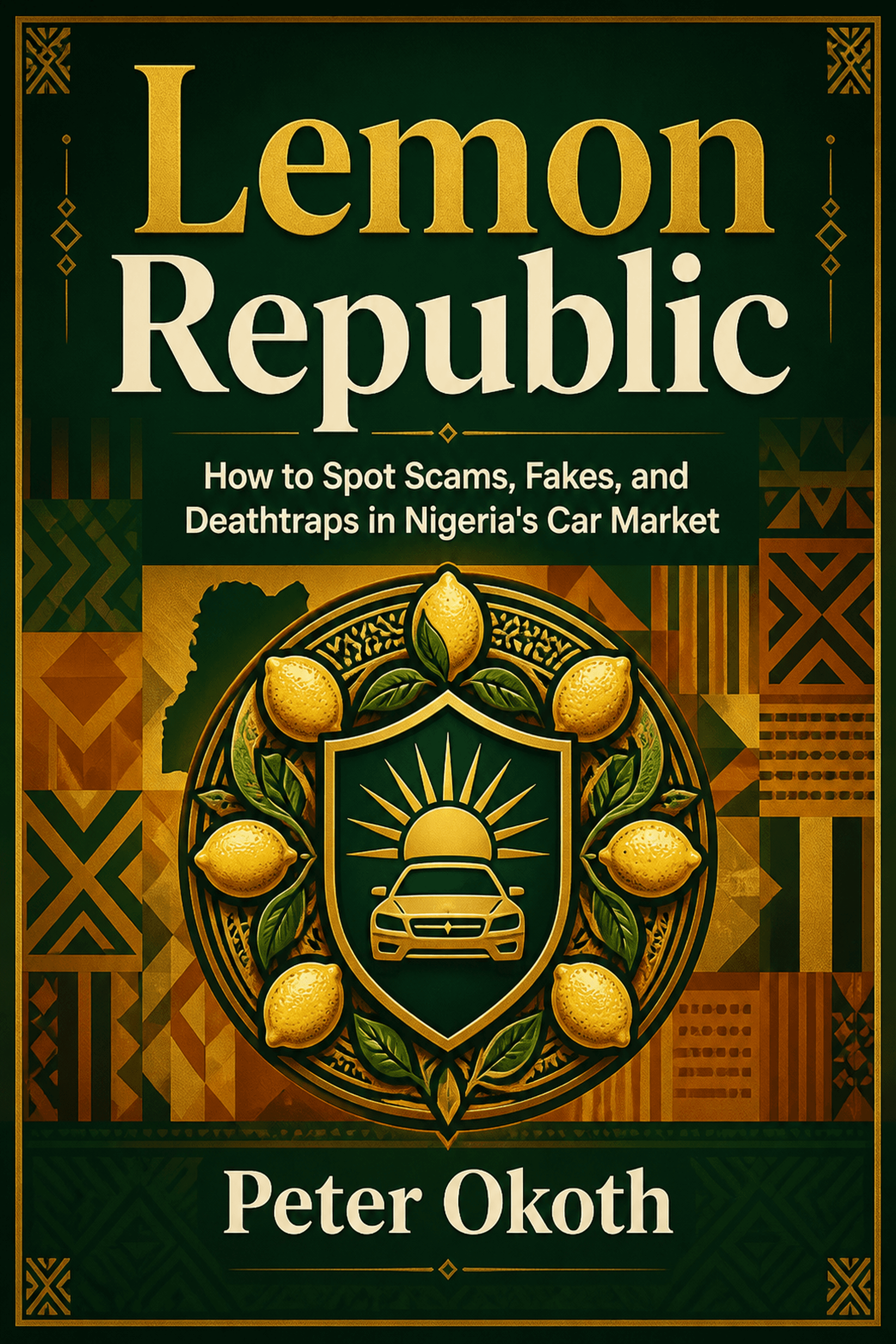
Lemon Republic
How to Spot Scams, Fakes, and Deathtraps in Nigeria's Car Market
Read the first chapter in your browser. It's free, with no account and no email needed.
Free to read. No account required.
About this book
You are about to spend a serious amount of money on a used car in Nigeria. The pictures look clean and the seller swears it is a proper tokunbo. But some of these cars have hidden histories: flood damage covered over, odometers rolled back, or a VIN that belongs to a different vehicle.
Lemon Republic is both an exposé and a protection manual for Nigeria's car market. It names the scams and shows how each one works, then teaches you how to detect them. You will learn how odometer fraud operates, how accident rebuilds and salvage titles enter the market, how flood damage is hidden, and how VIN cloning and stolen cars are disguised.
The book follows the salvage pipeline, exposes dealer tricks and yard games, and walks you through a forensic inspection you can do before paying. It also explains what to do if you have been conned and gives you a master list of red flags to check every time.
Look inside
Preface
Nigeria imports over 400,000 used vehicles every year. Nobody knows exactly how many of them are rolling disasters.
The car that was declared a total loss in Houston after a flood – cosmetically restored, shipped to Lagos, and sold as "clean tokunbo." The Lexus RX 350 with a VIN that belongs to a different car entirely. The Honda Accord whose odometer was rolled back by 120,000 kilometres before it reached the lot at Berger.
These are not rare events. They are the market.
This book is an expose and a protection manual. We name the scams. We show you exactly how they work – who does them, where, and how much they profit. Then we teach you how to detect every single one before you hand over your money.
Who This Book Is For
- Anyone about to spend N5 million or more on a vehicle in Nigeria
- Buyers who have been conned before and want to understand what happened
- Mechanics and inspectors looking for a systematic fraud detection framework
- Anyone who has ever looked at a too-good-to-be-true car deal and wondered what the catch was
What You Will Walk Away With
By the last page, you will know how odometer fraud works and how to detect it, how accident rebuilds enter the Nigerian market and how to spot them, how VIN cloning works and how to verify a VIN, how flood damage is hidden and how to find it, and what to do – legally and practically – when you discover you have been conned.
Don't fall again. This time, you will know.
The Scale of the Problem
Kola paid N12 million for a 2017 Lexus RX 350 at a well-known lot on Berger. The car looked immaculate – gleaming silver paint, pristine leather interior, crisp dashboard with 52,000 km on the clock. The dealer said it was a "direct Belgium" – meaning imported from Europe, not from American salvage. "No accident, no flood, very clean."
Kola's mechanic checked the engine, tested the electrics, and gave the thumbs up. Kola drove away satisfied.
Eight months later, during the rainy season, Kola noticed a musty smell that would not go away no matter how much air freshener he used. Water started collecting under the passenger floor mat after heavy rain. His mechanic traced the leak and found something disturbing: inside the door panels, behind the dashboard, and under the seats, there were telltale signs of previous water damage – corroded wire connectors, silt deposits in the seat rail channels, and a faint waterline stain inside the trunk compartment.
Kola ran the VIN through Carfax. The result: the car had been declared a total loss by an American insurance company in Houston, Texas, after Hurricane Harvey in 2017. It was purchased at a Copart auction for USD 3,800, shipped to Lagos, cosmetically restored, and sold as a clean European import.
The car Kola paid N12 million for was worth about N4 million. He lost N8 million.
And Kola is not unusual. He is the market.
What You Will Learn
- Estimate how many scam vehicles are operating on Nigerian roads
- Explain the economics that make vehicle fraud profitable
- Identify the five major fraud categories in Nigeria's car market
- Understand why the system does not protect buyers – and what that means for you
Why This Matters
Nigeria imports an estimated 400,000 to 500,000 used vehicles annually. Nobody publishes exact numbers, but industry sources and port data suggest this range.
Of those vehicles:
- An estimated 30-40% come from US salvage auctions (Copart, IAAI) – meaning they were declared total losses by American insurance companies
- An unknown but significant percentage have had their odometers rolled back before sale
- VIN cloning – copying a legitimate vehicle's identification number onto a stolen or illegally imported car – is endemic in the market
- Fake customs documentation circulates freely, especially for vehicles entering through Cotonou
There is no national database that tracks vehicle histories across imports. There is no mandatory disclosure of salvage status. There is no government-backed buyer protection scheme. The Standards Organisation of Nigeria (SON) conducts pre-shipment inspection, but this verifies that the vehicle meets minimum standards – not that it has a clean history.
The result: Nigeria's car market operates on information asymmetry. The seller knows the car's history. The buyer does not. And the gap between what the seller knows and what the buyer pays is measured in millions of Naira.
The Five Fraud Categories
Every vehicle scam in Nigeria falls into one of five categories:
1. Odometer Fraud
What it is: Reducing the displayed mileage on a vehicle's odometer to make it appear less used.
Scale: Estimated to affect 40-60% of used vehicles sold in Nigeria. Almost every car that passes through a tokunbo yard has the potential for odometer manipulation.
How it works: For older analog odometers, physical cable disconnection or roller manipulation. For modern digital odometers, software tools that reprogram the instrument cluster. These tools cost N50,000-150,000 and are widely available. "Odometer correction" is openly advertised by auto electricians in Lagos.
Profit: A car with 50,000 km on the clock sells for N1-3 million more than the same car with 150,000 km. The cost of the rollback: N50,000-100,000. The profit margin makes this scam irresistible.
Chapter 2 covers detection in detail.
2. Accident Rebuilds and Salvage Concealment
What it is: Vehicles that were involved in serious collisions, declared total losses, purchased at salvage auctions, structurally repaired, cosmetically restored, and sold as clean imports.
Scale: An estimated 30-40% of US-origin vehicles in Nigeria came through salvage auctions. Not all are dangerous – some are professionally repaired. But many have compromised structural integrity, hidden frame damage, and safety systems (airbags, crumple zones) that cannot function as designed.
How it works: A 2017 Toyota Highlander is totaled in a rear-end collision in Texas. The insurance company pays out the owner and sells the wreck to Copart for USD 2,000. A Nigerian buyer purchases it at auction for USD 4,500. The car is shipped to Lagos. A body shop in Mushin does the bodywork – new panels, new paint, new bumper. Total restoration cost: N800,000-1,500,000. The car is then sold at Berger for N14-16 million as "clean tokunbo, no accident."
Profit: The total investment (purchase + shipping + restoration + duty) might be N8-9 million. The selling price: N14-16 million. Profit: N5-7 million per vehicle.
Chapter 3 covers detection.
3. Flood Damage Concealment
What it is: Vehicles that were submerged in flood water (hurricanes, flash floods), declared total losses, and then cleaned, dried, and resold.
Scale: After every major US hurricane season, thousands of flood-damaged vehicles flow into the West African market. Hurricane Harvey (2017), Hurricane Ian (2022), and subsequent events each sent an estimated 50,000+ vehicles to salvage auctions, many of which ended up in Nigeria.
Why it is dangerous: Water destroys electrical systems from the inside. Corrosion progresses for months and years after the initial flood. A flood car that looks fine today may have cascading electrical failures, mould growth, and rust-through within 12-24 months.
Chapter 4 covers detection.
4. VIN Cloning and Stolen Vehicles
What it is: Copying the Vehicle Identification Number (VIN) from a legally registered vehicle onto a stolen or illegally imported car. The cloned vehicle then appears legitimate in any standard check.
Scale: Nigeria-specific and significant. VIN cloning is used for two purposes: laundering stolen vehicles and creating documentation for vehicles that were smuggled into the country without paying duty.
Quotes to share
The pictures look clean and the seller swears it is a proper tokunbo.
Free to read. No account required.