Free first chapter
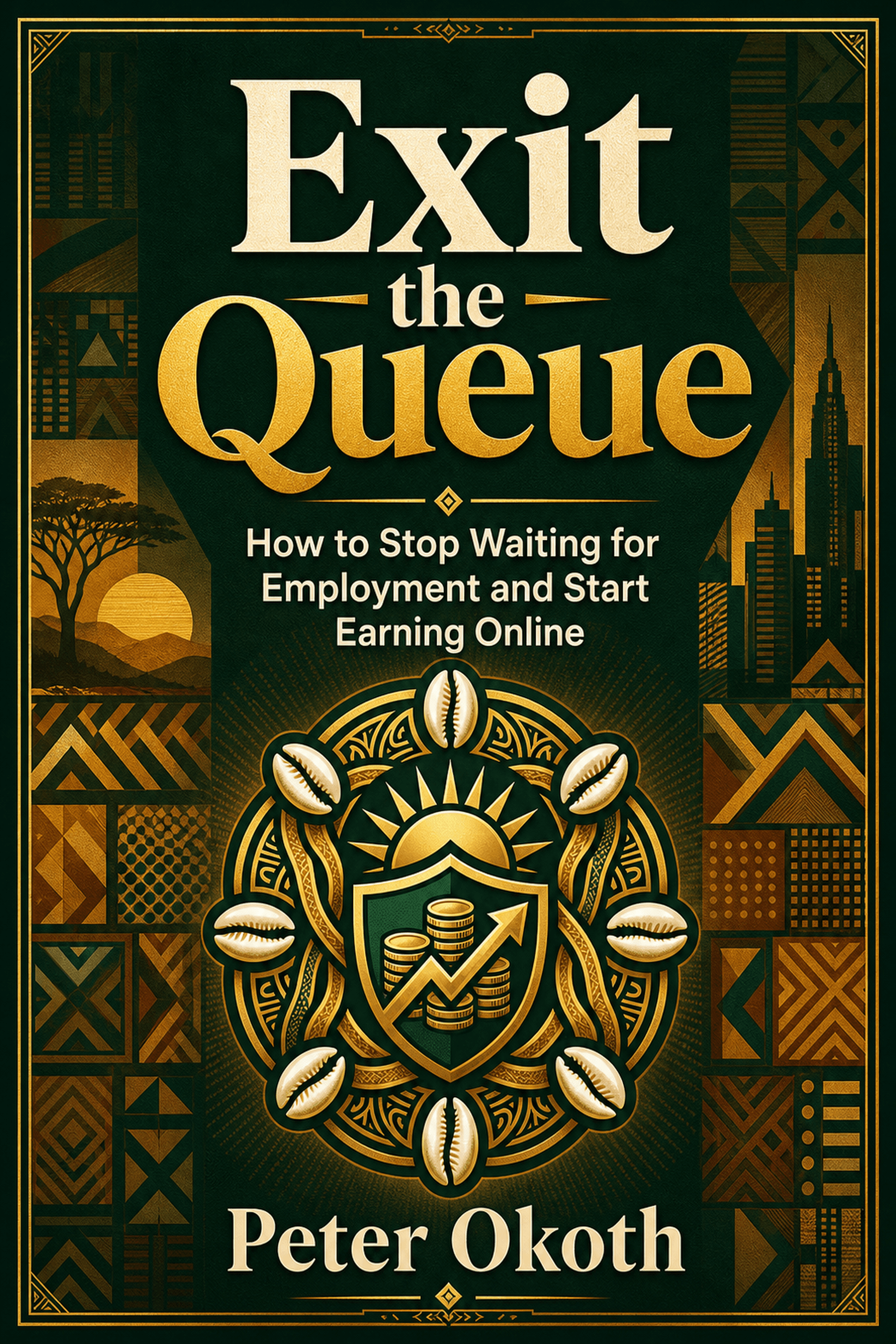
Exit the Queue
How to Stop Waiting for Employment and Start Earning Online
Read the first chapter in your browser. It's free, with no account and no email needed.
Free to read. No account required.
About this book
You have applied, interviewed and waited, and the job you are waiting for still has not come. This book argues that the employment queue in Nigeria has stopped moving, and shows you how to build income online while you decide whether to stay in it.
It opens by counting the real cost of waiting in time, money and mental health, then maps the legitimate ways to earn online, ranked by startup cost and how quickly you might see a first payment. You then follow practical steps toward your first ten thousand naira, a 30-day plan for building a skill, and a playbook for profiles and proposals on Upwork, Fiverr and Selar. Further chapters cover getting paid through Payoneer, Wise and bank transfers, spotting scams aimed at job seekers, and deciding when side income can become main income.
It closes with a personal 12-month exit plan to fill in. Results depend on your effort and circumstances.
Look inside
Preface
The queue is not a line. It is a trap.
You have been standing in it since graduation – or maybe since NYSC ended, or since the last ASUU strike killed your academic calendar for the third time. The queue for government jobs. The queue for oil company interviews. The queue for any position that pays enough to cover rent in Lagos or Abuja.
The queue does not move. It has not moved in years. New graduates join behind you. Experienced candidates push in front. And the exit – formal employment – gets narrower every year.
This book is about leaving the queue. Not leaving Nigeria. Leaving the queue.
Who This Book Is For
- Graduates who have been applying for jobs for months or years without success
- Employed Nigerians stuck in jobs that pay N60,000-N120,000/month – not enough to live, too much to quit
- NYSC members who want to build income before service ends
- Anyone who is tired of waiting and ready to start building
What You Will Walk Away With
By the last page, you will understand why the employment queue is structurally broken, what the real alternatives look like, how to build your first online income stream, and how to scale from survival money to serious income. You will have a concrete exit plan – not motivation, not theory, but steps you can execute this week.
The queue is optional. Let us exit.
The Queue Is a Choice
Tolu graduated from Obafemi Awolowo University in 2021 with a degree in Accounting. What should have taken four years took six – two ASUU strikes added sixteen months to her calendar. She finished NYSC in 2023. She started applying.
By March 2024, she had sent 340 applications. Eight interviews. Zero offers.
Her father, a retired civil servant in Osogbo, still believes in the queue. "Just keep applying. Something will come." Her mother supplements this with prayers and fasting. Her younger brother – a 22-year-old who did not go to university – sells phone accessories on Instagram and earns N150,000/month.
Tolu has a degree. Her brother has a phone and a hustle. Her brother earns more.
This is not a story about education failing. It is a story about the queue failing. And Tolu staying in the queue is now a choice – not a requirement.
Here is what changes when you see it that way.
What You Will Learn
- Explain why the Nigerian employment queue is structurally broken – not temporarily slow
- Calculate the real cost of staying in the queue (time, money, mental health)
- Identify the moment when "waiting for a job" becomes a worse strategy than "building income"
- Reframe the decision: the queue is not your only option
Why This Matters
There is a difference between a slow queue and a broken one. A slow queue eventually moves – you just need patience. A broken queue does not move. It creates the illusion of progress (you submit more applications, you attend more interviews, you update your CV) while delivering none.
Nigeria's employment queue is broken. Here is the evidence:
The math: Over 500,000 graduates per year. Approximately 100,000-150,000 formal sector jobs created annually. Even if every new job went to a fresh graduate, at least 350,000 per year are left behind. The deficit compounds year after year.
The hidden cost of waiting: Every month you spend in the queue, you are spending money (data for applications, transport to interviews, printing CVs), losing potential income (the N100,000-N300,000/month you could be earning online), and paying a psychological toll (rejection, family pressure, self-doubt).
The opportunity cost over 12 months:
- Data and internet for job applications — N60,000
- Transport to interviews (Lagos) — N80,000
- CV printing and professional photos — N15,000
- Application fees and tests — N30,000
- Income NOT earned (if you were earning N100K/month online) — N1,200,000
- Total cost of staying in the queue for 1 year — N1,385,000
That is N1.4 million in direct costs and lost income – spent on a queue that has a success rate of less than 5%.
The Queue vs. The Build
- Who controls the outcome? — The employer — You
- Time to first income — Unknown (months to years) — 2-8 weeks
- Income ceiling — Set by employer — Set by your skills and effort
- What happens if it does not work? — Start over with another application — Adjust, pivot, try a different approach
- Skills gained while waiting — CV formatting — Marketable, sellable skills
- Psychological effect — Rejection, helplessness — Agency, momentum
This is not an argument against employment. If a good job appears, take it. But waiting for a job is not a strategy. Building income while waiting – that is a strategy. And many people who start building discover they no longer need the queue at all.
When to Exit
The queue makes sense when:
- You have a specific, high-probability opportunity (a referral, an interview at a company where you know someone on the inside)
- The job you want requires specific institutional credentials (medical doctor, lawyer, pilot)
- You are genuinely happy waiting and financially supported
The queue stops making sense when:
- You have been applying for more than 6 months with no credible leads
- The jobs you qualify for pay less than what you could earn online
- The waiting is costing you money, time, and mental health
- You have marketable skills (writing, design, organization, teaching) that someone would pay for
"But What About Job Security?"
"A job gives you security. Online income doesn't."
Let us talk about "security." The average Nigerian private sector job can be terminated with 30 days' notice – or less. Companies restructure. Contracts end. The Naira devalues and your salary stays the same. That N120,000/month banking job is now worth 40% less in purchasing power than it was two years ago.
An online income stream you control – with multiple clients, growing skills, and increasing rates – provides more security than a single employer who can fire you next Friday.
Your Checklist
- ☐ — I understand that the employment queue is structurally broken
- ☐ — I have calculated the cost of staying in the queue for another year
- ☐ — I can see the difference between "queue" and "build" strategies
- ☐ — I have honest clarity on whether the queue still makes sense for me
Your Move
- Calculate your personal queue cost – add up everything you have spent on job-seeking in the last 6 months (data, transport, printing, fees). Then add the income you could have earned online. Write down the total.
- Set a queue deadline. If you want to keep applying for jobs, give yourself a specific end date. "I will apply for 90 more days. If nothing credible materializes, I commit fully to building online income." Write the date down.
- Start the build NOW – even while you are still in the queue. The two strategies are not mutually exclusive. Build income in the hours you are not applying for jobs.
What is Next
The queue is a choice. But the myths that keep people in it are not obvious. The next chapter dismantles the three lies you have been told about employment – "just get a degree," "apply harder," and "know the right people" – and shows you what actually determines who earns in Nigeria's economy.
The Employment Lie Nobody Corrects
Uche's father sold two plots of land in Umuahia to send Uche to a private university in Lagos. "Education is the best investment," his father said at every family meeting. "Get the degree. The job will follow."
Free to read. No account required.