Free first chapter
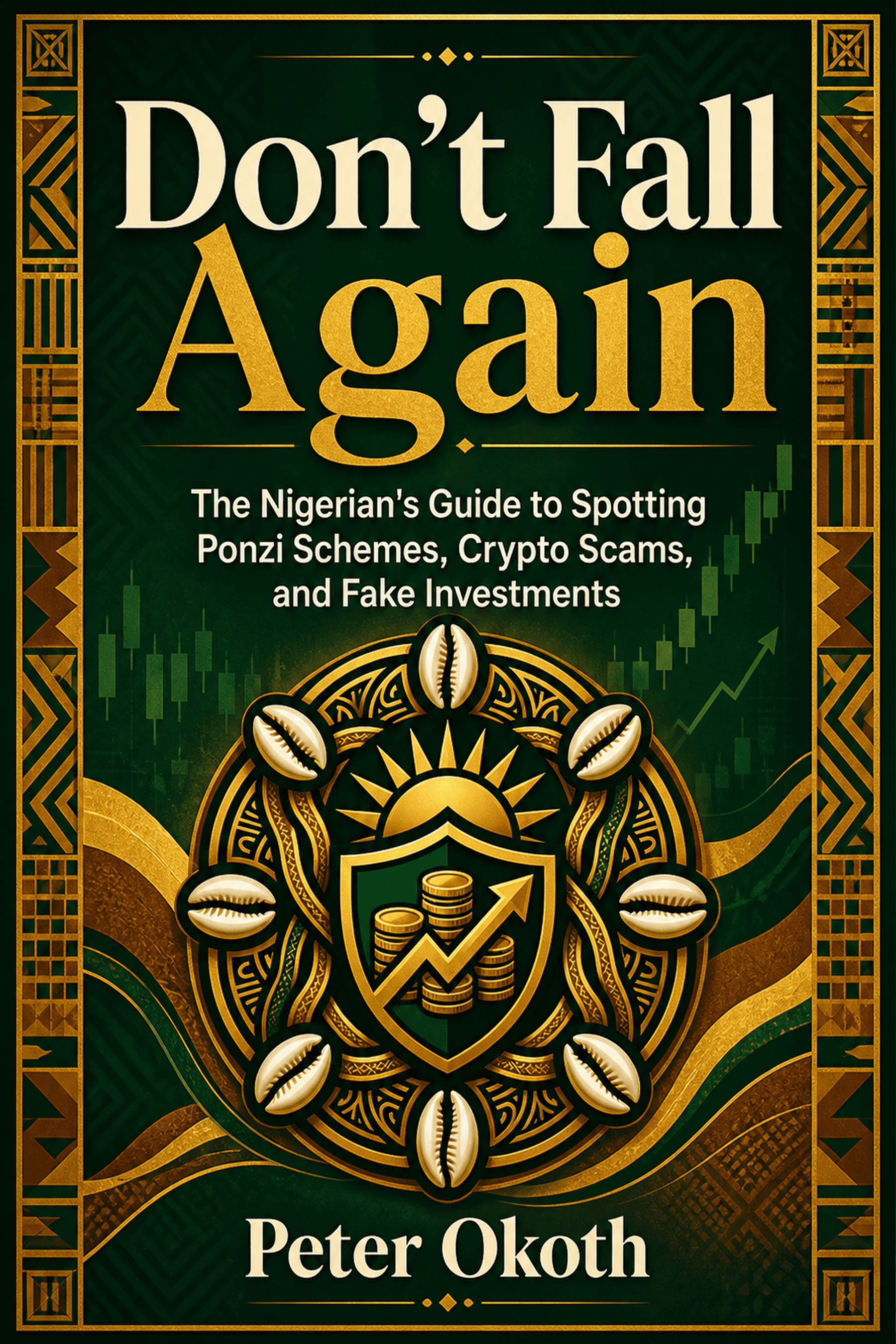
Don't Fall Again
The Nigerian's Guide to Spotting Ponzi Schemes, Crypto Scams, and Fake Investments
Read the first chapter in your browser. It's free, with no account and no email needed.
Free to read. No account required.
About this book
The pattern is always the same. A platform appears, pays early investors with money from later ones, spreads through WhatsApp groups, churches and offices, then freezes withdrawals and disappears. Afterwards comes the phrase many Nigerians know too well: I don fall again.
This book is a shield. It explains why people keep falling, then takes apart the anatomy of a Ponzi scheme so you can see the mechanics, the psychology and the red flags. You look at the crypto scam pipeline and at fake forex and investment platforms, with the tricks they use to look legitimate.
At the centre is a verification system: a way to check any investment claim using free, public tools before you hand over a naira. For readers who have already lost money, there is a chapter on what you can realistically do next. The final chapter looks at where to put your money instead, so that one bad experience does not keep you from ever investing again.
Look inside
Preface
In 2025, CBEX collapsed and took an estimated ₦1.3 trillion from Nigerian investors. Before that, it was MBA Forex. Before that, Racksterli. Before that, MMM — which in 2016 alone consumed an estimated ₦18 billion from Nigerians who believed 30% monthly returns were real.
The pattern is always the same. A platform appears. It pays early investors — with money from later investors. Word spreads through WhatsApp groups, church gatherings, office gossip. Returns seem real because they are real — for a while. Skeptics are mocked. Then the platform freezes withdrawals. Then it disappears. Then the crying starts.
"I don fall again."
That phrase — "I have fallen again" — carries the weight of generational financial trauma. It is not just money lost. It is trust destroyed. It is the reason some Nigerians refuse to invest in anything, keeping their money under the mattress or in a savings account earning less than inflation. The scammers have not just stolen money — they have stolen an entire generation's willingness to invest.
This book is a shield. It teaches you how every scam works — the mechanics, the psychology, the red flags — so you can spot the next one before it spots you. It teaches you how to verify any investment claim in under 30 minutes using free, public tools. And for those who have already fallen, it tells you what you can actually do.
Who This Book Is For
- Anyone who has been approached with an investment opportunity that sounds too good to be true
- Anyone who has lost money to a Ponzi, crypto scam, or fake investment platform
- Parents whose children are being recruited into schemes on social media
- Anyone afraid to invest because they cannot tell the difference between legitimate and fraudulent
- Church members, ajo/esusu groups, and communities targeted by "investment" recruiters
What You Will Walk Away With
By the last page, you will know exactly how Ponzi schemes work and why they always collapse, how to identify crypto scams from legitimate platforms, how to verify any investment opportunity using SEC Nigeria and CBN databases, what to do if you have already lost money, and where you can actually invest your money safely. Every red flag in this book comes from real Nigerian scams that real Nigerians fell for.
Shine your eye. This time, you will know better.
Why Nigerians Keep Falling
Amaka is a branch manager at a commercial bank in Asaba. She has a degree in accounting. She processes loan applications daily. She knows what a balance sheet looks like. She understands compound interest. By every measure, she is financially literate.
In August 2024, her pastor — a man she had known for eleven years, who had prayed with her family, who had counseled her through her divorce — mentioned CBEX from the pulpit. Not as an endorsement, he said. Just as "a testimony." Brother Uchenna, an elder in the church, shared how his ₦500,000 had grown to ₦1.2 million in four months. Sister Ngozi confirmed it — she had withdrawn twice, real money in her account.
Amaka's three closest colleagues at the bank had already invested. One showed her his dashboard: ₦3.8 million, growing daily. The WhatsApp group had 2,000 members. Payment screenshots flowed every morning — so many that the group had a "no duplicate screenshot" rule.
Amaka invested ₦2.5 million. She did not check SEC Nigeria's register. She did not Google "CBEX scam." She did not apply any of the tools she uses daily at the bank. She did not need to — her pastor, her elder, her colleagues, and 2,000 WhatsApp members had already verified it for her.
CBEX froze withdrawals in February 2025. Amaka's ₦2.5 million was gone. The pastor was also a victim — he had invested ₦4 million of the church building fund. Brother Uchenna's early withdrawals were real — paid with money from later investors like Amaka. The screenshots were real too. They just were not proof of what everyone thought they proved.
Here is what this chapter will teach you: why smart people like Amaka fall, not because they are stupid, but because these scams are engineered to exploit the very things that make us human.
What You Will Learn
- Identify the economic, psychological, and social factors that make Nigerians vulnerable to scams
- Explain why educated, financially literate people fall for obvious-seeming schemes
- Recognize how scammers exploit trust networks — churches, families, workplaces, WhatsApp groups
- Understand the role of economic desperation in overriding rational judgment
- Approach yourself and others with compassion rather than blame
Why This Matters
Between 2016 and 2025, Nigerians lost an estimated ₦3-5 trillion to Ponzi schemes, crypto scams, fake forex platforms, and fraudulent investment clubs. That is not money lost by the foolish or the uneducated. MMM's victim list included lawyers, doctors, engineers, and bankers. CBEX attracted accountants, civil servants, and small business owners. MBA Forex's victims included military officers and government contractors.
If scams only caught stupid people, they would not be a ₦3 trillion problem. They catch smart people. They catch careful people. They catch people who know better — or should know better.
Understanding why requires looking beyond individual decisions and into the systems that make those decisions feel rational.
The Economic Pressure Cooker
The Reality
Nigeria's economic conditions create the perfect environment for scam proliferation. This is not an excuse — it is context.
How It Actually Works
The math that drives desperation:
- Inflation: 28%+ — Your savings lose a quarter of their value every year
- Savings account interest: 2-4% — The "safe" option guarantees losses
- Treasury bill yield: 18-22% — Still below inflation — you lose less, but you still lose
- Naira devaluation: 70%+ since 2023 — Dollar-linked expenses (school fees, rent, fuel) have tripled
- Average salary increase: 10-15% — Your income grows at half the rate of your expenses
When the legitimate financial system cannot protect your purchasing power, the promise of 30% monthly returns does not sound crazy. It sounds like the only way to keep up.
"If bank dey give me 2% and inflation dey chop 28%, wetin I go do? Person no go try find where money dey grow?"
That reasoning is not irrational. It is desperate. And desperation is the first ingredient in every scam.
This Is Not an Excuse — It Is an Explanation
Understanding why people fall is not the same as saying they should have fallen. The goal of this chapter is awareness: if you recognize the pressure driving your investment decisions, you can pause before it drives you into a trap. The verification system in Chapter 5 works regardless of how desperate you feel — but only if you use it.
The Comparison That Kills
Scammers know exactly which comparison to draw. They do not say "invest in our Ponzi scheme." They say:
"Your money in the bank is losing value. We offer 5% weekly returns. That is better than any bank, any fund, any T-bill. The question is not whether you can afford to invest — it is whether you can afford not to."
This pitch works because the first part is true. Your money in the bank IS losing value. The second part — "we offer 5% weekly" — is the lie. But it is sandwiched between truths, which makes it feel true.
The Psychology of the Fall
The Reality
Human brains are not designed to evaluate investment opportunities. They are designed to take shortcuts — mental shortcuts that served our ancestors well but that scammers exploit ruthlessly.
How It Actually Works
Shortcut 1: Social Proof
If 2,000 people in a WhatsApp group are investing, it must be legitimate. If your pastor endorses it, it must be safe. If your colleague is showing you real withdrawals, it must work.
Free to read. No account required.