Free first chapter
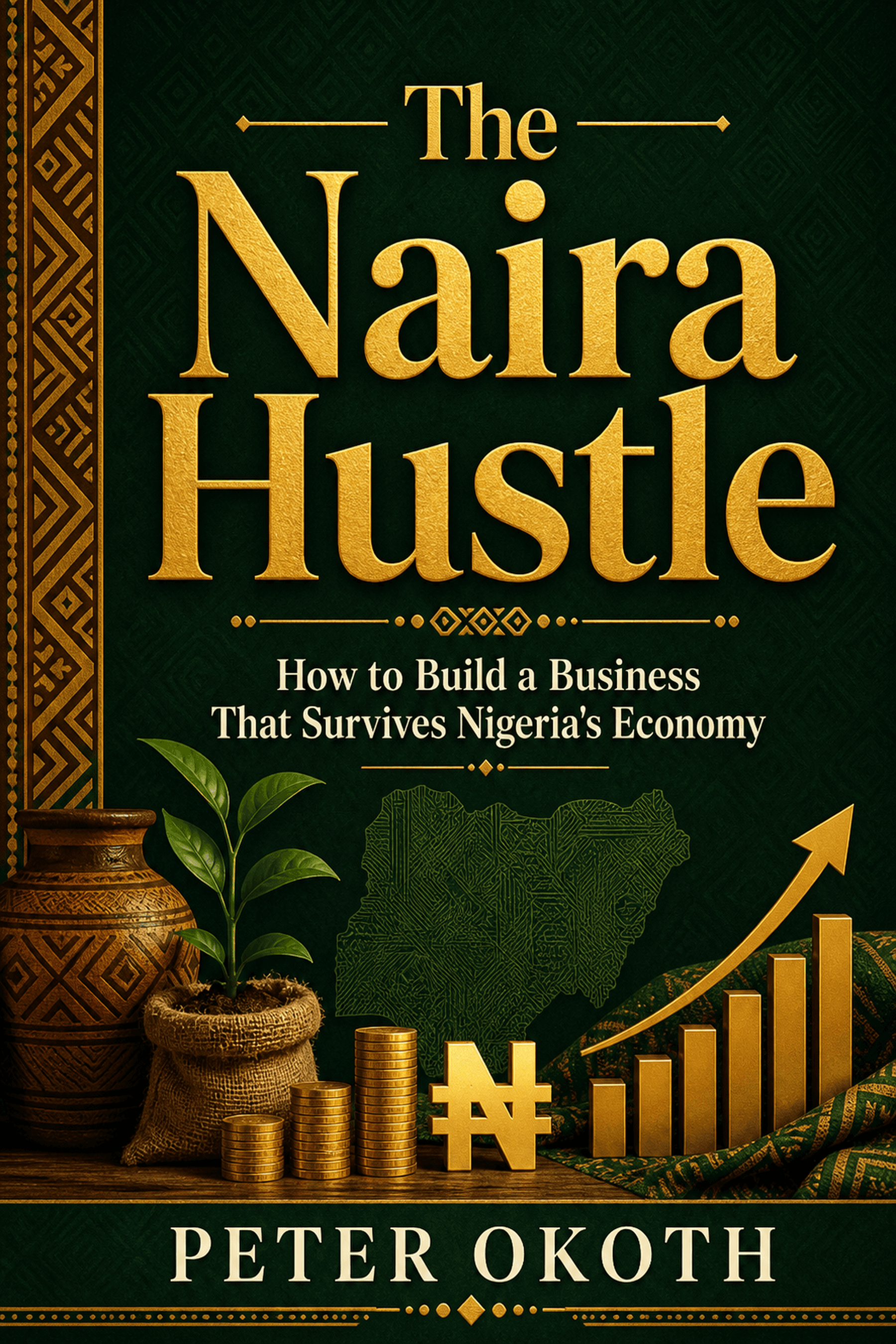
The Naira Hustle
How to Build a Business That Survives Nigeria's Economy
Read the first chapter in your browser. It's free, with no account and no email needed.
Free to read. No account required.
About this book
Running a business in Nigeria means pricing in a currency that can lose value within a year, budgeting for your own power, and watching costs climb faster than the prices your customers will accept. Plenty of entrepreneurs keep building anyway. Hustle dey pay, but only if the hustle is built to survive the economy.
The Naira Hustle is about survival rather than getting rich. It starts with the Nigerian business reality, then shows you how to price for inflation and keep cash flowing when everything feels chaotic. You learn ways to hedge your business against naira swings, cut costs without cutting quality, and build dollar revenue streams.
The final chapters look at resilient business structures, and exercises help you apply each idea to your own books. Whether you run a shop, trade in a market or sell a service, you get a practical framework for protecting your margins and making sure the business does not fall apart the next time the economy shifts.
Look inside
Preface
Building a business in Nigeria is not like building a business anywhere else. Nowhere else do you price your products in a currency that loses 20-40% of its value in a year. Nowhere else do you budget for the cost of generating your own electricity. Nowhere else do you pay tax to the federal government, the state government, and the local government — sometimes on the same transaction. Nowhere else do you plan inventory purchases around which day the dollar rate is lowest.
And nowhere else do entrepreneurs keep showing up and building anyway.
Hustle dey pay — but only if the hustle is smart enough to survive the economy.
This book is not about getting rich in Nigeria. Getting rich requires luck, connections, or a market position this book cannot give you. This book is about something more important: survival. How to build a business that does not die when the Naira devalues, when diesel prices double, when your landlord demands rent in dollars, when NRS and the state tax board both send you assessments for the same income.
Who This Book Is For
- Small business owners fighting to maintain margins in a devaluing economy
- Entrepreneurs starting a business and wanting to build it on solid financial ground
- Market traders and shop owners whose costs keep rising faster than their prices
- Service providers whose clients cannot absorb price increases
- Anyone running a Nigerian business who feels like the economy is working against them — because it is
What You Will Walk Away With
By the last page, you will know how to price products and services so that inflation does not eat your margins, how to manage cash flow when your costs are unpredictable, how to hedge your business against Naira devaluation, where to cut costs without cutting quality, how to build dollar-earning revenue streams alongside your Naira business, and how to structure your operations for maximum resilience.
This is the business survival manual for the Nigerian economy as it actually is — not as anyone wishes it were.
The Nigerian Business Reality
Femi runs a printing business on Allen Avenue in Ikeja, Lagos. Business cards, flyers, banners, wedding invitations — the everyday print jobs that keep a Lagos printer alive. He started in 2019 with one large-format printer, a laminator, and two staff. By 2022, he had three printers, five staff, and was doing ₦4.5 million in monthly revenue with 30% gross margin. A decent small business.
Then 2023 happened.
His large-format printer ink — imported from China — went from ₦45,000 per cartridge set to ₦112,000. His paper costs doubled. His diesel bill tripled. His landlord increased rent by 40%, citing "the dollar." Lagos State Internal Revenue Service sent an assessment. Nigeria Revenue Service (NRS), formerly FIRS sent a separate assessment. The local government demanded a "business premises levy." Femi counted: seven different tax and levy demands in one year.
He raised prices twice. Lost a quarter of his customers each time. His revenue dropped to ₦3.2 million. His margin shrank to 12%. One staff member quit for a remote job paying in dollars. Another he had to let go.
Femi did not make bad decisions. He priced well, managed costs, served customers, and showed up every day. Nigeria's economy made the decisions for him — devaluation set his input costs, inflation set his customers' willingness to pay, and the gap between those two forces compressed his margin until surviving became the goal, not growing.
"Na so the hustle be."
Here is what this chapter maps — the specific forces every Nigerian business must navigate, and why strategies designed for stable economies will not work here.
What You Will Learn
- Identify the five forces that make Nigerian business uniquely challenging
- Calculate how devaluation, inflation, and power costs affect your specific margins
- Assess your business's vulnerability to each force
- Set realistic planning assumptions for the Nigerian economy
- Stop blaming yourself for problems the economy created
Why This Matters
There are an estimated 40 million micro, small, and medium enterprises (MSMEs) in Nigeria. They employ over 80% of the labor force. They are the backbone of the economy. And most business advice available to them — from books, courses, and social media — was written for economies that have stable currencies, reliable electricity, single-tax-authority systems, and inflation below 5%.
Nigeria has none of those things.
Running a business in Nigeria requires a specific set of survival skills that standard business education does not teach. This chapter names the five forces, and the rest of the book provides the response to each.
Force 1: Currency Devaluation — Your Costs Are in Dollars, Your Revenue Is in Naira
The Reality
If any part of your business depends on imported inputs — and in Nigeria, almost every business does — your costs are effectively denominated in US dollars. Paper is imported. Ink is imported. Diesel is priced against the dollar. Machinery spare parts are imported. Even locally produced goods often use imported raw materials.
Your revenue, however, comes from Nigerian customers paying in Naira. And the Naira buys fewer dollars every year.
How It Actually Works
Femi's margin compression:
- Ink cartridge set (imported) — ₦45,000 — ₦112,000 — +149%
- A3 paper (per ream) — ₦4,500 — ₦9,200 — +104%
- Diesel (per month) — ₦180,000 — ₦520,000 — +189%
- Rent — ₦3,600,000/year — ₦5,040,000/year — +40%
- Monthly operating cost — ₦2,450,000 — ₦5,180,000 — +111%
- Monthly revenue — ₦4,500,000 — ₦3,200,000 (post-price-increase) — -29%
- Gross margin — ₦2,050,000 (46%) — ₦-1,980,000 (loss) — Negative
Femi had to slash costs dramatically to survive. His actual 2024 margin after cuts was 12%.
The math is brutal: when your costs rise 111% and your revenue drops 29%, there is no pricing strategy in the world that fixes the gap without losing customers.
Your Move
Do this now: List your top 10 business costs. Mark which ones are dollar-linked (imported inputs, dollar-benchmarked rent, diesel). Add up the dollar-linked costs as a percentage of your total. If the number is above 50%, you are highly exposed. Chapter 4 covers hedging strategies specifically for this.
Force 2: Inflation — Your Customers Cannot Afford Your Prices
The Reality
Inflation means your customers' purchasing power is shrinking too. When you raise prices to cover your increased costs, they have less money to spend. The market shrinks as you need it most.
This creates the Nigerian business squeeze: your costs rise (devaluation), your customers' ability to pay falls (inflation), and you are trapped in between.
The Squeeze Math
- Raise prices 30% to cover input costs — Have had 0-15% salary increases — You lose customers
- Maintain prices to keep customers — Your margin collapses — You lose money
- Cut costs to preserve margin — Quality suffers, staff leave — You lose competitive position
There is no perfect answer. The strategies in Chapters 2-7 are about finding the least-bad path through this squeeze.
Force 3: Power — You Are Running an Electricity Company on the Side
The Reality
The average Nigerian small business spends 30-40% of its operating costs on power. That means 30-40% of your revenue goes to keeping the lights on before you spend a single Naira on rent, inventory, or staff.
No business in a country with reliable electricity bears this cost. It is a uniquely Nigerian burden — and it puts Nigerian businesses at a structural disadvantage against every competitor with access to grid power.
Generator Economics (another book in this series) covers this in depth. For this chapter, the key point: power is a cost you must plan for, budget for, and aggressively manage.
Force 4: Multiple Taxation — Three Governments, One Business
The Reality
Nigerian businesses face tax demands from the federal government (NRS), state government (SIRS), and local government — sometimes on the same income or activity. Add informal levies, market association dues, and the occasional "security contribution" demanded by local enforcers, and a small business can face 20-40 different payment demands per year.
Quotes to share
Hustle dey pay, but only if the hustle is built to survive the economy.
Free to read. No account required.