Free first chapter
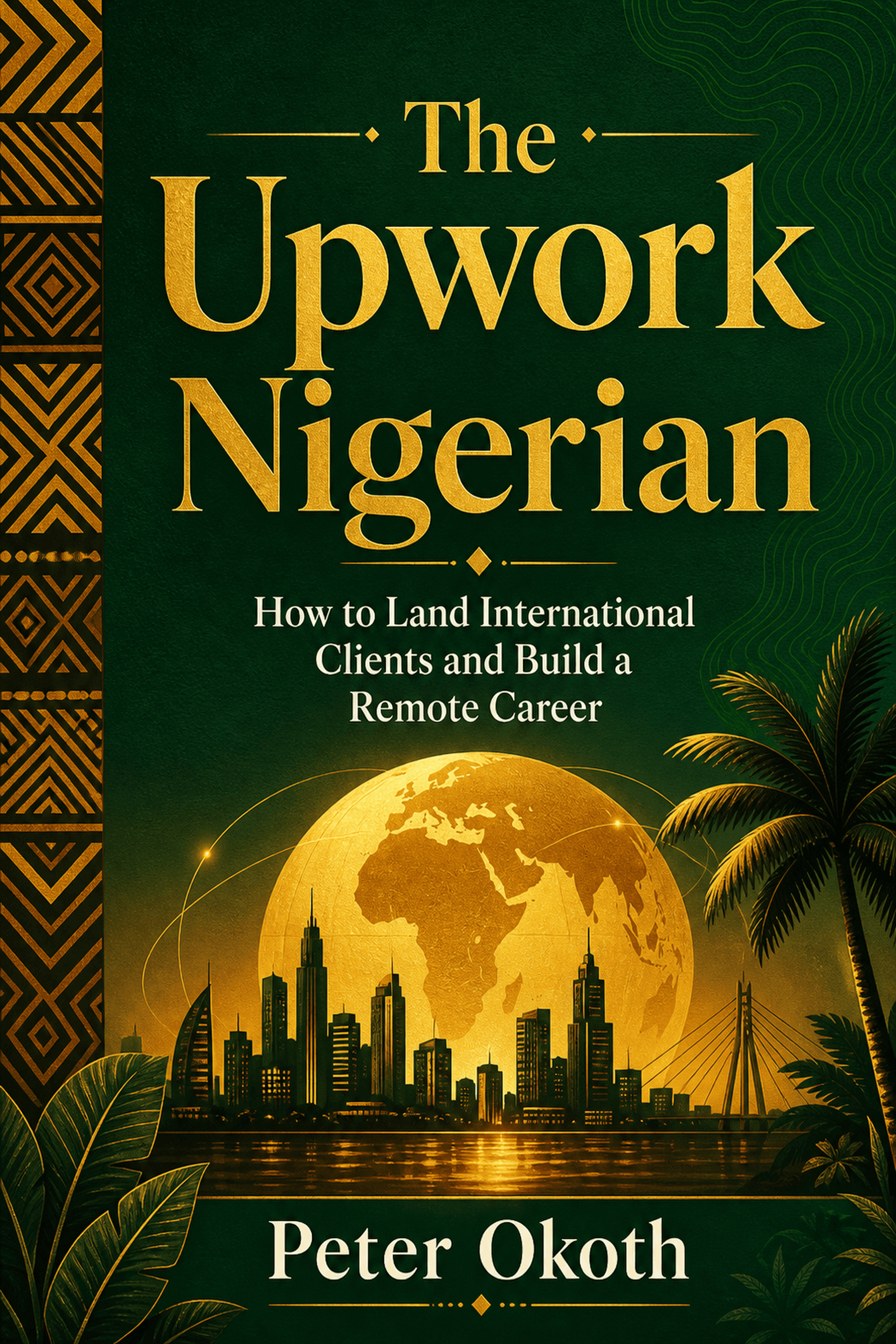
The Upwork Nigerian
How to Land International Clients and Build a Remote Career
Read the first chapter in your browser. It's free, with no account and no email needed.
Free to read. No account required.
About this book
Thousands of Nigerians have Upwork profiles, and many of them sit unseen, collecting unanswered proposals and rates that undersell real skills. The platform works, but its advice is usually written for someone in another country with different obstacles.
The Upwork Nigerian is a playbook written for freelancers in Nigeria. You start with the Upwork landscape as it looks from here, then build a profile that converts. You learn how to write proposals that get replies, land your first five clients, and set prices that can grow over time. The book covers communication that builds trust, managing projects from kickoff to delivery, and earning the reviews that build your reputation. A chapter on premium features helps you decide what is worth paying for.
The last chapter shows how to move from depending on one platform toward independence. You will understand how the platform works and what to do next, whatever service you sell.
Look inside
Preface
Upwork has over 500,000 Nigerian freelancers. Most of them are invisible. Their profiles do not convert. Their proposals do not win. Their rates do not reflect their skills.
This book fixes that. It is the Upwork playbook written specifically for Nigerian freelancers — addressing the platform mechanics, the country-of-origin challenges, and the specific strategies that turn a Nigerian Upwork account from a graveyard of unanswered proposals into a client-generating machine.
Who This Book Is For
- Nigerian freelancers already on Upwork who are not getting enough clients
- New Upwork users who want to start right instead of wasting months with a broken profile
- Readers of *Work From Lagos, Get Paid in Dollars* who want deeper Upwork-specific strategy
- Anyone in Nigeria who wants to master the world's largest freelancing platform
What You Will Walk Away With
By the last page, you will have a profile that converts, a proposal system that wins, a pricing strategy that grows, and a reputation that attracts clients instead of repelling them. Every strategy is tested on the Nigerian freelancer experience — including the challenges that Western Upwork guides never mention.
No generic platform advice. Upwork, the Nigerian way.
The Upwork Landscape for Nigerians
Damilola signed up for Upwork in January 2024. He had a degree in Computer Science, two years of experience building websites, and a burning desire to earn in dollars. He created a profile, set his rate at USD 8/hour, and started sending proposals.
Forty-seven proposals in his first month. Zero responses. Not even a "thanks but no thanks." Just silence.
Damilola concluded: "Upwork no dey work for Nigerians."
Three months later, he went to a tech meetup at a co-working space in Yaba. He met a developer named Tunde who earned USD 45/hour on Upwork. Same platform. Same country. Same profession.
Damilola asked: "How?"
Tunde showed him his profile. It was specific: "React/Next.js Developer | E-commerce & SaaS." His overview told a story. His portfolio had 8 detailed case studies. He had a 60-second video introduction. His JSS was 98%. He had 43 five-star reviews.
Damilola's profile said: "Web Developer | Freelancer." His overview was two generic sentences. His portfolio was empty. His video: none.
Same country. Same platform. One earned USD 45/hour. The other could not get a single response.
Here is what Tunde knew — and what this chapter will teach you.
What You Will Learn
- Understand how Upwork actually works — the marketplace, the algorithm, the fees
- See where Nigerian freelancers fit in the Upwork ecosystem — numbers, strengths, and challenges
- Identify the specific advantages Nigerians have on Upwork (and how to use them)
- Identify the specific challenges Nigerians face (and how to overcome them)
- Recognize the patterns that separate Nigerian top earners from the invisible majority
How Upwork Actually Works
The Marketplace Model
Upwork is a two-sided marketplace. Clients post jobs. Freelancers send proposals. Upwork takes a percentage of every transaction.
The platform processes over USD 3.5 billion in freelancer earnings annually. There are millions of registered freelancers and hundreds of thousands of active clients posting jobs every month.
The fee structure:
- First USD 500 — 20%
- USD 500.01 – USD 10,000 — 10%
- Above USD 10,000 — 5%
This means your first few projects with any client cost you 20% in fees. But as you build long-term relationships (which this book teaches), the fee drops to 10% and eventually 5%. Long-term clients are not just better income — they are cheaper income.
The Algorithm
Upwork's algorithm determines which freelancers clients see. It considers:
- Profile completeness — Complete profiles rank higher
- Relevance — How well your skills and title match the job post
- Job Success Score (JSS) — Your performance rating based on client feedback
- Activity — Active freelancers who send proposals regularly rank higher than dormant accounts
- Earnings history — Freelancers who have earned on the platform are prioritized over those who have not
The algorithm is not biased against Nigerians specifically. But it IS biased against incomplete profiles, generic titles, and freelancers with no earnings history — which describes most Nigerian accounts on the platform.
The Nigerian Freelancer on Upwork
The Numbers
- Nigerian freelancers on Upwork — 500,000+ registered
- Actively earning (at least 1 project/quarter) — ~50,000-80,000
- Earning USD 20+/hour — ~5,000-10,000
- Top Rated Nigerians — ~2,000-3,000
Most Nigerian Upwork accounts are dormant or earning below USD 5/hour. The top 10% earn rates that would shock the bottom 90%. The difference is not skill — it is platform strategy.
The Nigerian Advantage
1. English fluency. Nigeria is the largest English-speaking country in Africa. International clients communicate in English. Your English — including the ability to write clearly and speak confidently — is a competitive advantage over freelancers from non-English-speaking countries.
2. Timezone overlap. Nigeria (WAT/GMT+1) has meaningful business-hour overlap with both European and US East Coast clients. You can have real-time meetings with London clients all day and with New York clients from 2-7 PM Nigerian time. This is a significant advantage for client communication.
3. Cost arbitrage. Your living costs are a fraction of US/European costs. This is not about charging less — it is about the fact that USD 20/hour gives you an excellent lifestyle in Nigeria while being a bargain for clients used to paying USD 50-75/hour locally.
4. The Andela halo effect. Andela proved Nigerian tech talent is world-class. Clients who have worked with Andela engineers are more receptive to Nigerian freelancers. The Nigerian tech brand is stronger than most Nigerians realize.
The Nigerian Challenge
1. Country-of-origin bias. Some clients see "Nigeria" and think "risk." This is unfair and real. Chapter 2 addresses this with specific profile strategies.
2. Power and internet reliability. Missing a deadline because of a blackout is not acceptable to international clients. You need a power backup plan. Budget for it.
3. Payment withdrawal friction. Getting money from Upwork to your Nigerian bank account involves Payoneer, Wise, or direct transfer — each with fees and delays. Chapter 8 of Work From Lagos, Get Paid in Dollars covers this in detail.
4. Competition from other low-rate freelancers. With 500,000+ Nigerian accounts, the competition for low-rate jobs is fierce. The solution is not to compete at the bottom — it is to position yourself above it.
What Nigerian Top Earners Do Differently
After analyzing successful Nigerian freelancers on Upwork, the patterns are clear:
- Generic title: "Freelancer" or "Developer" — Specific title: "React Developer for SaaS Companies"
- No portfolio or generic samples — Detailed case studies with results
- No video introduction — Professional 60-second video
- Rate: USD 3-8/hour — Rate: USD 20-75/hour
- Send template proposals — Send customized proposals for each job
- Take any job — Only apply to jobs that match their niche
- Reactive communication — Proactive updates and check-ins
- No long-term client relationships — 60-80% of income from retainer clients
The rest of this book teaches you to move from the left column to the right.
Watch Out For — Chapter Summary
- "Upwork does not work for Nigerians" — It works for thousands of Nigerians earning USD 20-75/hour. It does not work for generic, under-positioned, under-priced profiles.
- "I sent 50 proposals and got nothing" — The number of proposals does not matter. The quality does. Chapter 3 fixes this.
- "The algorithm is biased" — The algorithm favours complete profiles, relevant skills, and proven track records. Complete your profile first.
- "I need to start cheap to get reviews" — Start at USD 10-15 minimum. Cheap attracts cheap clients who leave mediocre reviews.
Free to read. No account required.