Free first chapter
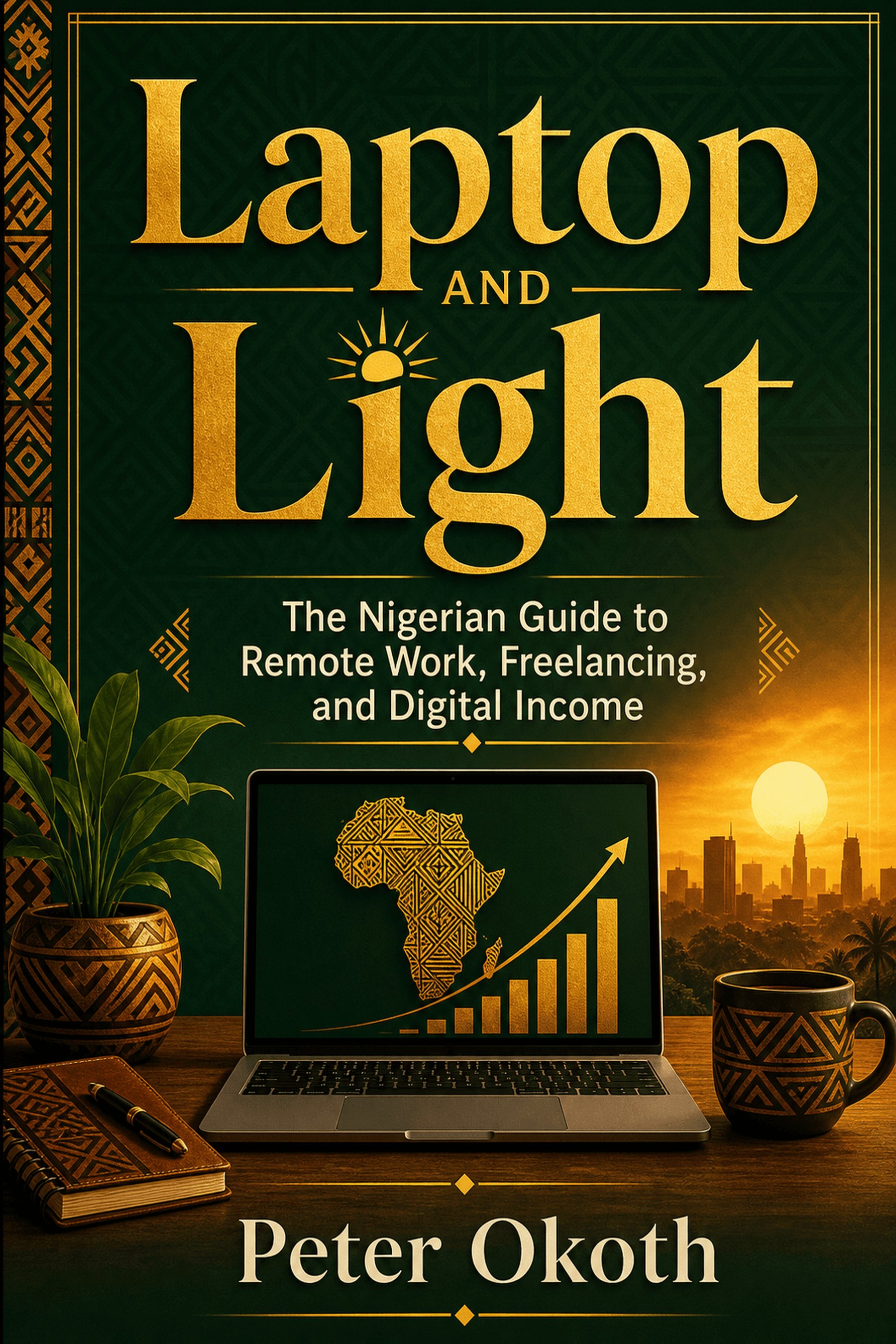
Laptop and Light
The Nigerian Guide to Remote Work, Freelancing, and Digital Income
Read the first chapter in your browser. It's free, with no account and no email needed.
Free to read. No account required.
About this book
The power cuts in the middle of a client call. The fan stops, the screen goes dark, and you wait. For many Nigerians, unreliable electricity and internet are the real barrier between them and a remote career, long before skills or clients come into it.
Laptop and Light tackles that barrier first. You learn how to plan a power setup that fits your budget and how to keep your internet from failing you. Then the book moves to the work itself, including skills the world will pay for, how to build a professional online presence, and where to find work that pays in dollars.
You also learn how to get paid without stress, how to structure a daily routine around your real conditions, and what to do when things go wrong. The book ends with a 90-day plan, and exercises throughout help you turn each chapter into action. It is a practical path from a laptop and light to steady remote income.
Look inside
Preface
"NEPA!"
Every Nigerian knows the moment. You are in the middle of something important — a client call, a deadline, a video render — and the power cuts. The fan stops. The screen goes dark. You sit in the heat and wait.
For millions of Nigerians, unreliable electricity is not an inconvenience. It is the single biggest barrier between them and a remote career that could pay ten times their current salary.
This book is about the two things you actually need to build a remote income in Nigeria: a laptop and light. Everything else — skill, clients, payment infrastructure — we will handle chapter by chapter. But if you cannot keep your laptop powered and your internet connected, none of it matters.
Who This Book Is For
- Nigerians who want to work remotely but feel blocked by power, internet, and infrastructure problems
- Aspiring freelancers and remote workers who need the complete playbook — from power setup to first client to payment
- Anyone who has tried remote work before and quit because the logistics were too frustrating
- NYSC members and recent graduates looking for a career path that does not depend on "who you know"
What You Will Walk Away With
By the last page, you will have a power and internet setup sized to your budget. You will have a skill path chosen from the international demand map. You will have a professional online presence, a payment pipeline, and a daily rhythm that works around — not against — Nigerian infrastructure.
This book does not pretend that working remotely from Nigeria is easy. It tells you exactly how hard it is, and then gives you the system to do it anyway.
Every amount is in ₦. Every solution has been tested in Nigerian conditions. Every workaround accounts for the fact that light no dey.
Let us build.
Tunde is a React developer in Ikorodu. In September 2025, he had a live demo scheduled with a startup founder in Austin, Texas. The contract was worth USD 3,000 per month — ₦4,650,000 at the parallel rate. Tunde had prepared for two weeks. His code was clean. His presentation was ready. His internet was stable.
At 3:47 PM, eight minutes into the demo, NEPA took light.
His screen went black. His router died. His phone had 11% battery — not enough to hotspot and rejoin on his laptop, which was also dying. By the time he found a generator-powered café and reconnected 35 minutes later, the client had already messaged: "Hey Tunde, no worries. I'm going to move forward with another developer. Good luck!"
Good luck. That was ₦4,650,000 per month gone — not because Tunde lacked skill, not because his code was bad, not because a Polish developer was better. Because NEPA took light.
The next week, Tunde spent ₦180,000 on a 1.5kVA inverter system with a 200Ah battery. Eighteen months later, he has not lost a single client to a power outage. He earns USD 4,500 per month from two American companies. The inverter paid for itself in the first three days of the contract it saved.
Here is what this chapter will teach you: the two things you actually need to build a remote income in Nigeria, and how to get them even if you are starting from zero.
What You Will Learn
- Understand why power — not skill, not internet, not clients — is the primary barrier for Nigerian remote workers
- Calculate the real cost of unreliable power in lost income
- Know the minimum laptop specifications for remote work (not what influencers say — what actually works)
- See the complete roadmap this book takes you through: from power setup to first income
- Assess your current setup using the Remote Work Readiness Checklist
The Two-Item Requirement
Every remote work guide tells you the same thing: find a skill, build a profile, land clients. They are not wrong. But they skip the part that makes remote work from Nigeria different from remote work from Lisbon or Bangkok or Bali.
In Nigeria, before you think about skills, before you think about Upwork, before you write a single proposal — you need two things:
- A laptop that works.
- Power to keep it running.
That is it. Everything else in this book builds on those two foundations. If your laptop dies during a client call, your skill does not matter. If your power cuts during a deadline, your Upwork rating does not matter. If you cannot keep your screen lit for eight consecutive hours, your ambition does not matter.
Light no dey is not just a complaint. For Nigerian remote workers, it is the single biggest career risk.
The Power Problem — In Naira
Nigerians already spend more on power than most people realize. Here is the math:
What Nigerians Spend on Generators
- Fuel (petrol at ₦700/litre, 4 litres/day, 20 days) — ₦56,000
- Maintenance (oil, servicing, parts — averaged) — ₦8,000-15,000
- Generator replacement (amortized over 3-year lifespan) — ₦5,000-10,000
- Total monthly generator cost — ₦69,000-81,000
Last verified: March 2026. Fuel prices fluctuate. Adjust for your local price.
Most Nigerians spending ₦70,000+ per month on a generator could fund an inverter system that pays for itself in 3-4 months and costs ₦5,000-10,000 per month to maintain after that.
What Unreliable Power Costs in Lost Income
- Lost client call → lost contract (Tunde's story) — ₦4,650,000/month ongoing
- Missed deadline → bad review → fewer clients — ₦500,000-2,000,000/month ongoing
- 3 hours/day of downtime → 60 hours/month of lost work time — ₦930,000-1,860,000/month (at USD 10-20/hr)
- Reputation damage → client does not return — Unquantifiable
The power problem is not just an inconvenience. It is a financial emergency hiding in plain sight.
The Laptop Spectrum
You do not need a MacBook Pro to start remote work. You do not even need a new laptop. Here is what you actually need, by work type:
Minimum Viable Laptop by Work Type
- Writing, VA, data entry — 4GB RAM, any processor, 128GB storage — Used ThinkPad T440, HP EliteBook 840 — ₦60,000-120,000
- Design (Canva, basic Figma) — 8GB RAM, i5 or equivalent, 256GB SSD — Used ThinkPad T480, HP ProBook 450 — ₦120,000-200,000
- Development, video editing — 8-16GB RAM, i5/i7 or equivalent, 256GB+ SSD — Used ThinkPad T480s, Dell Latitude 5490 — ₦180,000-350,000
- Heavy development, 3D, motion graphics — 16GB+ RAM, dedicated GPU, 512GB+ SSD — Used Dell XPS 15, MacBook Pro (2019+) — ₦300,000-600,000
Last verified: March 2026. Prices from Computer Village (Lagos), phone market (Abuja), and online sellers. Used ThinkPads are the best value for Nigerian remote workers.
Where to Buy Used Laptops in Nigeria
Computer Village, Ikeja (Lagos) — The largest electronics market in West Africa. Negotiate hard. Test everything before paying. Bring someone who knows laptops.
Phone/laptop markets in Abuja (Banex Plaza, GSM Village), Port Harcourt (Ikwerre Road), Ibadan (Gbagi Market).
Online: Jiji.ng, OList. Meet in public. Test before paying. Never send money first.
Red flags: No charger ("it is coming"), cannot boot the laptop, "the battery is just weak" (battery replacement costs ₦15,000-40,000), screen flickering, keyboard with dead keys.
Do Not Have a Laptop Yet?
If you are starting from zero, Chapter 5 of Export Your Skills and Chapter 5 of Fired? Rejected? Stuck? cover phone-only paths. Some work — data entry, transcription, basic VA tasks — can start from a smartphone while you save for a laptop. But be honest with yourself: a phone is a temporary bridge, not a permanent workstation.
Free to read. No account required.