Free first chapter
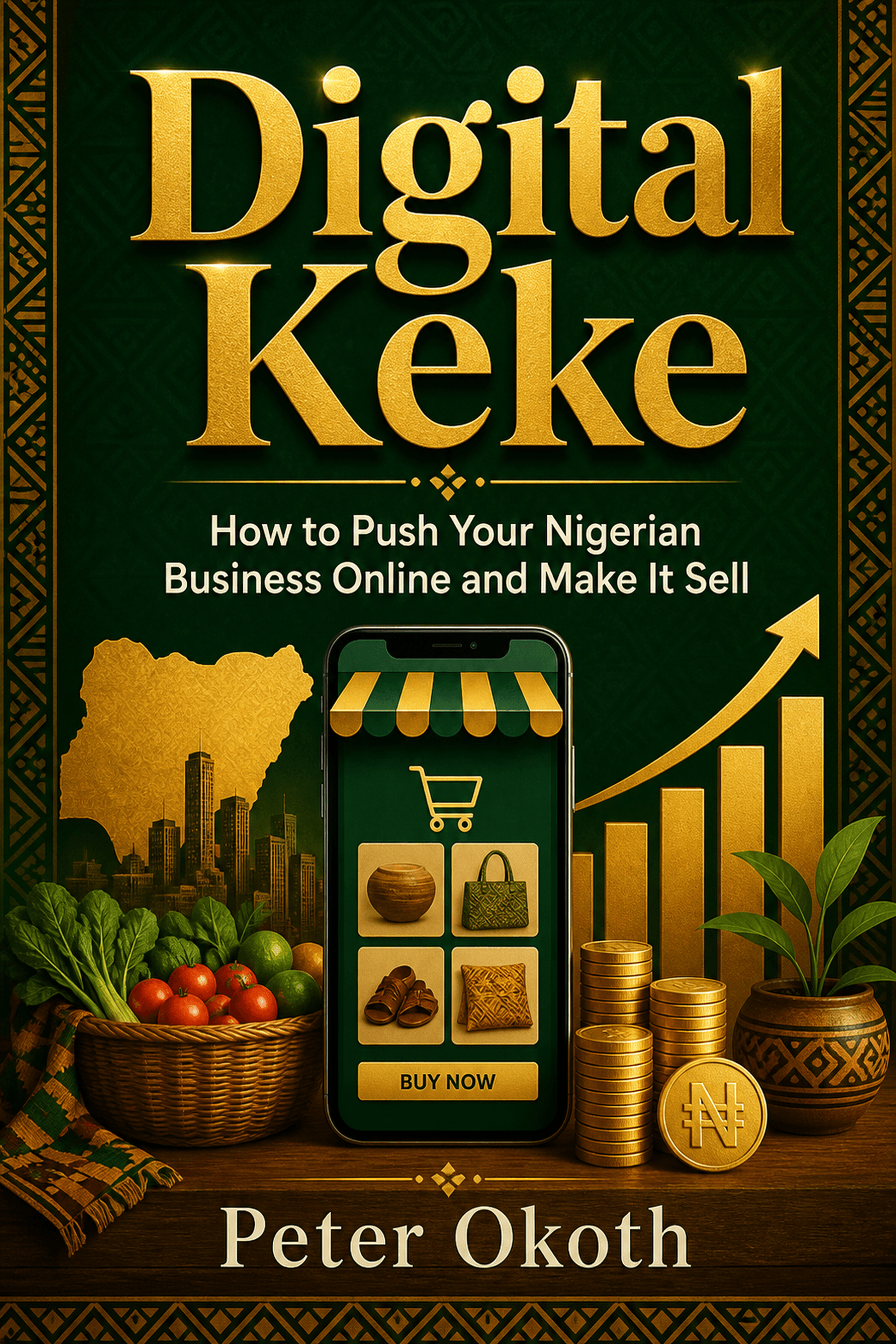
Digital Keke
How to Push Your Nigerian Business Online and Make It Sell
Read the first chapter in your browser. It's free, with no account and no email needed.
Free to read. No account required.
About this book
The keke moves people and goods through every Nigerian city, not because it is fancy but because someone knows the road and keeps pushing. Your business is the same. You know your products, your customers, and the hustle. What you may not know is how to take all of that online.
Digital Keke shows you how, using the phone in your pocket and about twenty minutes a day. You begin by seeing how online-ready your business already is, then set up WhatsApp Business, build a Facebook page that works like a market stall, and make sure customers can find you on Google. You learn to take product photos that sell, write descriptions that work, and get paid online.
The book puts it together as a daily twenty-minute marketing routine and a plan for your first fourteen days. It is written in plain English, with patience, for market traders, artisans, tailors, food vendors, and anyone helping a relative get started.
Look inside
Preface
The keke — that three-wheeled machine that moves people and goods through every Nigerian city — works because someone is pushing it forward. Not because it is fancy. Not because it has the latest technology. Because someone understands the road and keeps moving.
Your business is the same. You have been pushing it forward — through markets, through roadside shops, through word of mouth. You know your products. You know your customers. You know the hustle.
This book shows you how to push that same business online. Not with a laptop or a degree in marketing or a budget you do not have. With the phone in your pocket and 20 minutes a day.
Who This Book Is For
- Market traders and roadside sellers who know online is the future but do not know where to start
- Artisans, tailors, and food vendors who want customers beyond their physical location
- Business owners who are not "tech people" but are ready to learn
- Anyone helping a parent, spouse, or relative take their traditional business online
What You Will Walk Away With
By the last page, your business will be visible on WhatsApp, Facebook, and Google. You will have a daily marketing routine that takes 20 minutes. You will have made your first online sale. And you will know — from experience, not theory — that this works.
No big grammar. No oyinbo marketing jargon. Step by step, in plain English, with patience.
Let us push.
The Keke Is Digital Now
Mama Chidinma has sold egusi, ogbono, and groundnut oil at Eke-Awka market in Anambra State for 18 years. She knows her products better than anyone. She knows which palm oil is fresh by the colour. She knows which egusi will grind well by the weight. Her regular customers trust her completely.
But the market is changing. Younger customers do not walk through the market the way their mothers did. They search their phones. They order on WhatsApp. They buy from whoever shows up first on their screen.
Mama Chidinma's sales had been dropping for two years. Not because her products were worse — because her customers were finding other sellers online.
One Sunday afternoon, her daughter Chidinma sat down with her and set up WhatsApp Business on her phone. They photographed every product — the jars of groundnut oil, the bags of egusi and ogbono, the bundles of crayfish. They added prices. They posted the first WhatsApp Status at 5 PM.
By Monday evening, four people had placed orders. By Friday, Mama Chidinma had 12 new customers who had never visited Eke-Awka market in their lives. They paid via bank transfer and sent their addresses for delivery.
Within two weeks, her daily revenue went from ₦8,000-12,000 to ₦20,000-30,000. She did not change her products. She did not change her prices. She did not learn to code. She did not hire a marketing expert.
She changed how people find her.
Here is what Mama Chidinma's daughter knew — and what this chapter will teach you.
What You Will Learn
- Understand why going online is no longer optional for Nigerian businesses — even traditional ones
- See real examples of market traders and artisans who went digital with basic phones
- Identify the three free tools that make any Nigerian business findable online
- Separate what going online actually requires from what you think it requires
- Map the 10-chapter journey this book will take you on
Why This Matters
Here is a number that should keep every offline business owner awake at night: over 100 million Nigerians search for products and services on their phones every day. They type things like "tailor near me," "who sells palm oil in Awka," "best shoe repairer in Kaduna."
If your business does not show up when they search, you do not exist to them. They will find your competitor instead.
This is not about Lagos tech companies or Instagram influencers. This is about the tailor in Aba, the food seller in Ibadan, the mechanic in Benin City, the hairdresser in Enugu. Their customers are online. If they are not online too, they are losing sales every single day — to competitors who may not be better, but who are findable.
The Keke Metaphor
You know the keke — the three-wheeled tricycle that moves goods and people through every Nigerian city. The keke is not fancy. It is not a luxury vehicle. But it gets the job done because the person driving it knows the roads.
Your business is a keke. You have been pushing it forward through markets, through roadside shops, through word of mouth. You know your routes. You know your customers. You know the hustle.
Going online does not mean replacing your keke with a spaceship. It means finding a new road — a digital road — where more customers are waiting. The vehicle is the same. The driver is the same. You just need someone to show you the new route.
That is what this book does.
"This Is Not for People Like Me"
The Reality
If you are thinking "online marketing is for young people" or "I no sabi all this tech thing" or "na oyinbo people matter be that" — you are not alone. Most traditional Nigerian business owners think the same thing.
And they are all wrong.
Real Nigerians Who Went Digital
Alhaji Bello, 56 — Suya seller, Abuja. His son posted a 15-second video of suya sizzling on the grill on TikTok. The video got 40,000 views. Alhaji Bello now gets 20-30 orders per day via WhatsApp from people who have never visited his spot. He still does not understand TikTok. His son posts for him. His phone rings with orders.
Mrs. Okonkwo, 48 — Tailor, Nnewi. She sews aso-oke for weddings. Her niece set up a Facebook page and posted photos of her work. Within three months, she was getting orders from Nigerians in the diaspora — London, Houston, Toronto — who found her on Facebook and paid in dollars. Her monthly revenue tripled.
Baba Sule, 62 — Furniture maker, Ilorin. His apprentice listed his beds and wardrobes on Facebook Marketplace. Customers from across Kwara State now message him. He delivers using a hired truck. He went from ₦80,000/month to ₦300,000/month without changing a single thing about his furniture.
None of these people are tech experts. None of them built a website. None of them took a marketing course. They used a phone, a free app, and a few minutes of help from someone younger who showed them the basics.
What Going Online Actually Means
What It Does NOT Mean
- A laptop — Your phone
- A website — WhatsApp Business + Facebook page
- A marketing degree — This book
- Money for advertising — ₦0 (everything we teach is free)
- To become an influencer — To post photos of your products with prices
- To understand technology — To follow step-by-step instructions
What It DOES Mean
Going online means three things:
1. Being findable. When someone searches for what you sell, they can find you. This means having a WhatsApp Business profile, a Facebook page, and a Google My Business listing.
2. Being trustworthy. When someone finds you, they can see your products, your prices, and evidence that real people buy from you. This means having a catalog with photos and prices, and posting customer testimonials.
3. Being reachable. When someone wants to buy, they can contact you instantly and pay easily. This means having a WhatsApp link, responding quickly, and offering multiple payment options.
That is it. Findable, trustworthy, reachable. You can achieve all three with a phone and 30 minutes of setup time per platform.
Quotes to share
The keke moves people and goods through every Nigerian city, not because it is fancy but because someone knows the road and keeps pushing.
Free to read. No account required.