Free first chapter
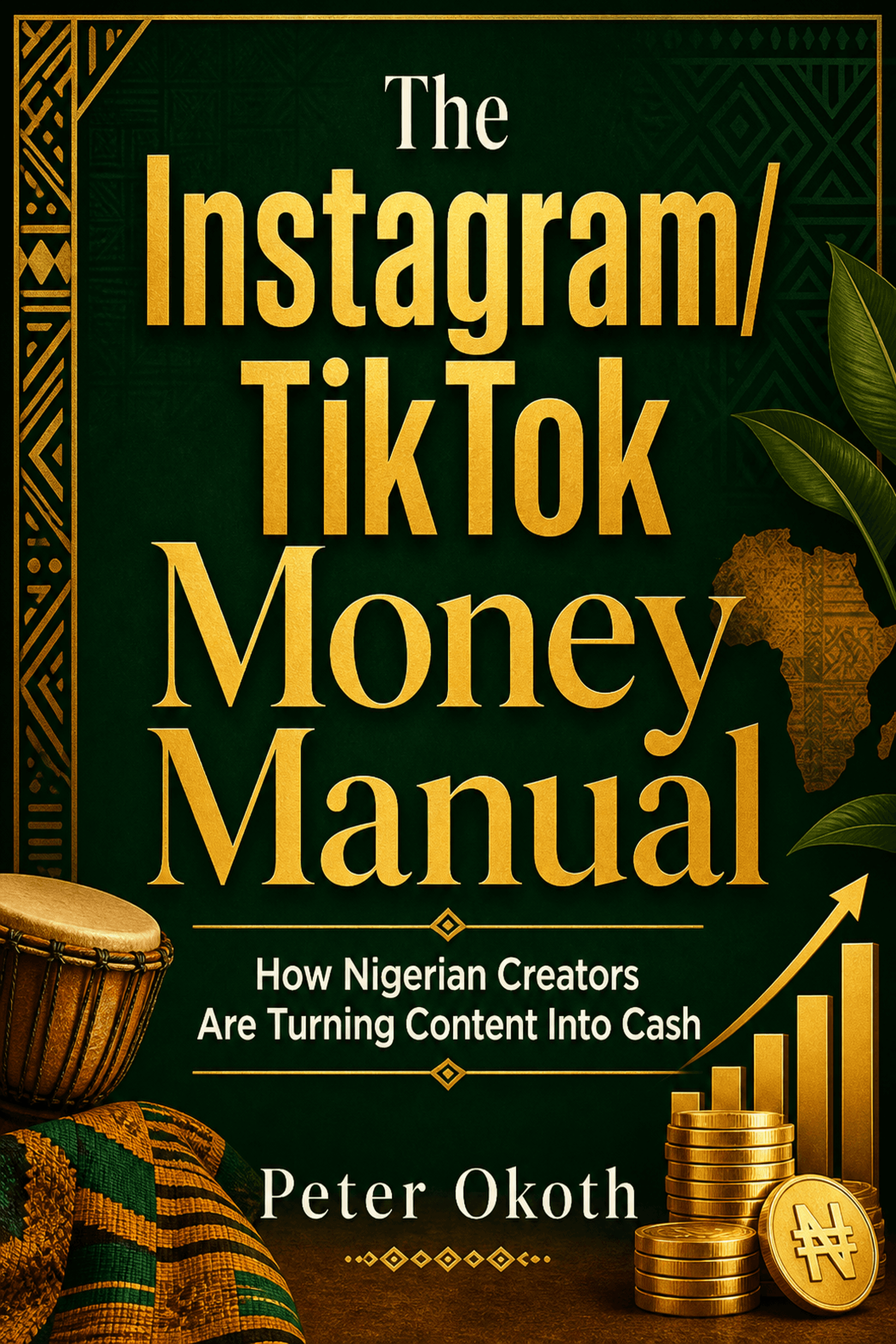
The Instagram/TikTok Money Manual
How Nigerian Creators Are Turning Content Into Cash
Read the first chapter in your browser. It's free, with no account and no email needed.
Free to read. No account required.
About this book
Nigerian creators post content that gets thousands of views, sometimes millions. But views do not pay rent, followers do not cover school fees, and likes do not buy generator fuel. The gap between content and cash is where most creators get stuck.
The Instagram/TikTok Money Manual is not a guide to going viral. It is a guide to building a business around your content. You start with how the Nigerian creator economy works and how to find a niche in the local market. You learn what kind of content builds an audience, how Instagram commerce works, and how to turn TikTok views into revenue.
Later chapters cover brand deals and sponsorships, selling your own products, affiliate marketing and building multiple income streams, all with Nigeria's realities such as data costs and power outages in mind. The book ends with a creator business plan to guide your next 90 days, with exercises to help you apply it.
Look inside
Preface
Every day, Nigerian creators post content that gets thousands — sometimes millions — of views. But views do not pay rent. Followers do not pay school fees. Likes do not buy generator fuel.
This book closes the gap between content and cash.
It is not a guide to going viral. It is a guide to building a business from your content — with brand deals, product sales, affiliate income, and the kind of Nigerian-specific strategies that imported creator guides never mention.
Who This Book Is For
- Content creators with followers but no income strategy
- Aspiring influencers who want to turn their phone into a money-making machine
- Business owners using Instagram and TikTok to sell products
- Anyone who creates content in Nigeria and wants to know how the business side works
What You Will Walk Away With
By the last page, you will know how much Nigerian creators actually earn (the real numbers, not the hype). You will know how to build an audience in a profitable niche, attract brand deals, sell your own products, and build multiple income streams from your content. You will have a 90-day plan from wherever you are now to consistent creator income.
Every earning figure in this book is in Naira. Every example is from the Nigerian creator economy. Every strategy accounts for the realities of creating content in Nigeria — data costs, power outages, and all.
No motivational speeches. No "just be authentic" platitudes. The business of being a Nigerian creator, step by step.
The Nigerian Creator Economy — Real Numbers, Real Money
Chiamaka has 12,000 Instagram followers. She creates content about natural hair — protective styles, product reviews, wash-day routines. She built her following over 18 months by posting three Reels per week and sharing tips on her Stories.
One Tuesday morning, a Nigerian hair product company sent her a DM: "Hi Chiamaka. We love your content. Would you be interested in creating a sponsored Reel featuring our new edge control gel? Budget: ₦50,000."
Chiamaka almost closed the message. She thought it was a scam. Who pays ₦50,000 for one video?
It was not a scam. She filmed the Reel in 20 minutes — showing how she used the product during her morning routine. She posted it on Thursday. The brand reposted it. She got paid via bank transfer on Friday.
₦50,000 for 20 minutes of work. Her part-time job at a retail store in Ikeja paid ₦35,000 for the entire month.
Chiamaka had an asset she was not using. Not her camera skills. Not her hair knowledge. Her audience. 12,000 people who trust her recommendations about natural hair products. That trust has a price — and brands are willing to pay it.
Here is what Chiamaka did not know before that DM — and what this chapter will teach you.
What You Will Learn
- See the real earning ranges for Nigerian creators by follower count and niche
- Identify who pays Nigerian creators and how much they pay
- Map the most profitable content niches in the Nigerian market
- Separate creator economy hype from the actual business model
- Calculate your estimated earning potential based on your current audience
Why This Matters
The Nigerian creator economy is not a side show. It is a growing market where real money changes hands — from brands to creators, from audiences to creators, and from platforms to creators.
But most Nigerian creators are not making money. Not because the money is not there. Because they do not understand the business model. They think the path is: get followers → get famous → somehow make money. The actual path is: build a niche audience → create trust → offer brands access to that trust → get paid.
This chapter shows you the business, not the hype.
What the Nigerian Creator Economy Looks Like
The Reality
Nigeria has the largest creator ecosystem in Africa. More Nigerian brands are spending money on influencer marketing than ever before — not because it is trendy, but because it works. A product recommendation from a trusted creator converts better than a billboard on Third Mainland Bridge.
The Numbers
- Active Instagram creators (posting weekly) — 200,000+
- Active TikTok creators — 150,000+
- Nigerian brands using influencer marketing — 5,000+
- Average brand deal for micro-influencer (5K-20K followers) — ₦20,000-100,000 per post
- Average brand deal for mid-tier (20K-100K followers) — ₦100,000-500,000 per post
- Average brand deal for macro (100K-500K followers) — ₦500,000-2,000,000 per post
- Average brand deal for mega (500K+ followers) — ₦2,000,000+ per post
Last verified: March 2026. Rates vary significantly by niche, engagement rate, and negotiation skill. These are market averages, not guarantees.
Look at the micro-influencer row. ₦20,000-100,000 per post. That is accessible to someone with 5,000-20,000 followers. You do not need millions of followers to make money as a creator. You need a niche audience that brands want to reach.
Who Pays Nigerian Creators
The Reality
There are four sources of creator income in Nigeria. Most creators rely on only one. The smart ones build all four.
The Four Revenue Streams
1. Brand deals and sponsorships (the biggest source).
Nigerian brands — from hair products to fintech apps to food brands — pay creators to feature their products. This is the largest single revenue stream for most Nigerian creators. It works because Nigerians trust recommendations from people they follow more than they trust advertisements.
Who pays: Hair/beauty brands, fashion brands, fintech (OPay, PalmPay, Moniepoint), food/beverage brands, betting companies, telecom (MTN, Airtel, Glo), real estate companies.
2. Selling your own products (the highest margin).
Creators who sell their own products — physical goods, digital downloads, courses, presets, templates — keep the entire revenue. A fashion creator selling their own clothing line. A finance creator selling a budgeting spreadsheet. A beauty creator selling their own cosmetics line.
This takes more work to set up but produces the most sustainable income.
3. Affiliate marketing (commission-based).
You recommend a product. Your followers buy through your unique link. You earn a percentage. In Nigeria, affiliate programs from Jumia, Konga, and various digital product platforms offer 3-15% commission per sale.
4. Platform payments (smallest but growing).
TikTok Creator Fund, Instagram bonuses, YouTube ad revenue. These platform payments exist but are currently modest in Nigeria compared to other revenue streams. Do not build your business plan around platform payments alone.
The Smart Creator Builds All Four
No single revenue stream is enough. Brand deals dry up in quiet months. Product sales fluctuate. Affiliate commissions are small individually. Platform payments change without notice. The creators earning consistent income in Nigeria are the ones with 2-4 active revenue streams. This book teaches you to build each one.
The Most Profitable Niches in Nigeria
Not all niches are equally profitable. A comedy creator with 100,000 followers may earn less per brand deal than a finance creator with 20,000 followers — because finance brands pay more per engagement.
- Beauty / Natural hair — Very high — ₦50,000-200,000 — High — Nigeria's beauty market is massive. Many brands, many deals.
- Fashion / Style — Very high — ₦50,000-250,000 — High — Instagram commerce leads Africa in Nigeria.
- Food / Cooking — High — ₦30,000-150,000 — Medium — Growing fast. Restaurant and food brand sponsorships.
- Finance / Money — Very high — ₦80,000-300,000 — Low-medium — Fintech brands pay premium rates. Fewer creators in this niche.
- Tech / Gadgets — High — ₦50,000-200,000 — Medium — Phone brands and tech companies sponsor heavily.
- Comedy / Entertainment — Medium — ₦30,000-100,000 — Very high — Many creators, lower per-post rates, but high volume potential.
- Lifestyle / Travel — Medium — ₦30,000-150,000 — High — Broad niche — harder to monetize unless sub-niched.
- Parenting / Family — Growing — ₦30,000-100,000 — Low — Underserved niche with growing brand interest.
- Fitness / Health — Medium — ₦30,000-100,000 — Medium — Supplement and gym brands are active.
Quotes to share
The gap between content and cash is where most creators get stuck.
Free to read. No account required.