Free first chapter
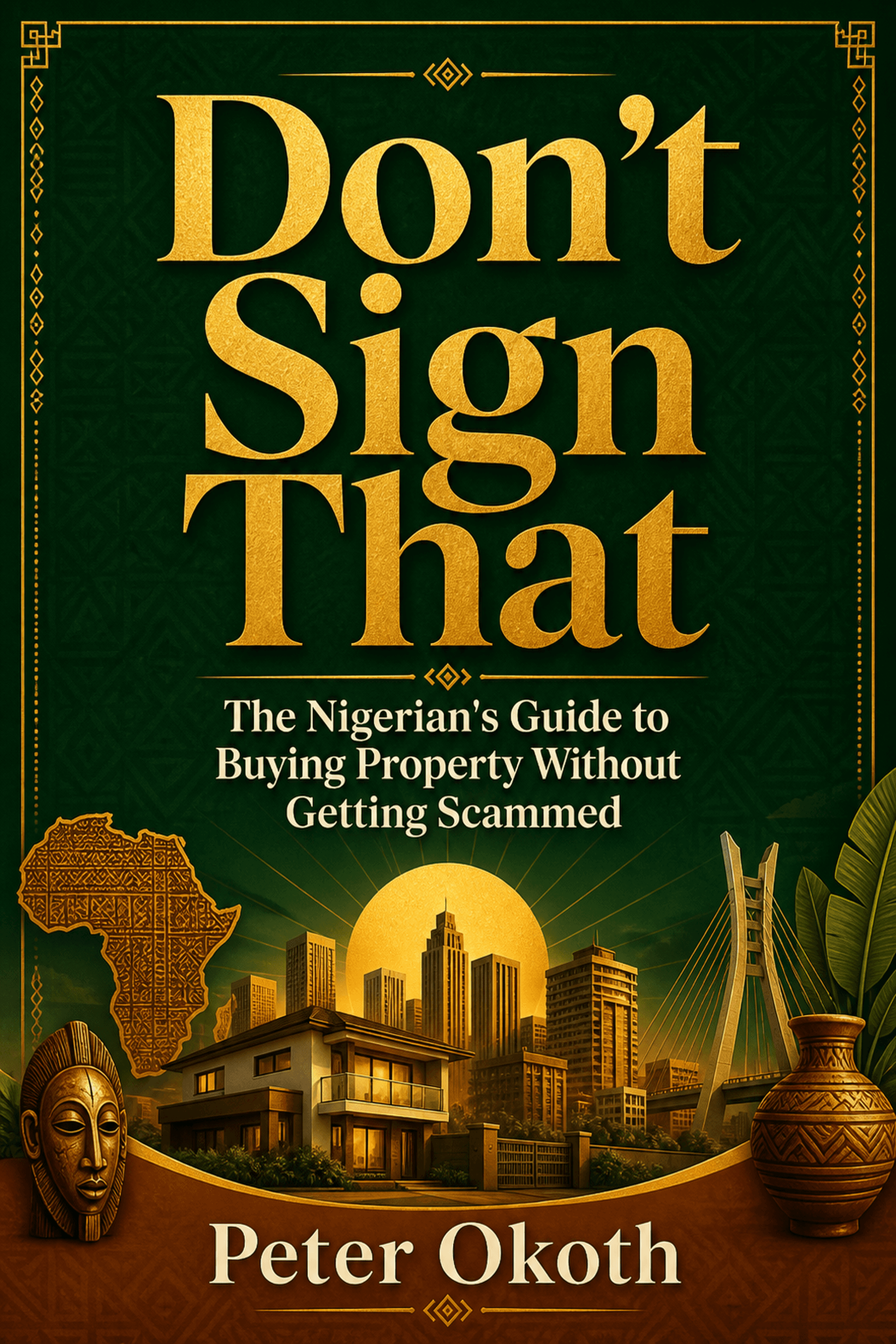
Don't Sign That
The Nigerian's Guide to Buying Property Without Getting Scammed
Read the first chapter in your browser. It's free, with no account and no email needed.
Free to read. No account required.
About this book
You have saved, you have watched other people build while you pay rent, and now you are ready to buy land. Maybe in Ibeju-Lekki, maybe in Abuja, maybe back in your home state. Before you sign anything, you need to know where the traps are.
This book is the map through the minefield. It opens with the story of a plot that was not there, then explains the C of O, Governor's Consent and Deed of Assignment in plain language. You learn how to run a property search, why a surveyor is your first defence, and how to handle the Omo-Onile factor. You see common scam patterns, the gamble of buying off plan from a developer, and the special care needed when buying family or community land.
Later chapters cover property taxes, the full cost of buying, and investment strategy around location, yield and funding. The book closes with a property buying war plan you can follow step by step.
Look inside
Preface
You have worked hard. You have saved. You have watched other people build houses while you pay rent. Now you are ready to buy your own land. Maybe a plot in Ibeju-Lekki. Maybe something in Abuja. Maybe a quiet place in your home state where you plan to retire.
Before you sign anything, read this book.
Nigeria's property market is one of the most rewarding – and one of the most dangerous – in Africa. Fortunes are made in real estate every year. Fortunes are also lost. And the losses are not always dramatic scams with fake agents and forged documents. Sometimes the loss is quiet: a C of O that turns out to be for a different plot. An Omo-Onile demand you did not budget for. A Governor's Consent you never obtained, which means the transfer is not legally recognized. A family land dispute that surfaces five years after you built your house.
Every one of these traps is avoidable. Every one of them has been sprung on someone who thought they were careful.
This book is the map through the minefield.
Who This Book Is For
- The first-time buyer about to spend ₦5-50 million on land and terrified of getting it wrong
- The diaspora Nigerian sending money home for property and relying on agents or relatives to "handle it"
- The ajo or cooperative member whose group is pooling money for a property purchase
- The Abuja or Lagos professional who has seen friends burned by fake land deals and wants to protect themselves
- Anyone who has ever heard the phrase "this land has C of O" and wants to know what that actually means – and how to verify it
What You Will Walk Away With
By the last page, you will know how to verify land ownership in any Nigerian state, how to conduct a search at the Land Registry, how to hire a surveyor, how to recognize the six most common scam patterns, how to handle Omo-Onile situations, how to calculate the real total cost of buying property, and how to execute a purchase from search to registration without losing money.
Every fee, every process, and every institution in this book reflects Nigerian reality as of 2026. Where processes differ by state, we tell you. Where rates change, we tell you where to check.
Before you pay that money, read this book. The land will still be there next week. If it will not – that is a red flag.
The Plot That Was Not There
Chidi had done what every financial advisor tells you to do. He saved. For seven years, he put money aside – first in his cooperative account, then in Treasury bills, then in a dedicated savings account for his land fund. He did not chase crypto. He did not fall for any of the Instagram investment schemes that swept through his WhatsApp groups. He did the disciplined thing.
By 2024, he had ₦18 million. Enough, he thought, to buy a plot in Bogije, along the Lekki-Epe corridor – an area everyone said was "the next Lekki." Prices were moving fast. If he did not buy now, he would be priced out.
He found the plot through a colleague's agent – "a very reliable guy who has been selling land in that axis for years." The agent showed him a plot along a graded road. Nice location. Relatively flat. The agent produced what he said was a Certificate of Occupancy (C of O) – the primary legal document proving land ownership in Nigeria, issued by the State Governor under the Land Use Act. The name on the C of O was a company – "Grandview Properties Limited." The agent said the company was the original allottee from the Lagos State Government. Clean title. No wahala.
Chidi visited the plot twice. He met the "director" of Grandview Properties. The man was well-dressed, drove a Lexus, had business cards. He showed Chidi a receipt book, a development plan, and a photocopy of the C of O. The agreement was signed. Chidi paid ₦18 million – ₦5 million deposit by transfer, the balance three weeks later.
Four months after payment, Chidi went to the plot with his architect to discuss the building plan. There was a fence. Someone else was building.
It took two weeks of phone calls, a lawyer, and a visit to the Lagos State Land Registry to piece together what had happened. The C of O was real – but it covered a different plot entirely, two streets away. The plot Chidi was shown belonged to a family that had not authorized any sale. The "director" of Grandview Properties was not a director – the real company had been dissolved three years earlier. The agent's phone was switched off. The "director" had relocated.
Chidi lost ₦18 million. Seven years of discipline. Gone in a transaction that took less than a month.
Here is what Chidi did not know – and what this chapter will teach you.
What You Will Learn
- Recognize why Nigeria's property market is uniquely dangerous for buyers
- Identify the five main ways Nigerians lose money on property
- Understand the single step that would have protected Chidi – and will protect you
- Map the rest of this book to your specific buying situation
Why This Matters
Every year, thousands of Nigerians lose money on property transactions. The exact number is impossible to determine because most victims never report – they are ashamed, confused about legal options, or convinced that the police and courts cannot help. Na who dem cheat go talk? Person go just swallow am and move.
The numbers that do surface are staggering. Lagos State alone processes thousands of land dispute cases annually. The Abuja Geographic Information Systems (AGIS) office regularly revokes allocations that were fraudulently obtained. Family land disputes in the South-West and South-East clog court dockets for years. Omo-Onile attacks on construction sites make the news weekly in Lagos.
The money involved is generational. A single fraudulent sale in Ibeju-Lekki costs someone ₦10-30 million. A collapsed off-plan estate in Abuja can wipe out ₦500 million from hundreds of families. Diaspora Nigerians send billions of Naira home annually for property – and a significant portion disappears into scams.
And here is the part that should make you angry: the people who profit from this are not criminal masterminds. They are opportunists who exploit the same gaps over and over – gaps that are completely avoidable if the buyer knows what to look for. The agent who sold Chidi's plot had probably done it before. The fake director had probably impersonated a company before. The playbook does not change because it does not need to. New buyers walk in uninformed every day.
Nobody is going to protect you except you. Not the agent. Not the seller. Not the state government. Not the police – land fraud cases move through the justice system at a pace that would make a tortoise impatient. The protection is in your hands. This book puts the tools in those hands.
Nigeria's Property Market – Massive, Broken, and Waiting for You
The Reality
Nigerians love land. This is not just financial – it is cultural, spiritual, and deeply emotional. "Buy land" is advice that transcends every ethnic group, every state, every income level. Land is security. Land is legacy. Land is the one thing you can point to and say, "This is mine."
Quotes to share
Before you sign anything, you need to know where the traps are.
Free to read. No account required.