Free first chapter
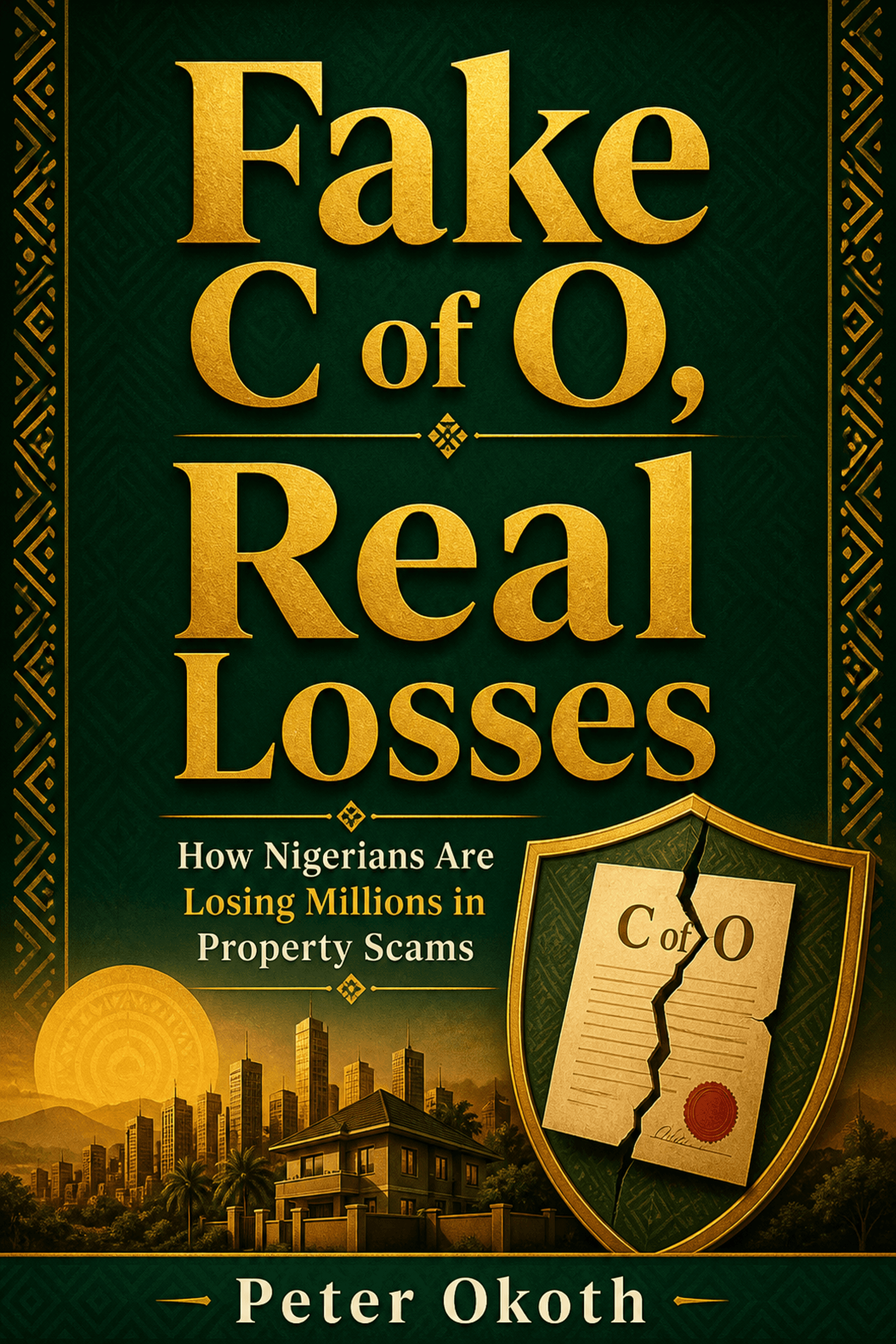
Fake C of O, Real Losses
How Nigerians Are Losing Millions in Property Scams
Read the first chapter in your browser. It's free, with no account and no email needed.
Free to read. No account required.
About this book
The certificate looks real. The paper is thick, the seal looks official, and the seller is convincing. Then the document turns out to be fake, and a buyer in Nigeria loses millions of Naira. The names and places change from Lagos to Abuja to Port Harcourt, but the patterns repeat.
Fake C of O, Real Losses is a catalogue of how property fraud actually works. Each chapter takes one pattern: the woman who sold the same Lagos land twice, the anatomy of a fake Certificate of Occupancy, the web of brokers, government-acquired land sold as private, the omo-onile problem, family land fraud, vanishing developers, and Abuja land swap scandals. For each, you will see the red flags and the verification steps that can stop it.
If you have already been scammed, a dedicated chapter explains what to do next. The book closes with a verification toolkit you can use before you pay for any property transaction.
Look inside
Preface
Somewhere in Nigeria right now, someone is looking at a document that says "Certificate of Occupancy" and feeling confident. The paper is thick. The seal looks official. The plot number is specific. The seller is convincing.
The document is fake. And in three weeks, that buyer will be ₦15 million poorer.
This book is a catalogue of pain – but necessary pain. Every chapter documents a specific way Nigerians lose money to property fraud. Not theoretical risks. Actual patterns that repeat across Lagos, Abuja, Port Harcourt, and every property market in the country. The names change. The locations change. The scam patterns do not.
If you are about to buy property in Nigeria, this book will scare you – and that fear will save you millions.
If you have already been scammed, this book will help you understand what happened and what options you have.
Who This Book Is For
- The buyer who wants to know every trap before entering the market – knowledge is armour
- The victim who needs to understand what happened – and what recourse exists
- The adviser – lawyers, agents, and surveyors who need a scam pattern reference
- Anyone who has heard a property horror story and wants to know how to avoid becoming the next one
What You Will Walk Away With
Every major property scam pattern in Nigeria, named and explained. Red flags for each. Verification steps that stop them. And a complete toolkit chapter you can reference for any property transaction.
If you know how dem dey take scam people, dem no fit scam you.
The Woman Who Sold Lagos Twice
The woman called herself Mrs. Adewale. Sometimes Mrs. Okafor. Once, Mrs. Ibrahim. She operated in the Lekki-Epe axis for at least four years before anyone connected the dots.
Her method was elegant in its simplicity. She would identify plots of land belonging to people who had travelled – diaspora Nigerians, elderly owners, companies that had bought land speculatively and never developed it. She would obtain information about the plot: size, location, survey coordinates, and crucially, the C of O number. Then she would produce a forged Deed of Assignment purporting to show that the real owner had sold the land to a company she controlled. With that forged Deed and a photocopy of the genuine C of O, she would market the land to buyers.
She did not sell each plot once. She sold each plot to two, sometimes three, buyers simultaneously. By the time Buyer A tried to start construction and discovered Buyer B was already building, Mrs. Adewale had collected ₦30-50 million per plot and moved on to the next one.
Between 2020 and 2024, the pattern was repeated across at least eight plots along the Lekki-Epe Expressway corridor. Conservative estimate of total losses: over ₦200 million across multiple victims.
She was not a criminal mastermind. She was organized, patient, and she understood one thing: most Nigerian property buyers do not verify.
What You Will Learn
- Understand the scale and sophistication of property fraud in Nigeria
- Recognize why serial fraudsters succeed – the systemic gaps they exploit
- Identify the specific verification steps that would have stopped every sale
- Map the scam patterns covered in this book to your buying situation
The Scale of the Problem
The Reality
Property fraud in Nigeria is not occasional. It is industrial.
The Economic and Financial Crimes Commission (EFCC) receives thousands of property-related complaints annually. State Land Registries process fraud disputes that can take 5-15 years to resolve. Family land disputes under customary tenure generate litigation that spans generations.
The losses are not small. Individual victims lose ₦5-50 million per transaction. Developer scams can wipe out ₦500 million to ₦2 billion from hundreds of families. Omo-Onile activities cost the Lagos State economy billions annually in construction delays, security costs, and deterred investment.
And yet, the basic verification steps that would prevent most fraud cost less than 5% of the purchase price. The gap between the cost of prevention and the cost of fraud is the widest in any Nigerian financial market.
Why Scammers Succeed
The fraud works because of five systemic gaps:
Gap 1: Paper-based records. Most State Land Registries still rely on physical files. Records can be altered, misplaced, or destroyed. Digitization efforts (like Lagos State's recent land records reform) are progressing but incomplete.
Gap 2: Buyer ignorance. Most buyers do not know how to verify a C of O, do not know that a search is possible, or assume the seller's agent or lawyer will protect them. The agent works for the seller. The lawyer – unless you hired them independently – may not conduct thorough due diligence.
Gap 3: Consent backlog. The Governor's Consent process can take 6-18 months and costs significant money. Many buyers skip it, leaving themselves in a legally vulnerable position. Scammers exploit this by selling land to multiple buyers, knowing that none of them will complete the consent process quickly enough to discover the duplicates.
Gap 4: Family land opacity. Large areas of Nigerian land – especially in the South-West and South-East – are held under customary tenure with no formal title. Ownership is determined by family history, not Land Registry records. This creates opportunities for unauthorized family members to sell.
Gap 5: Enforcement weakness. Even when fraud is discovered, prosecution is slow and recovery is rare. Property cases in Nigerian courts take years. Scammers know this and factor it into their operations.
The Nine Scam Patterns
This book covers nine specific patterns. Every property fraud in Nigeria falls into one or more of these categories:
- 1 — Forged C of O / fake documents — Chapter 2 — ₦5-50M
- 2 — Broker chains obscuring ownership — Chapter 3 — ₦5-30M
- 3 — Government/community land sold as private — Chapter 4 — ₦5-30M
- 4 — Omo-Onile extortion and land grabbing — Chapter 5 — ₦1-10M
- 5 — Unauthorized family land sales — Chapter 6 — ₦5-50M
- 6 — Developer fraud (off-plan estates) — Chapter 7 — ₦3-30M
- 7 — Abuja land swap and allocation fraud — Chapter 8 — ₦10-100M
- 8 — Impersonation of owner — Chapters 2, 6 — ₦5-50M
- 9 — Double/triple selling the same plot — Chapters 2, 3 — ₦10-50M per plot
Mrs. Adewale's operation combined patterns 1, 8, and 9: forged documents, impersonation of a company, and multiple sales of the same plot. The sophistication was not in the forgery – it was in the timing and the exploitation of buyer behaviour.
How Mrs. Adewale Could Have Been Stopped
Every single one of her victims could have protected themselves with three steps:
Step 1: Official search at the Land Registry (₦20,000-30,000). This would have shown the real owner of each plot. None of Mrs. Adewale's victims were the registered owner.
Step 2: CAC company search (₦5,000-10,000). Her "company" was either dissolved or had different directors. A simple CAC search would have revealed this.
Step 3: Physical verification with an independent surveyor (₦50,000-150,000). Comparing the survey plan on the C of O with the actual plot on the ground would have revealed discrepancies.
Total cost of these three steps: approximately ₦75,000-190,000. Total losses by her victims: over ₦200 million.
The verification would have taken two weeks. The losses will take years to recover – if they are recovered at all.
Watch Out For – Chapter Summary
- Serial fraudsters are organized. They study the market, identify vulnerable properties, create convincing documentation, and time their exits. They are not random criminals – they are operators.
- The buyer's greatest vulnerability is trust. Every victim trusted the agent, the seller, or the documents without independent verification.
- Verification is cheap. Fraud is expensive. The cost of a search, a CAC check, and a surveyor is less than 2% of a typical property purchase. The cost of not doing it is 100%.
- Multiple sales are common. Fraudsters often sell the same plot to multiple buyers simultaneously. If you are not the first to verify and complete consent, you may lose to someone who did.
Quotes to share
The names and places change from Lagos to Abuja to Port Harcourt, but the patterns repeat.
Free to read. No account required.