Free first chapter
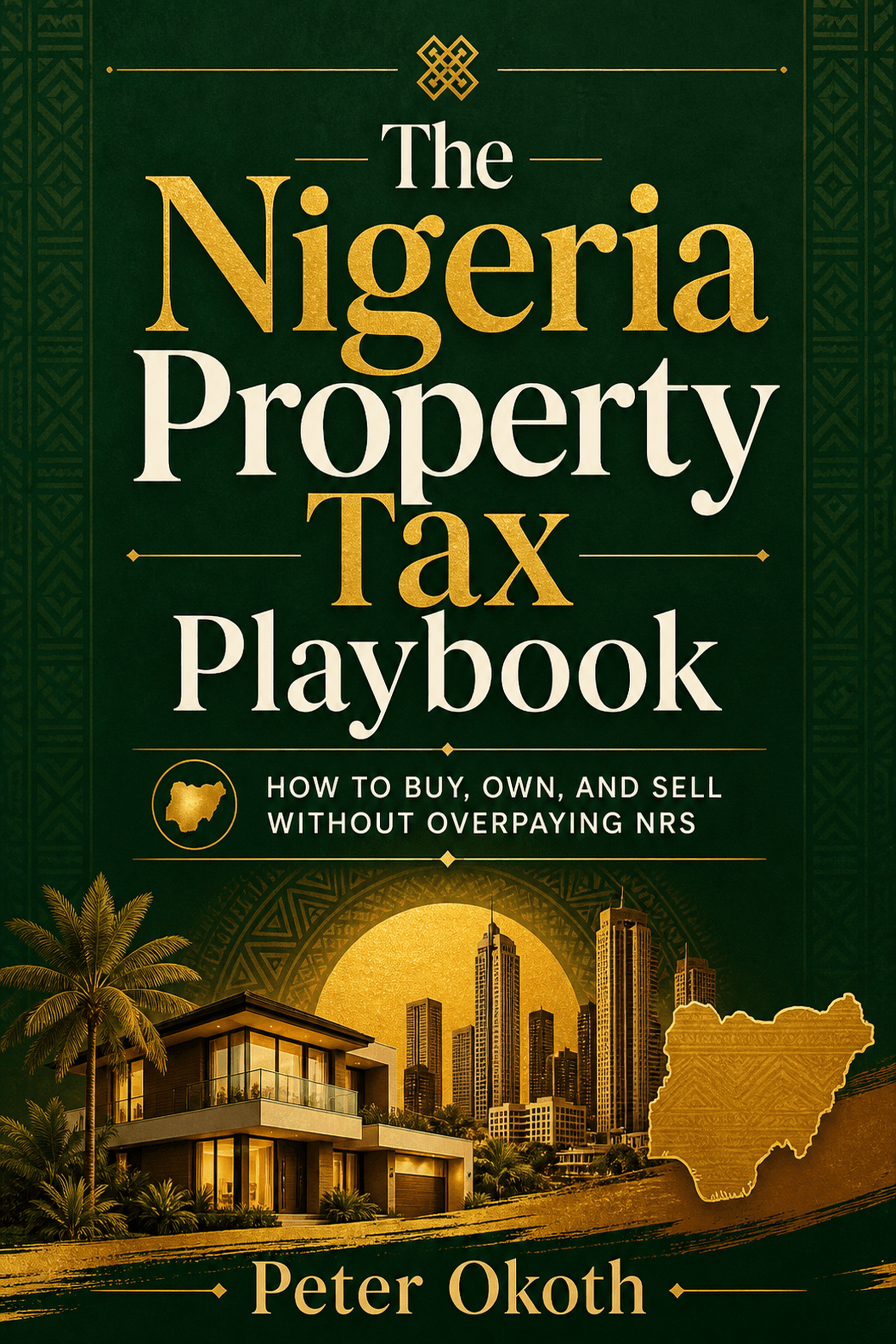
The Nigeria Property Tax Playbook
How to Buy, Own, and Sell Without Overpaying NRS
Read the first chapter in your browser. It's free, with no account and no email needed.
Free to read. No account required.
About this book
The price you agree with the seller is not the price you will pay. Stamp duty, consent fees, registration charges, land use charge, and, when you sell, capital gains tax can all land on top, and many Nigerians only find out when the bills arrive.
The Nigeria Property Tax Playbook names every tax and fee that comes with buying, owning, and selling property, then explains how each one works. You will go through stamp duty as the entry tax and capital gains tax as the exit tax, then land use charge, consent fees and registration costs, rental income tax, and VAT on property.
The book also looks at ownership structures and how they affect what you pay, takes you through the TaxPro Max property workflow, and finishes with a property tax calculator you can work through. It is a general guide, so confirm details for your own transaction with a qualified professional.
Look inside
Preface
The price of property in Nigeria is not the price you pay the seller. It is the price you pay the seller, plus stamp duty, plus consent fees, plus registration charges, plus land use charge, plus your lawyer's fees, plus your surveyor's fees, plus the development levy, plus – if you sell the property later – capital gains tax.
Most Nigerians budget for the purchase price. They do not budget for the 8-15% in taxes and fees that sit on top of it. Then the bills arrive, and the shock begins.
This book kills the shock. Every tax, every fee, every levy associated with buying, owning, and selling property in Nigeria – named, explained, calculated, and shown step by step.
Who This Book Is For
- The buyer who wants to know the true total cost before committing
- The property owner who keeps getting land use charge bills and does not understand them
- The landlord who collects rent and does not know what NRS expects
- The seller who wants to understand capital gains tax before listing
- The investor who needs to calculate net returns after all taxes
- Anyone who has been surprised by property-related tax bills and does not want it to happen again
What You Will Walk Away With
A complete understanding of every property-related tax in Nigeria, with fill-in calculators for each scenario. You will know what to pay, when to pay, how to pay through TaxPro Max, and how to structure ownership for maximum tax efficiency.
Every rate and process in this book reflects Nigerian tax law as of March 2026. For full NRS optimization across all income types, see NRS vs. You in Series 1.
The Tax Bill Nobody Warned Him About
Yusuf bought a plot in Gwarinpa, Abuja for ₦25 million. He thought he was done. Then his lawyer handed him the list of additional costs:
- Stamp duty: ₦375,000
- Governor's Consent fee: ₦750,000
- Registration fee: ₦125,000
- Survey fee: ₦180,000
- Legal fees: ₦500,000
- Land use charge (annual): ₦85,000
- Development levy: ₦200,000
Total additional cost: ₦2,215,000. That is 8.9% on top of the purchase price. Yusuf had budgeted ₦25 million. He actually needed ₦27.2 million.
And that is before he builds. And before he sells – when capital gains tax will take another bite.
Yusuf's mistake was not buying the wrong property. His due diligence was solid. His mistake was not knowing the tax and fee landscape. He is in good company – most Nigerian property buyers budget for the price and nothing else.
What You Will Learn
- Name every tax, fee, and levy associated with property in Nigeria
- Understand when each one applies (buying, owning, selling)
- Calculate the approximate total cost above the purchase price
- Know which costs are negotiable and which are mandatory
The Full Cost Map
Here is every property-related cost in Nigeria, mapped to when it hits:
When You Buy
- Stamp duty — Buyer — 1.5% (varies by state) — ₦375,000
- Governor's Consent — Buyer (usually) — 3-6% (varies by state) — ₦750,000-1,500,000
- Registration fee — Buyer — 0.5% or fixed — ₦125,000
- Legal fees — Both (buyer pays own) — 1-2% (negotiable) — ₦250,000-500,000
- Survey fees — Buyer — Fixed/negotiable — ₦100,000-250,000
- Search fees — Buyer — Fixed — ₦20,000-50,000
While You Own
- Land Use Charge — Annual — Varies by state, location, property value
- Tenement rates — Annual (some states) — Varies
- Development levy — One-time or periodic — Varies by state
When You Sell
- Capital gains tax — Seller — 10% of gains
- Stamp duty on new transfer — New buyer (usually) — 1.5%
- Agent commission — Seller (usually) — 5-10%
When You Rent Out
- Rental income tax — Landlord — Personal income tax rates (up to 24%)
- Withholding tax — Corporate tenant deducts — 10% (companies), 5% (individuals in some states)
Rates are illustrative and vary by state. Last verified: March 2026.
The Shock Absorber
Here is the rule of thumb: Budget 8-15% above the purchase price for total acquisition costs.
On a ₦25 million property, that is ₦2-3.75 million in additional costs. On a ₦100 million property, ₦8-15 million.
If you do not budget for this, you either: (a) cannot complete the transfer, leaving yourself in a legally vulnerable position with no Governor's Consent, or (b) borrow to cover the gap, adding interest costs to an already expensive transaction.
The Biggest Mistake: Skipping Governor's Consent
Governor's Consent is the single most expensive step in a property transaction – typically 3-6% of the property value. Because of the cost and the processing time (6-18 months), many buyers skip it.
This is the most dangerous shortcut in Nigerian property. Without Governor's Consent, the transfer is legally void under the Land Use Act. The seller can technically sell the same property again. Your claim is weaker than it should be. If a dispute arises, you are fighting from a position of legal vulnerability.
The consent fee is expensive. Losing the property is more expensive.
Your Move
Before you turn the page:
- Calculate your total budget. Take your target purchase price and add 12%. That is your real budget.
- Identify which state you are buying in. Rates vary significantly. Lagos, Abuja, and Ogun have different fee structures.
- Accept that tax and fees are non-negotiable costs. You can negotiate the purchase price. You cannot negotiate stamp duty or CGT.
What is Next
Chapter 2 breaks down stamp duty in detail – rates, calculation methods, payment process, and the penalties for paying late or not at all.
Stamp Duty – The Entry Tax
Every time a property changes hands in Nigeria, the government takes a cut. The first cut is stamp duty – a tax imposed on documents that transfer property, payable at the time of the transaction.
Stamp duty is not optional. It is not something you handle "later." An unstamped Deed of Assignment is inadmissible as evidence in Nigerian courts. If a dispute arises and your transfer document is not stamped, the court will not accept it. Your ₦15 million purchase becomes legally invisible.
What You Will Learn
- Calculate stamp duty for any property transaction in Nigeria
- Understand the payment process and timeline
- Know the penalties for late payment
- Identify situations where stamp duty is reduced or exempt
How Stamp Duty Works
The Reality
Stamp duty is governed by the Stamp Duties Act (Cap S8, LFN 2004) and the Finance Act amendments. It applies to documents that create, transfer, or extinguish rights in property.
For property transactions, the relevant documents are:
- Deed of Assignment (transfer of land/property)
- Deed of Mortgage (property used as loan security)
- Lease agreements (long-term rental agreements)
The Rates
- Deed of Assignment (conveyance) — 1.5% — Of the consideration (purchase price) or market value, whichever is higher
- Deed of Mortgage — 0.375% — Of the loan amount secured
- Lease (over 21 years) — 6% of annual rent — Of the average annual rent
- Lease (7-21 years) — 3% of annual rent — Of the average annual rent
- Lease (under 7 years) — 1% of annual rent — Of the average annual rent
Rates as of the Finance Act amendments. Verify current rates as legislation evolves. Last verified: March 2026.
Calculation Example
Scenario: You buy a plot of land in Lagos for ₦20 million.
- Purchase price — ₦20,000,000
- Stamp duty rate — 1.5%
- Stamp duty payable — ₦20,000,000 x 1.5% — ₦300,000
If the market value of the property is higher than ₦20 million (as assessed by the state valuation office), stamp duty will be calculated on the higher value. Buyers sometimes try to declare a lower purchase price to reduce stamp duty – this is tax evasion and carries penalties.
Free to read. No account required.