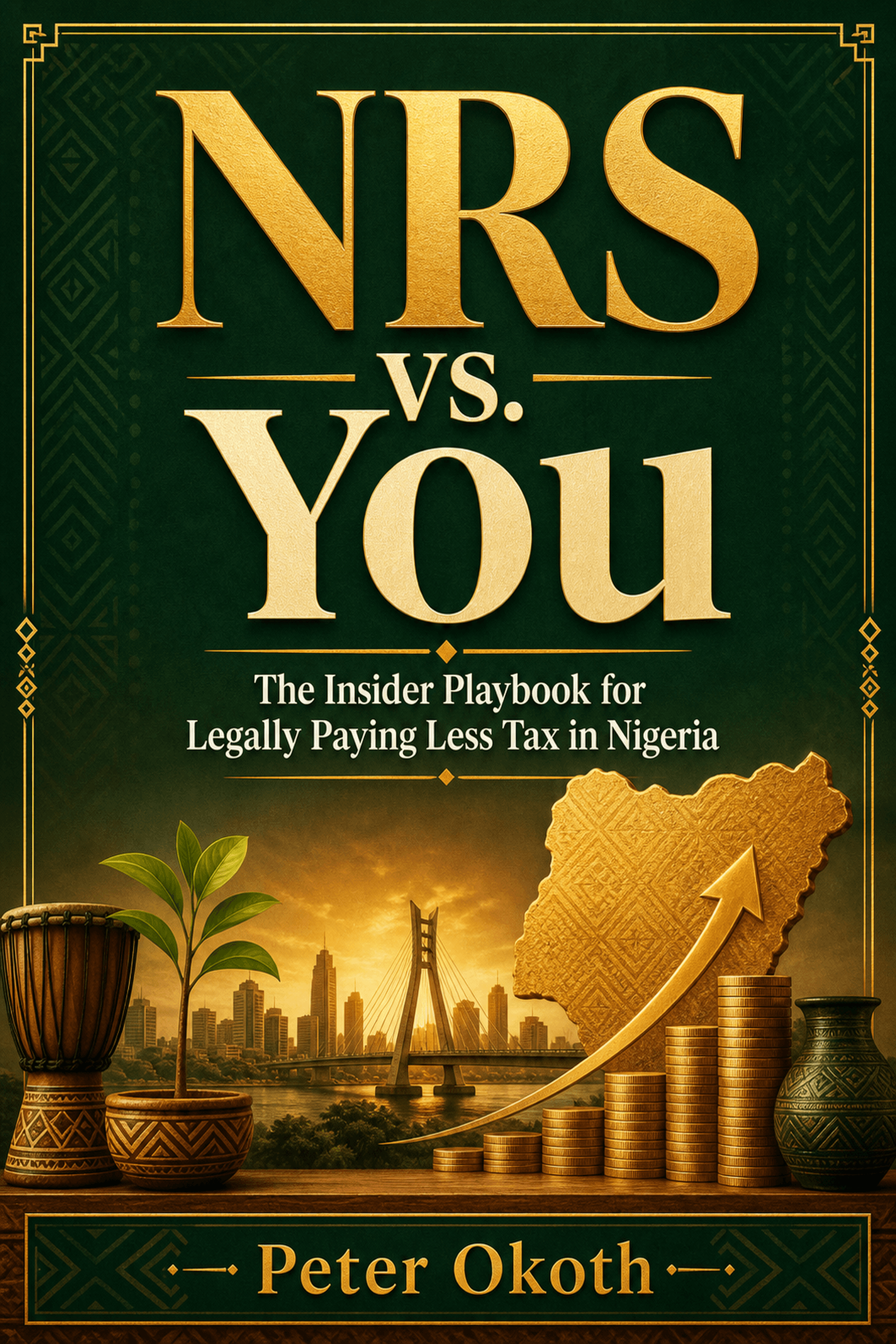
Free first chapter
NRS vs. You
The Insider Playbook for Legally Paying Less Tax in Nigeria
Read the first chapter in your browser. It's free, with no account and no email needed.
Free to read. No account required.
About this book
Many Nigerians never learn that the tax rules include deductions, thresholds and structures meant to be used. The laws are public, the allowable deductions are written down, and yet the information rarely reaches the people it affects most. This book is not about hiding money. It is about understanding the system well enough to follow it with confidence.
NRS vs. You begins with how the Nigeria Revenue Service really works and how to set up your TIN and TaxPro Max properly. You then decode income tax and PAYE, make sense of small business tax decisions including CIT and VAT, and learn about allowable deductions that many people never claim.
Further chapters cover surviving multiple taxation, sector-specific approaches, what is expected of freelancers and digital earners, and how audits and disputes work. A full tax calendar and a chapter on business structure help you stay organized. It is education about the rules, not tax advice for your personal situation.
Look inside
Preface
You are not paying too much tax because you earn too much. You are paying too much tax because nobody ever showed you the legal options sitting right in front of you.
This book is not about breaking the law. It is not about hiding money. It is about understanding the Nigerian tax system well enough to use every deduction, every threshold, and every structure the law already provides — the same ones the Big Four accounting firms use for their wealthiest clients.
Every year, millions of Nigerians hand the Nigeria Revenue Service (NRS), formerly FIRS — renamed the Nigeria Revenue Service (NRS) from 2026 — more money than they legally owe. Not because they are generous — because nobody taught them otherwise. The Companies Income Tax Act, the Personal Income Tax Act, the VAT Act, and the Finance Act are all public documents. The allowable deductions are written in plain English. The thresholds and exemptions are published. But somehow, this information never reaches the people who need it most.
Na so the money dey go — but that ends here.
Who This Book Is For
- Salaried professionals who watch PAYE shrink their salary every month and wonder if there is another way
- Small business owners drowning in CIT, VAT confusion, and overlapping state taxes
- Freelancers and online earners making money from clients abroad and hoping NRS does not notice
- Side hustlers turning a profit on Instagram and WhatsApp but filing nothing
- Anyone who has ever received a NRS penalty and thought, "I did not even know I owed that"
What You Will Walk Away With
By the last page, you will know exactly how your taxes are calculated, which deductions you qualify for, how to file correctly on TaxPro Max, how to handle an audit without panicking, and how to structure your income so you keep more of what you earn — all within the law.
Every strategy in this book is legal. Every number is based on Nigerian tax law as of March 2026. Where rates and thresholds change, we tell you exactly where to check for updates.
Let us get into it.
How NRS Really Works
Chioma runs a hair salon in Surulere, Lagos. Three stylists, a small reception area, loyal customers. She pulls in about ₦3.5 million per month in revenue — solid for a neighbourhood salon in Lagos.
Two years ago, a man she met through a WhatsApp group offered to "handle NRS" for her. He called himself a tax consultant. He charged her ₦20,000 per month, showed up once a quarter to "check things," and told her not to worry.
Last month, Chioma needed a tax clearance certificate — a document from the NRS proving your taxes are up to date. She needed it to bid on a supply contract with a hotel chain. Big opportunity. ₦15 million deal.
She tried logging into TaxPro Max — NRS's online tax management portal — for the first time. What she found made her stomach drop.
The "consultant" had been filing nil returns for 18 months. Zero income declared. Zero tax paid. Meanwhile, her bank statements showed millions flowing through her account every month — and NRS can access bank data. The mismatch had triggered penalties. She owed ₦850,000 in late filing penalties alone, plus the actual tax she should have been paying.
Then Lagos Internal Revenue Service (LIRS) showed up at her shop. She had employees — three stylists on salary. She had never remitted PAYE for them. More penalties. More back-taxes.
The ₦360,000 she had paid the consultant over 18 months? Gone. The hotel supply contract? She could not get the tax clearance. Gone too.
Na so the money dey commot — silently, steadily, because nobody told her how the system actually works.
Here is what Chioma did not know — and what this chapter will teach you.
What You Will Learn
- Identify exactly which taxes apply to your specific income type
- Describe the main tax categories in Nigeria and when each one kicks in
- Explain the difference between tax avoidance (legal, smart) and tax evasion (criminal, expensive)
- Understand the split between NRS (federal taxes) and your state tax authority (state taxes) — this is where most Nigerians get confused
- Read a basic tax obligation summary without your eyes glazing over
Why This Matters
Every year, NRS and the 36 state tax authorities collect trillions of Naira in taxes. Some of that money comes from you — whether you know it or not.
If you are employed, your employer deducts PAYE (Pay As You Earn) from your salary before you see it. If you run a business, you may owe Companies Income Tax (CIT) on your profits — or you may owe nothing at all if your turnover is below ₦25 million. If you sell goods or services above a certain threshold, you owe VAT (Value Added Tax). If you rent out property, your tenant should be deducting withholding tax on the rent. If you sell property, you owe capital gains tax.
The problem is not that these taxes exist. The problem is that most Nigerians do not understand which ones apply to them, how much they actually owe, which authority they should be paying, and — critically — how much they could legally avoid paying.
That ignorance is expensive. Chioma's situation is not unusual. Thousands of Nigerians are either paying the wrong amount, paying the wrong tax, paying the wrong authority, or paying nothing and hoping nobody notices. All four approaches end badly.
This chapter maps the entire terrain. By the end, you will know exactly what gets collected, by whom, which taxes apply to you, and where the legal boundaries sit.
The Tax Categories Every Nigerian Should Understand
The Reality
Walk into any market in Lagos, any mechanic workshop in Aba, any provision store in Kano, and ask the owner what taxes they pay. Most will say "NRS" — as if NRS is a single tax. It is not. NRS is one of several collectors. The taxes themselves are different animals with different rules, different rates, and different deadlines. And some of those taxes are not even collected by NRS — they are collected by your state.
Not knowing the difference is how people like Chioma end up in trouble. Her salon needed to handle both CIT (federal, to NRS) and PAYE for her staff (state, to LIRS). Instead, her fake consultant filed nil returns with NRS and ignored LIRS entirely.
How It Actually Works
Nigeria's tax system has two layers that most other countries do not: federal taxes collected by NRS (formerly FIRS), and state taxes collected by each state's Internal Revenue Service. This is the single most important thing to understand. Pay the right tax to the wrong authority and you are still non-compliant.
Here are the main categories.
1. Companies Income Tax (CIT)
If you run a registered company, you owe CIT on your profits. But the rate depends on your size — and the 2026 NTA made the threshold much more generous:
- Small — Turnover ≤ ₦100 million AND fixed assets ≤ ₦250 million — 0% — Exempt
- Other — Above the small company thresholds — 30% — Applies
Last verified: March 2026. Source: Nigeria Tax Act 2025 (NTA), effective 1 January 2026. Check nrs.gov.ng for current rates.
Read that first row again. Zero percent. If your company's annual turnover is ₦100 million or below (and your fixed assets are under ₦250 million), you pay no CIT at all. Under the old law, this threshold was only ₦25 million — the NTA 2025 quadrupled it. This is one of the most powerful tax incentives in Nigeria, and it now covers the vast majority of Nigerian businesses. We will come back to this in Chapter 4.
Quotes to share
Many Nigerians never learn that the tax rules include deductions, thresholds and structures meant to be used.
Free to read. No account required.