Free first chapter
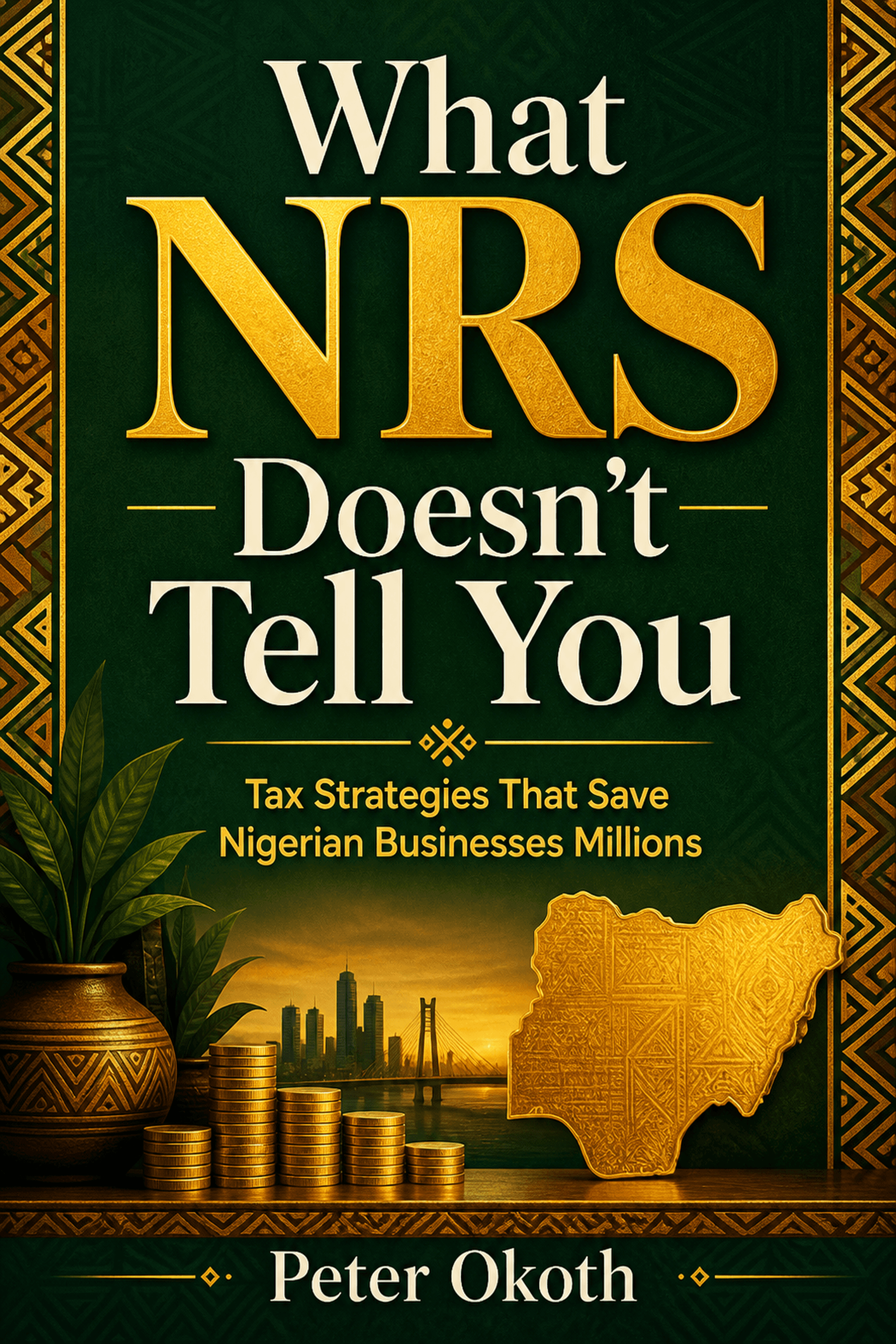
What NRS Doesn't Tell You
Tax Strategies That Save Nigerian Businesses Millions
Read the first chapter in your browser. It's free, with no account and no email needed.
Free to read. No account required.
About this book
Your accountant keeps you compliant. But filing on time is not the same as having a tax strategy, and many Nigerian businesses never get past the first. The tax code includes incentives that owners rarely hear about unless they pay for expensive advisory.
This book is a guide to understanding how the system works so you can plan and ask better questions. It starts with the tax code as a business tool, then looks at how business structures affect what you pay. You see deductions that are easy to miss, VAT strategies for growing businesses, and how to navigate multiple taxation. Later chapters cover sector-specific plays, payroll tax, capital allowances and asset strategy.
It also prepares you for an NRS audit and ends with a template for an annual tax strategy playbook. Shine your eye: it is written for business owners, finance managers and advisers who serve smaller companies and want a structured reference they can come back to each year.
Look inside
Preface
Your accountant keeps you compliant. This book makes you strategic.
There is a difference between filing your tax returns on time and building a tax strategy that saves your business real money. Most Nigerian businesses do the first — and leave millions of Naira on the table because nobody showed them the second.
The Nigerian tax code is not designed to punish businesses. It is designed with incentives — pioneer status, capital allowances, investment tax credits, free trade zone benefits — that most business owners never hear about unless they are paying ₦5 million a year for advisory from one of the Big Four firms. Those firms do not serve businesses doing ₦20 million in revenue. This book does.
If you run a business in Nigeria and suspect you are overpaying tax, you are probably right. Shine your eye — this book shows you exactly where the money is hiding.
Who This Book Is For
- Business owners running limited companies, partnerships, or sole proprietorships generating ₦10 million to ₦500 million in annual revenue
- Finance managers at mid-size companies looking for quick-win deductions and strategies
- Accountants and tax advisors serving SME clients who want a structured reference
- Entrepreneurs who have recently scaled past the small company threshold and are overwhelmed by new obligations
What You Will Walk Away With
By the last page, you will have a complete tax strategy — the right business structure, every deduction you qualify for, a VAT approach that works in your favour, a payroll strategy that benefits both you and your employees, a capital allowances plan for your assets, and an annual tax strategy calendar with quarterly actions.
Every strategy is legal. Every number reflects Nigerian tax law as of March 2026.
Let us build your playbook.
The Tax Code Is a Business Tool
Two logistics companies on the Lagos-Ibadan corridor. Both run fleets of trucks. Both clear about ₦120 million in annual revenue. Both are profitable.
Company A — let us call it Ade Transport — pays ₦28 million in total taxes every year. CIT at 30%, plus Tertiary Education Tax at 2.5%, plus NASENI levy, plus state levies, plus VAT net of input credits. Ade, the owner, considers this the cost of doing business. His accountant files everything on time. He is compliant. He is also overpaying by millions.
Company B — Bayo Haulage — pays ₦16 million. Same revenue. Same industry. Same routes. Bayo's effective tax rate is 13%. Ade's is 23%.
The difference is not fraud. The difference is not a special connection at NRS (formerly FIRS). The difference is that Bayo reads the tax code the way a builder reads a blueprint — looking for the structure that supports the most weight at the lowest cost.
Bayo's company claims full capital allowances on every truck purchased — initial allowance plus annual allowance. His fleet depreciation strategy is planned around the tax calendar. He structures maintenance as deductible expenses with proper documentation. His VAT input credit recovery is systematic — every fuel receipt, every tyre purchase, every spare part is captured and offset. He times major purchases for maximum first-year deduction. He structures driver compensation to maximize tax-efficient allowances.
Ade does none of this. His accountant files returns. He pays what the return says. He has never once asked: "Is this the lowest amount I am legally required to pay?"
This chapter teaches you to think like Bayo.
What You Will Learn
- Calculate your business's effective tax rate (the real rate, not the headline rate)
- Identify the three levels of tax sophistication and determine where your business sits
- Understand why businesses at the same revenue pay vastly different tax bills
- Recognize the strategic opportunities in Nigeria's tax code that most SMEs never use
- Build the mindset shift from "compliance" to "strategy"
Why Most Nigerian Businesses Overpay
The Reality
Nigeria's tax system is complex. CIT, VAT, WHT, the Development Levy, NITDA, state levies, local government levies — the compliance burden is real. Most business owners respond to this complexity in one of two ways:
- Ignore it — file nothing, hope for the best, and pay penalties when caught.
- Outsource it — hire an accountant whose job is compliance, not strategy.
Both approaches leave money on the table. The first costs you in penalties. The second costs you in missed opportunities. Neither approach asks the strategic question: "What is the minimum amount I am legally required to pay, and how do I get there?"
The Three Levels of Tax Sophistication
Level 1: Chaotic. No system. File late or not at all. Respond to NRS letters with panic. Pay whatever is demanded. This is where most informal businesses sit, and where many formal businesses stay longer than they should.
Level 2: Compliant. An accountant files returns on time. You pay what the return says. Penalties are rare. But nobody asks whether the return could show a lower number. This is where most accountant-managed SMEs sit.
Level 3: Strategic. You (or your advisor) actively use the tax code to minimize your bill. Business structure is chosen for tax efficiency. Deductions are claimed systematically. Capital allowances are planned. VAT input credits are recovered. Timing decisions are tax-aware. This is where the top 5% of Nigerian businesses operate.
The difference between Level 2 and Level 3 at ₦100 million revenue is often ₦5-₦15 million per year in tax savings. Over five years, that is ₦25-₦75 million — enough to open a new location, hire a full department, or fund expansion into a new market.
Your Effective Tax Rate — The Number That Actually Matters
How It Actually Works
The headline CIT rate for large companies is 30%. But nobody should actually pay 30% — because the tax code provides deductions, allowances, and incentives that reduce your taxable profit before the rate applies.
Your effective tax rate is the total tax you actually pay divided by your total profit, expressed as a percentage. It includes CIT, the Development Levy, and any other federal levies.
Here is the math for a large company with ₦100 million in revenue and ₦30 million in pre-tax profit:
Level 2 (Compliant) approach:
- Pre-tax profit — ₦30,000,000
- Standard deductions — ₦2,000,000
- Taxable profit — ₦28,000,000
- CIT at 30% — ₦8,400,000
- Development Levy at 4% — ₦1,120,000
- Total tax — ₦9,520,000
- Effective rate — 31.7%
Level 3 (Strategic) approach:
- Pre-tax profit — ₦30,000,000
- Standard deductions — ₦2,000,000
- Additional capital allowances — ₦5,000,000
- Properly documented business expenses — ₦3,000,000
- R&D super-deduction — ₦1,500,000
- Timing-optimized deductions — ₦2,000,000
- Taxable profit — ₦16,500,000
- CIT at 30% — ₦4,950,000
- Development Levy at 4% — ₦660,000
- Total tax — ₦5,610,000
- Effective rate — 18.7%
The difference: ₦3.77 million. Same revenue. Same actual business expenses. The only difference is that Company B's tax advisor found every legal deduction and applied it correctly.
Last verified: March 2026. CIT, TET, and NASENI rates may change with future Finance Acts.
Your Move
Calculate your effective tax rate right now. Pull your last filed CIT return. Add up total tax paid (CIT + TET + NASENI + any other federal levies). Divide by your pre-tax profit. If the number is above 25% for a non-small company, you are likely leaving money with NRS that you do not have to.
What the Tax Code Actually Offers — And Why Most Businesses Miss It
The Reality
Nigeria's tax code is not as hostile to businesses as most business owners believe. It contains:
- 0% CIT for small companies — turnover ≤ ₦100 million (and fixed assets ≤ ₦250 million)
- Pioneer status — 3 to 5 years of CIT exemption for qualifying industries
- Free trade zone benefits — CIT exemption, duty-free imports, no WHT on dividends
- Capital allowances — initial allowance of up to 50% plus annual allowances of 10-25%
- R&D super-deduction — 120% deduction for qualifying research expenditure
- Agricultural income exemption — primary agriculture is CIT-exempt
- Investment tax credits — direct credits against CIT for qualifying investments
- Export expansion grant — for qualifying exporters
Free to read. No account required.