Free first chapter
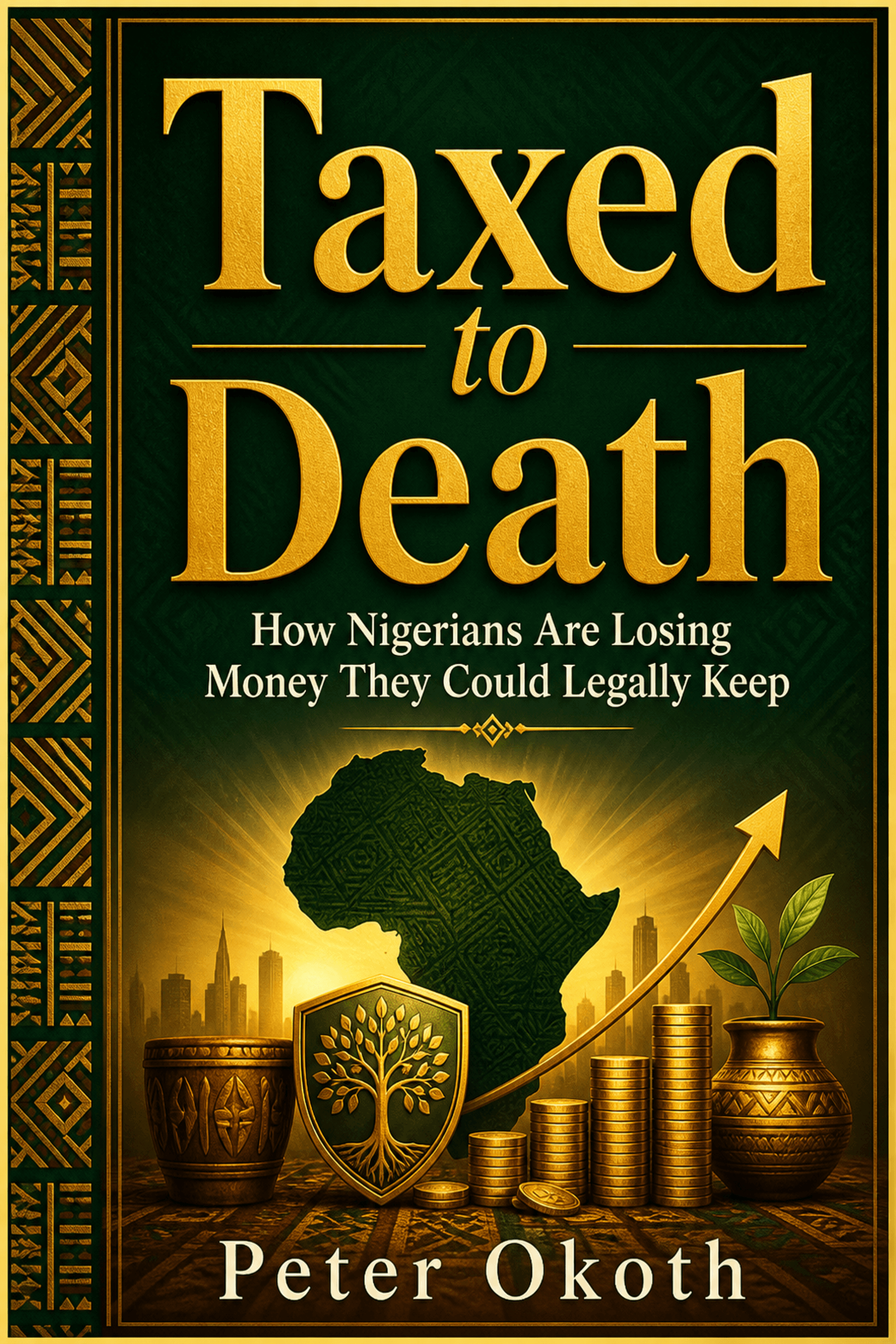
Taxed to Death
How Nigerians Are Losing Money They Could Legally Keep
Read the first chapter in your browser. It's free, with no account and no email needed.
Free to read. No account required.
About this book
Money leaves your account every month, through PAYE, VAT, and levies baked into prices, and no one has ever explained which of it you can legally reduce. Your payslip is full of lines you have never understood, and your side hustle raises questions you are afraid to ask.
Taxed to Death is that missing conversation, in plain language. You will start with where your money quietly goes, then learn to read your payslip. You will see the deductions and reliefs that people rarely hear about, and what the truth is on tax for side hustles. Chapters follow on digital money and NRS, rent and property traps, and how supporting family fits in with tax. You will also learn how to handle scams, penalties, and mistakes, and how to fight back.
The book ends with a simple tax calendar so you know what is due and when. No accounting background is needed, and the book is written for Nigerians who want to understand their money.
Look inside
Preface
You are losing money right now. Not because someone stole it — because nobody ever told you how the system works.
Every month, money leaves your account to NRS, to your state tax board, to LIRS or NRS or both. Your employer deducts PAYE before you see your salary. The government takes 7.5% VAT on almost everything you buy. You pay levies you have never heard of, baked into prices you cannot negotiate. And nobody — not your employer, not your bank, not that uncle who "knows business" — has ever sat you down and explained which of those deductions you can claw back.
This book is that conversation. No long thing — we show you exactly where Nigerians lose money they could legally keep, and what to do about it.
Who This Book Is For
- Young professionals who have never understood what their payslip actually means
- Side hustlers selling on Instagram, WhatsApp, and Jumia who have no idea what NRS expects from them
- Anyone supporting family — because black tax is real, but your own taxes should not make it worse
- Everyone who has ever felt overtaxed and wondered if there is a legal way to pay less
What You Will Walk Away With
By the last page, you will know exactly where your money goes to tax, which deductions and reliefs you qualify for, how to handle side income legally, and how to deal with NRS mistakes and penalties. No accounting background needed. No jargon. No wahala.
Let us recover your money.
The Money You Don't Know You Are Losing
Chidinma is 28. She works as a marketing coordinator at an FMCG company in Victoria Island, Lagos. Salary: ₦400,000 per month gross. After deductions, ₦281,000 hits her account.
₦119,000 disappears every month before she sees it. That is ₦1.43 million per year — money that leaves her account and goes... where, exactly?
She has never checked. She assumed it was "tax." She assumed it was unavoidable. She assumed somebody somewhere was doing this correctly.
She was wrong on all three counts.
₦119,000 sounds bad. But that is only the visible part. The money Chidinma loses to tax does not stop at her payslip. Every time she buys fuel for her car, 7.5% VAT is included in the pump price. Every time she buys groceries at Shoprite, VAT is in the receipt. Every time her bank pays interest on her savings and deducts 10% withholding tax — that is her money too. Every time the Naira drops another 5% against the dollar and her ₦281,000 buys less than it did last month — that is a tax in everything but name.
When you add it all up, Chidinma is working until Thursday every week just to pay taxes, deductions, and levies she never agreed to and barely understands.
Na so money dey go — and nobody is explaining where.
This chapter opens the books.
What You Will Learn
- Calculate the true percentage of your income that goes to tax (not just PAYE)
- Identify hidden taxes you pay every day without realizing it
- Understand the difference between taxes you can reduce and taxes you cannot
- See exactly where the money goes before it reaches your bank account
- Know which deductions exist to claw back some of what you lose
Your Visible Taxes — The Payslip Deductions
Let us start with what you can see. On a ₦400,000 gross salary, here is what typically comes out:
- PAYE (income tax) — ~₦37,000 — State Internal Revenue Service (LIRS in Lagos)
- Pension (employee 8%) — ₦32,000 — Your PFA (Pension Fund Administrator)
- NHF (2.5% of basic) — ~₦5,000 — Federal Mortgage Bank of Nigeria
- NHIS (5% of basic) — ~₦10,000 — National Health Insurance
- Other deductions — ~₦35,000 — Varies (union dues, cooperative, etc.)
- Total deducted — ~₦119,000
- Take-home — ~₦281,000 — Your bank account
Amounts are illustrative for a ₦400,000 gross salary with standard allowance structure. Your payslip will differ. Last verified: March 2026.
Already, 30% is gone before you see it. But here is what your payslip does not show.
Your Invisible Taxes — What You Pay Every Day
VAT: The 7.5% You Never Agreed To
Everything you buy — data, groceries (processed), electronics, restaurant meals, clothing, fuel — includes 7.5% VAT. This is baked into the price. You never see a line item. You never agreed to it. You cannot avoid it.
If Chidinma spends ₦180,000 per month on VATable goods and services (a conservative estimate for someone in Lagos), she pays approximately ₦12,500 per month in VAT. That is ₦150,000 per year.
Bank Interest WHT: The 10% They Quietly Take
If you have savings and earn interest, your bank deducts 10% withholding tax on that interest before crediting it to your account. Most Nigerians never notice because banks do not highlight it. On ₦50,000 in annual interest, that is ₦5,000 taken.
The "Inflation Tax": The Devaluation Nobody Calls a Tax
This is not technically a tax. But it functions exactly like one. When the Naira loses 30% of its value against the dollar in a year — as it has done repeatedly — your savings lose 30% of their purchasing power. Your ₦281,000 monthly take-home bought more six months ago than it does today.
If you saved ₦1 million at the start of 2025, and the Naira depreciated 30% against the dollar by year-end, your savings lost ₦300,000 in international purchasing power. No tax authority collected it. But it is gone just the same.
Fuel and Energy: The Embedded Cost
Since the fuel subsidy removal, petrol prices have surged. The price includes VAT, excise duties, and infrastructure levies. If you spend ₦50,000 per month on fuel (or diesel for your generator — because nepa no dey), a significant portion is embedded taxes and levies.
The Total Tax Burden — Let Us Add It Up
For Chidinma at ₦400,000 gross monthly:
- PAYE — ₦444,000 — 9.3%
- Pension (employee share) — ₦384,000 — 8.0%
- NHF — ₦60,000 — 1.3%
- NHIS — ₦120,000 — 2.5%
- VAT (estimated) — ₦150,000 — 3.1%
- Bank interest WHT — ₦5,000 — 0.1%
- Fuel/energy embedded levies — ₦30,000 — 0.6%
- Total visible + invisible — ₦1,193,000 — 24.9%
One quarter of her gross income. And this does not include the Naira devaluation effect, which could add another 10-30% in lost purchasing power depending on the year.
Sound familiar?
What You Can and Cannot Reduce
Here is the critical distinction:
You CANNOT avoid:
- VAT on purchases (built into prices)
- WHT on bank interest (deducted automatically)
- Pension contributions (mandatory — but your money, accessible at retirement)
- NHF (mandatory)
You CAN reduce:
- PAYE — through claiming deductions your employer may not be applying (Chapter 3)
- Your effective PAYE rate — through proper CRA application and additional reliefs
- Some WHT — by offsetting it against your annual tax liability if you file returns
You CAN eliminate (legally):
- Overpaid PAYE due to employer errors (more common than you think)
- Penalties from non-compliance (by filing correctly and on time)
The rest of this book focuses on the taxes you CAN reduce. Because even saving ₦100,000 per year — less than ₦10,000 per month — compounds into real money over a career. And for most Nigerians, the available savings are much larger than that.
Your Checklist
- ☐ — I know my gross salary — The number before deductions
- ☐ — I know my net salary — The number that hits my account
- ☐ — I have calculated the gap — Gross minus net = total deductions
- ☐ — I understand what each deduction is — PAYE, pension, NHF, NHIS, others
- ☐ — I know which deductions I can reduce — PAYE is the main one (Chapter 3)
Watch Out For — Chapter Summary
- Assuming "tax" is just PAYE — Your total tax burden is 25%+ when you include invisible taxes.
- Never checking your payslip — Many employers apply PAYE incorrectly. Chapter 2 shows you how to verify.
- Ignoring deductions — Under the 2026 NTA, pension contributions, NHF, and the new rent relief (20% of annual rent, max ₦500,000) reduce your taxable income before PAYE is calculated. Most salaried Nigerians never claim the rent relief because they do not submit documentation to HR.
- Treating the Naira devaluation as "just the economy" — It is the biggest wealth eroder for most Nigerians. Every financial plan must account for it.
- Accepting payslip deductions without understanding them — ₦119,000/month is not a rounding error. Know where it goes.
Quotes to share
Your payslip is full of lines you have never understood, and your side hustle raises questions you are afraid to ask.
Free to read. No account required.