Free first chapter
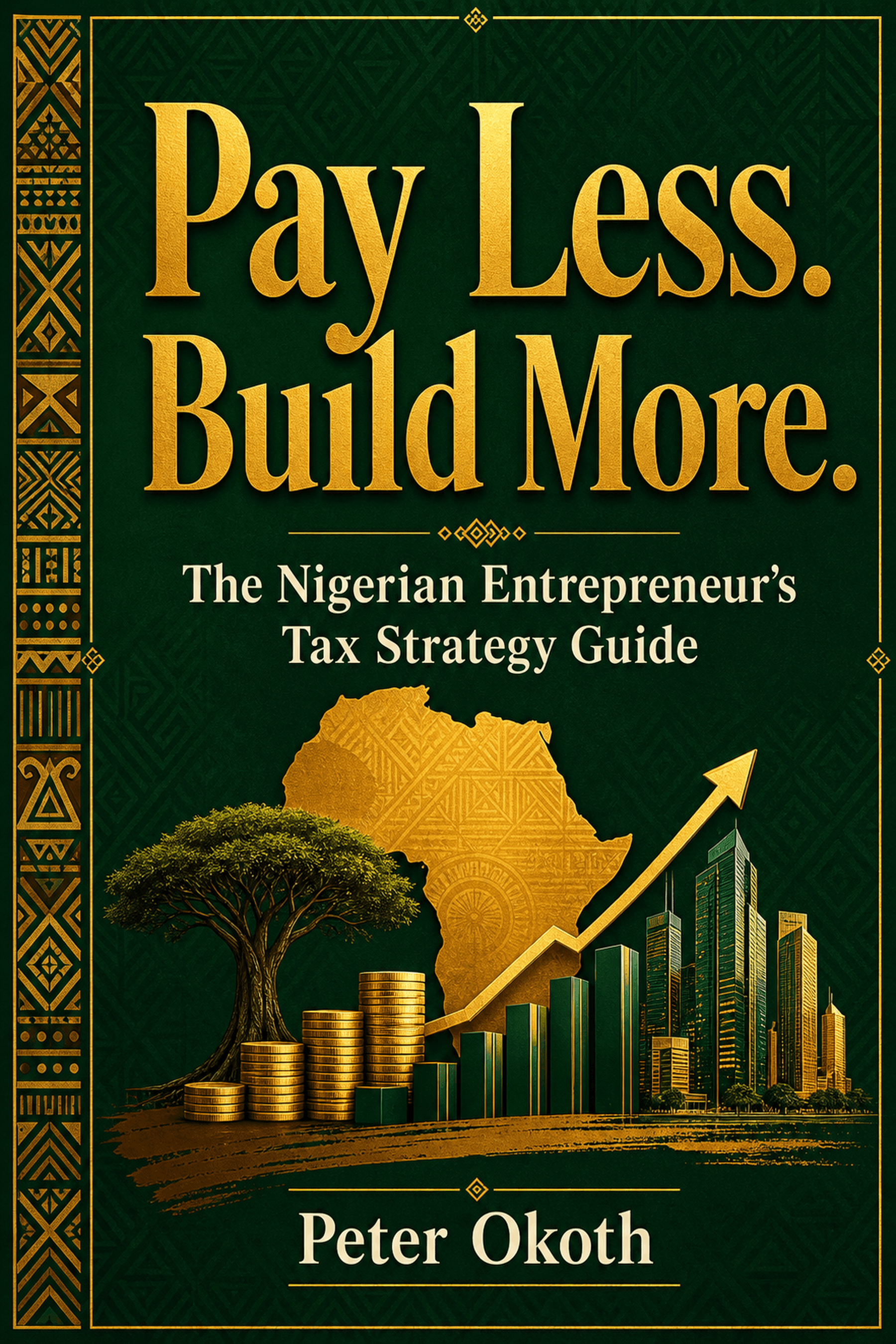
Pay Less. Build More.
The Nigerian Entrepreneur's Tax Strategy Guide
Read the first chapter in your browser. It's free, with no account and no email needed.
Free to read. No account required.
About this book
You started a business to build something, not to become a tax expert. Yet in Nigeria, tax decisions made early can either speed up your growth or quietly drain it, depending on whether anyone told you the rules.
Pay Less. Build More. follows your journey from the day you register. You will learn how to choose a business structure from day one, how to get through the first year of compliance, and how to price with tax built in. The book explains what changes as you scale past tax thresholds, what hiring your first employee means in practice, and how investor money, loans, and grants are treated. Separate chapters cover tax for tech and digital entrepreneurs and how to protect your business from surprises from the Nigeria Revenue Service.
It ends with a simple tax system you can keep running as the business grows. It suits first-time founders, scaling owners, and diaspora Nigerians building at home.
Look inside
Preface
You started a business to build something. Not to become a tax expert.
But here is the truth nobody tells you when you register at the Corporate Affairs Commission (CAC): the Nigerian tax system is going to take a bigger bite of your revenue than your rent, your staff costs, or your generator diesel — unless you build tax into your business design from day one.
This book follows your journey. From the day you register, through your first year of compliance, past every threshold that triggers new obligations, all the way to the point where you are hiring staff, raising capital, and building something real. At every stage, the tax decisions you make will either accelerate your growth or bleed you dry.
Hustle dey pay — but only if NRS, your state tax board, and the local government are not eating your margins because nobody told you the rules.
Who This Book Is For
- First-time entrepreneurs registering a business and overwhelmed by tax obligations
- Scaling founders hitting new revenue thresholds and unsure what changes
- Side-hustle-to-company transitioners ready to formalize
- Tech founders and digital entrepreneurs building in Nigeria's growing startup ecosystem
- Diaspora Nigerians building businesses in Nigeria remotely
What You Will Walk Away With
By the last page, you will have the right business structure for your stage, pricing that accounts for tax, a first-year tax survival kit, clear thresholds for every scaling milestone, a hiring plan that includes PAYE reality, and a simple tax system that grows with your business.
Pay less. Build more. Let us go.
Tax Is a Building Tool
Amaka is 27. Six months ago, she quit her job at a commercial bank in Ikoyi to start a food delivery business. She saw the gap — busy professionals in Lagos who want home-cooked Nigerian food delivered to their offices. Not the fast food chains. Real food. Egusi, jollof, pounded yam. Proper.
First month: ₦1.2 million in revenue, ₦300,000 profit after costs. She was excited. By month six: ₦4 million in revenue. She had hired two cooks and a rider. The business was working.
Then the letter arrived. LIRS — Lagos Internal Revenue Service. They wanted to know why she had employees but no PAYE remittance on record. They wanted to know where her company's CIT returns were. They wanted back-taxes, penalties, and documents she had never heard of.
Amaka panicked. She called her former colleague at the bank — the one who always "knew things." He said: "Ah, you need to register. Go to Nigeria Revenue Service (NRS), formerly FIRS. Get a TIN. But be careful — once they have your name, they will come for you."
This is the advice that kills Nigerian businesses. Not the tax. The fear of the tax.
Here is what Amaka did not know: if she had registered her business correctly from the start — a limited company through CAC, turnover under ₦100 million — her CIT rate would be zero percent under the NTA 2025. She would owe nothing in company income tax. The only obligations would be PAYE for her staff (deducted from their salaries, not her pocket). Small companies are also exempt from VAT filing and the Development Levy.
Twenty minutes of setup on day one would have prevented six months of penalties and a terrifying LIRS letter. And it would have cost her exactly nothing in CIT.
Tax is not the enemy of your business. Ignorance about tax is.
What You Will Learn
- Understand why tax is a design parameter, not a punishment
- Know the 0% CIT threshold and why it is your greatest startup advantage
- See how Nigeria's top startups handled tax from day one
- Calculate the real cost of ignoring tax (it is always more expensive than compliance)
- Build the mindset that turns tax from a crisis into a background process
The 0% CIT Advantage — Nigeria's Gift to Small Companies
Let us start with the single most important fact in this book:
If your company's annual turnover is ₦100 million or below (and fixed assets are under ₦250 million), you pay 0% Companies Income Tax.
Read that again. Zero. Not reduced. Not deferred. Zero.
This means that a properly registered Nigerian limited company earning ₦99 million per year owes nothing in CIT. The profits stay in the business. No CIT return showing tax owed. No quarterly installment payments. Just file your annual return showing zero tax liability, and keep building.
The NTA 2025 quadrupled this threshold from the old ₦25 million limit. This exists because the government wants small businesses to grow. It is not a loophole, a trick, or something that will be "caught." It is the Nigeria Tax Act 2025 — the law.
Last verified: March 2026. Source: NTA 2025, effective 1 January 2026.
Here is what this means in practice:
- ₦10M — 0% — ₦0 — All ₦5M
- ₦20M — 0% — ₦0 — All ₦5M
- ₦25M — Crossing to 20% — ₦1,000,000 — ₦4M
- ₦50M — 20% — ₦1,000,000 — ₦4M
- ₦100M — 20% — ₦1,000,000 — ₦4M
- ₦110M — 30% — ₦1,500,000 — ₦3.5M
Assumed ₦5M profit for illustration. Last verified: March 2026.
The jump from ₦24M to ₦26M in turnover costs you ₦1 million in CIT on ₦5M profit. That is real money. Chapter 5 teaches you how to manage this threshold as you scale.
But right now, at the start of your journey, this threshold is pure advantage. Use it.
The Cost of Ignoring Tax — The Math Nobody Shows You
Amaka thought ignoring tax saved her money. Here is what it actually cost:
- LIRS late filing penalty (6 months) — ₦150,000
- Back PAYE for 2 employees (6 months) — ₦180,000
- LIRS penalty on unpaid PAYE — ₦36,000
- Emergency accountant to sort everything out — ₦200,000
- Lost time (2 weeks dealing with LIRS instead of growing) — Unquantifiable
- Total cost of ignoring tax — ₦566,000
If she had set up correctly from day one:
- CAC limited company registration — ₦150,000
- TIN registration — ₦0 (free)
- TaxPro Max setup — ₦0 (free)
- Annual CIT (0% threshold) — ₦0
- Monthly PAYE filing (done by payroll) — ₦0 additional cost
- Total cost of doing it right — ₦150,000
The difference: ₦416,000. And that is just six months. If Amaka had ignored tax for two years — as many Nigerian entrepreneurs do — the penalties would have been in the millions.
No be say tax go finish you. Na the penalty go finish you.
How the Best Nigerian Startups Think About Tax
You know the names: Flutterwave, Paystack, Andela, Moniepoint. They did not become successful by ignoring tax. They became successful by handling tax correctly from the start — and then optimizing as they grew.
Here is what they all have in common:
- Incorporated from day one. Not "we will sort it out later." From the first line of code, they were limited companies registered with CAC.
- Tax-compliant before revenue. They had TINs and filed nil returns before they made a single Naira. This made them investable.
- Structure designed for growth. Their entity structure, compensation packages, and equity arrangements were designed with tax in mind — not as an afterthought.
Investors check tax compliance before writing cheques. Government contracts require tax clearance certificates. Bank loans require evidence of filed returns. Your tax status is your business's financial credibility.
The Builder's Tax Mindset
Here is the mindset shift this book teaches:
- "Tax is something I deal with when NRS comes" — "Tax is something I set up once and maintain"
- "Paying tax means losing money" — "Paying the right amount of tax means I am building legally"
- "I am too small for tax to matter" — "The 0% CIT threshold is my competitive advantage"
- "My accountant handles it" — "I understand the basics, my accountant handles the details"
- "Compliance is expensive" — "Non-compliance is 10x more expensive"
Free to read. No account required.