Free first chapter
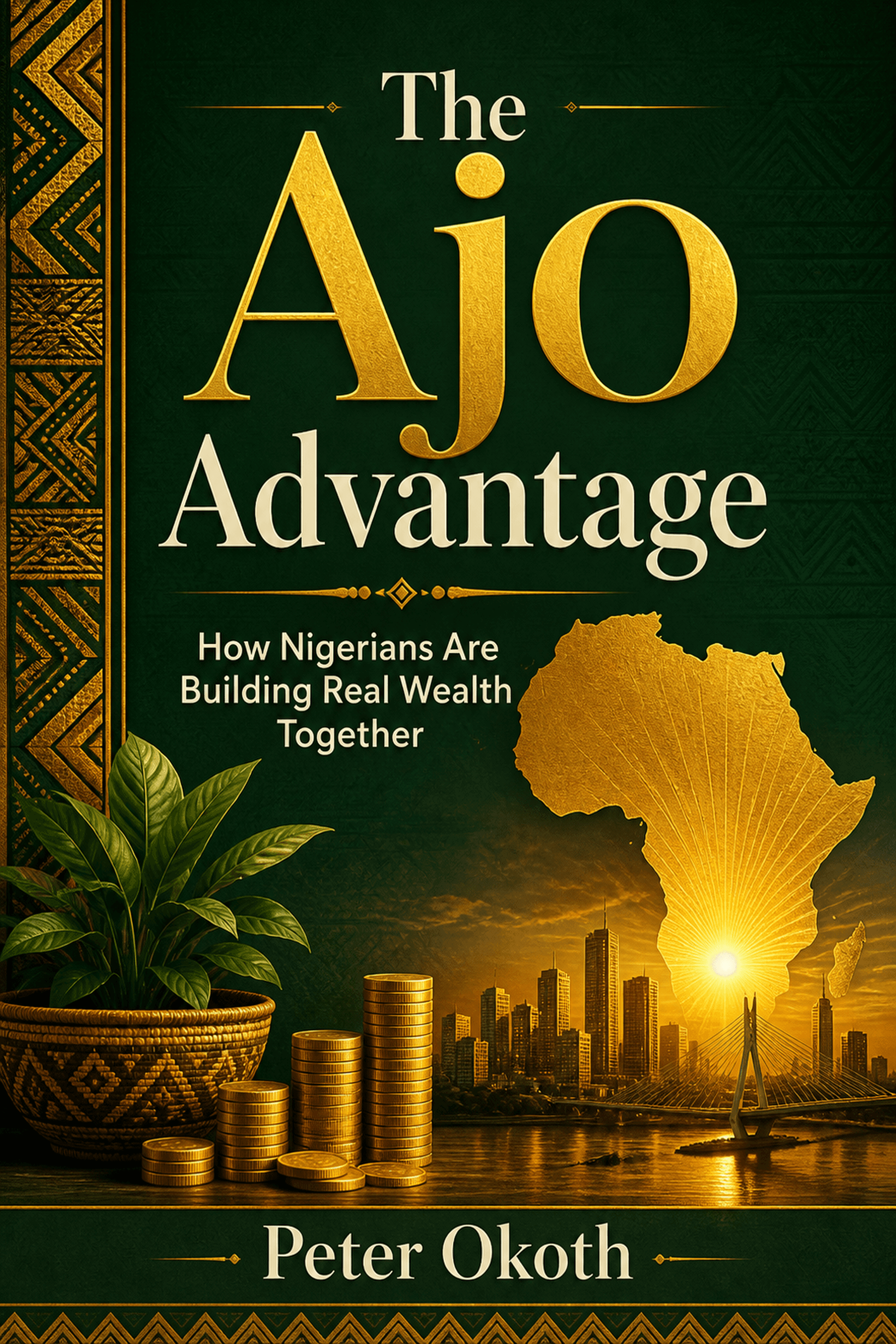
The Ajo Advantage
How Nigerians Are Building Real Wealth Together
Read the first chapter in your browser. It's free, with no account and no email needed.
Free to read. No account required.
About this book
You have heard the advice to save more and invest early, and you have nodded along. But nobody told you where to actually put the money. Which cooperative? Which fund? How do you buy a Treasury bill? And all the while your Naira savings are losing ground against the dollar.
The Ajo Advantage is a practical guide to building wealth in a Nigerian context. It starts with the money trap you do not see, then decodes ajo and esusu and shows how cooperative societies can take things to the next level. You will walk through buying your first Treasury bill, opening an account on the Nigerian Exchange, and looking at real estate beyond the hype. The book also covers Naira hedging and dollar investments, putting a portfolio together, protecting what you build, and writing your own investment plan.
It is educational, not personalised financial advice, and all investing carries risk, so it focuses on helping you understand your options and their costs.
Look inside
Preface
You have heard the advice. Save more. Invest early. Let your money work for you. And you have nodded along, because it sounds right – but nobody told you where to actually put the money.
Not in theory. In practice. Which cooperative society. Which money market fund. How to buy a Treasury bill. How to open a brokerage account on the NGX. Whether that plot in Ibeju-Lekki is a wealth-building move or an Omo-Onile trap. The specific steps, the real costs, the actual returns, and the traps that catch people who go in blind.
And nobody mentioned the thing that is quietly destroying your wealth while you sleep: the Naira. Every month your money sits in a savings account earning 3%, the Naira loses ground against the dollar. Your savings are not just sitting still – they are shrinking. Na so the money dey go.
That is what this book fixes.
Who This Book Is For
- The salaried Nigerian who has been meaning to invest "next month" for the last three years
- The cooperative member who deposits every month but has no idea whether the returns are good or whether the cooperative is safe
- The ajo group member whose contributions circulate but never grow
- The OPay saver sitting on ₦500,000 earning almost nothing, wondering what else is out there
- The first-time investor who has ₦50,000 to ₦500,000 and wants to know exactly where to put it
- Anyone who watched the Naira slide from ₦400 to ₦1,500 per dollar and thought, "I should have done something"
What You Will Walk Away With
By the last page, you will understand every major investment vehicle available to ordinary Nigerians – ajo and esusu groups, cooperative societies, Treasury bills, FGN bonds, NGX stocks, real estate, and dollar-denominated investments. You will know the real returns, the real costs, the real risks, and the exact steps to get started with each one. You will have a diversified investment plan that includes Naira hedging – because in Nigeria, building wealth without protecting against currency depreciation is like filling a bucket with a hole in the bottom.
Every Naira amount, every interest rate, and every fee in this book reflects real Nigerian market conditions as of 2026. Where rates change, we tell you exactly where to check for updates.
Let us put your money to work.
The Money Trap You Do Not See
Chidinma is 31. She works as a marketing executive at a consumer goods company on the Island in Lagos. Her take-home pay is ₦450,000 per month. She is not bad with money. She does not overspend. She does not carry payday loan debt. She has been doing something most Nigerians never do – saving consistently.
For four years, Chidinma has put ₦50,000 every month into her bank savings account at one of the big five banks. She feels responsible. Disciplined. The balance reads ₦2.5 million.
Here is what the balance should read.
If Chidinma had put that same ₦50,000 per month into a money market fund (MMF) – a low-risk investment fund that pools money to invest in short-term government and corporate debt – earning 14% per year, she would have approximately ₦3.2 million. That is ₦700,000 more. For doing nothing different except choosing a different place to put her money.
If she had split the money between a cooperative society earning 15% dividends and Treasury bills (T-bills) – short-term government debt instruments paying 18% – the number would be even higher.
But here is the part that should keep Chidinma awake at night. In 2022, her ₦2.5 million was worth roughly $5,400 at the parallel market rate. By March 2026, that same ₦2.5 million is worth roughly $1,600. She did not spend the money. She did not get scammed. The Naira lost over 70% of its value against the dollar. Her savings account did not just fail to grow – it collapsed in real terms.
Chidinma did not lose money. She left it in a trap. And she is not alone.
Here is what Chidinma did not know – and what this chapter will teach you.
What You Will Learn
- Calculate the real return on your current savings after inflation and Naira depreciation
- Name every major investment vehicle available to ordinary Nigerians and what each one actually pays
- Understand risk and return without the jargon – what "safe" really costs you in Nigeria
- Assess whether you are ready to invest or need to sort out the basics first
Why This Matters
Let us start with a number that most banks would prefer you not think about.
The average savings account at a Nigerian commercial bank pays between 1.5% and 4% interest per year. Meanwhile, inflation in Nigeria runs between 25% and 35% per year. Last verified: March 2026.
Do the math. If your savings earn 3% but prices rise by 28%, your money is losing 25% of its purchasing power every year. That ₦1 million in your savings account can buy dramatically less at the end of the year than it could at the beginning. You are not saving. You are slowly, quietly, bleeding money.
And that is just inflation. Layer on Naira depreciation – the decline in the Naira's value against foreign currencies, which makes imported goods, school fees for foreign education, and everything priced in dollars more expensive – and the picture gets worse. A Nigerian holding only Naira-denominated savings has watched their purchasing power collapse by over 70% since 2020 in dollar terms.
This is not your bank's fault – or maybe it is, depending on how you look at it. Banks take your deposits and invest them in the same T-bills and bonds that earn 18-22%. They pay you 3% and keep the difference. That is their business model. It is legal. It is also the reason you need to learn how to invest directly.
The gap between what your bank pays you and what your money could actually earn is the money you are leaving on the table. For Chidinma, over four years, that gap was at least ₦700,000 in Naira terms – and millions more when you factor in what she could have protected through dollar-denominated investments.
And all of this assumes the simplest, lowest-risk investment option. The returns get better from there.
The Savings Account Lie
The Reality
Walk into any bank branch in Lagos, Abuja, or Port Harcourt and ask to open a savings account. The process is smooth. The customer service is polite. Nobody will mention that the account you are opening will lose you money in real terms – not just a little, but catastrophically.
Banks need your deposits. Your ₦500,000 sitting in a savings account is money they can lend to someone else at 25-30% interest, or invest in T-bills at 18-22%. They pay you 3%. Everyone is happy – except you, once you understand the math.
How It Actually Works
Here is what happens to ₦1,000,000 over five years at different return rates:
- Bank savings account — 3% — ₦1,159,000 — ₦338,000 (you lost 66%)
- OPay/PalmPay savings — 6% — ₦1,338,000 — ₦390,000 (still losing)
- Money market fund — 14% — ₦1,925,000 — ₦562,000 (losing less)
- Treasury bill (364-day) — 18% — ₦2,288,000 — ₦668,000 (breaking even-ish)
- Cooperative dividends — 15% — ₦2,011,000 — ₦587,000 (modest real return)
Free to read. No account required.