Free first chapter
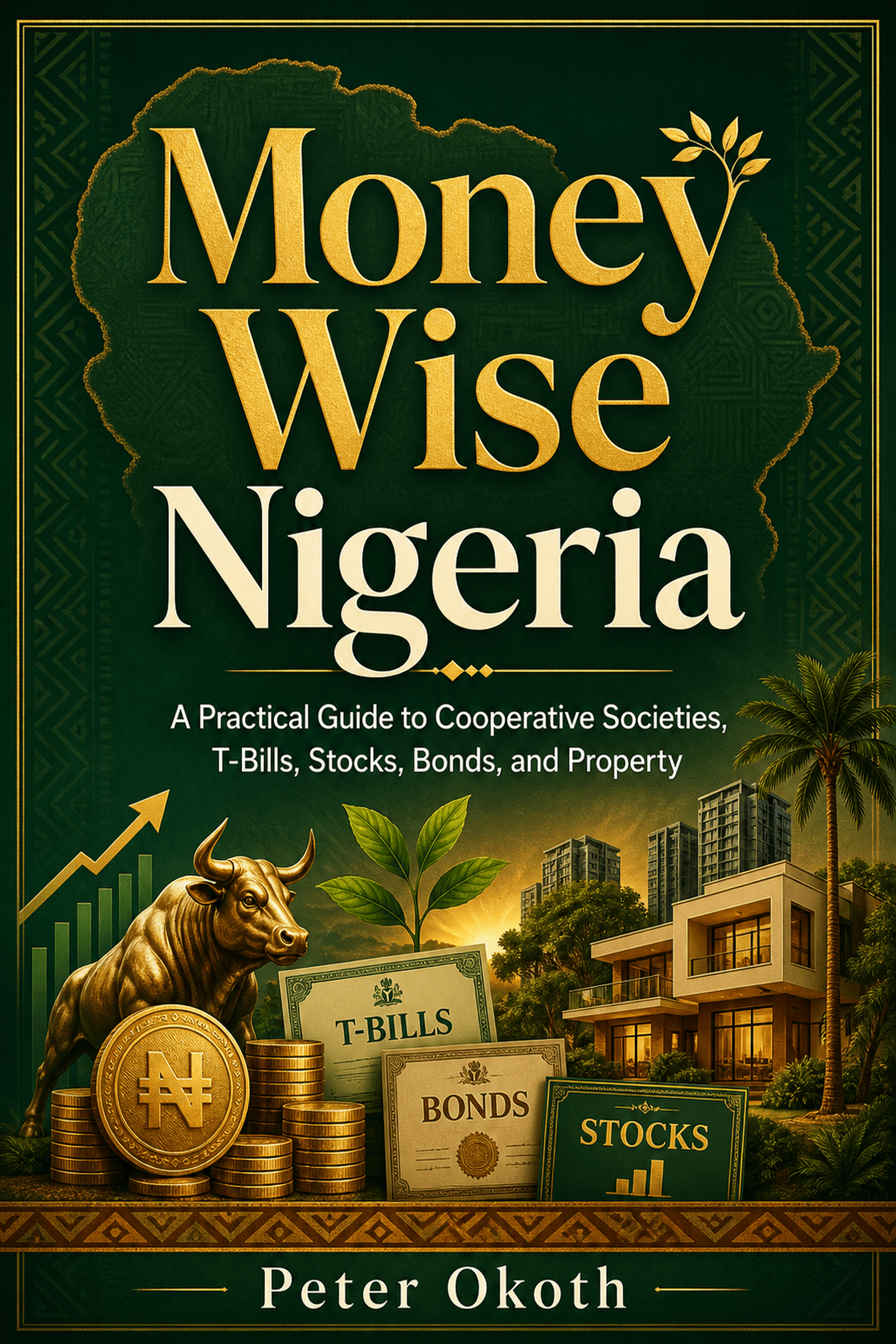
Money Wise Nigeria
A Practical Guide to Cooperative Societies, T-Bills, Stocks, Bonds, and Property
Read the first chapter in your browser. It's free, with no account and no email needed.
Free to read. No account required.
About this book
You have heard the advice to save more and invest early, and you have nodded along, but nobody told you how. Which cooperative is worth joining, how to buy a Treasury bill, how to open a brokerage account and buy a first share on the NGX, whether a plot someone is selling has real papers.
Money Wise Nigeria treats each option as a vehicle and explains how it works, step by step, along with the traps that catch first-time investors. After a look at the money you may be leaving on the table, you move through cooperative societies, money market funds, Treasury bills and FGN bonds, and your first share on the NGX.
The book also covers real estate investment, how an ajo group can invest its pool instead of only rotating it, building a portfolio, and protecting your wealth. It closes with a personal investment plan, and exercises help you apply each chapter. It is an educational guide with no promises about returns.
Look inside
Preface
You have heard the advice. Save more. Invest early. Let your money work for you. And you have nodded along, because it sounds right – but nobody told you how.
Not the theory. The steps. Which cooperative society is worth joining. Which money market fund to open first. How to actually buy a Treasury bill from the Central Bank of Nigeria. How to open a brokerage account and buy your first share on the NGX. Whether that plot your uncle's friend is selling in Epe has a real C of O or a photocopy from 1994.
That is what this book does. Every chapter is a vehicle. Every vehicle comes with step-by-step instructions, real numbers, real returns, and the specific traps that catch first-time Nigerian investors.
Who This Book Is For
- The salaried Nigerian who deposits into a cooperative every month but has no idea whether the returns are good
- The saver with ₦500,000-₦5,000,000 sitting in a bank account earning almost nothing
- The first-time investor who has heard of T-bills but does not know how to buy one
- The ajo group member who wants to invest the pool instead of just rotating it
- The aspiring property investor who needs to understand the numbers before committing millions
- Anyone who wants a single, comprehensive guide to every investment option available to ordinary Nigerians
What You Will Walk Away With
By the last page, you will understand cooperative societies, money market funds, Treasury bills, FGN bonds, NGX stocks, real estate, and ajo group investing. You will know the real returns, the real costs, the real risks, and the exact steps to get started with each one. You will have a diversified investment plan tailored to your income, your goals, and your risk tolerance.
Every Naira amount, every interest rate, and every fee in this book reflects real Nigerian market conditions as of 2026. Where rates change, we tell you exactly where to check for updates.
Make we start.
The Money You Are Leaving on the Table
Adaeze is 33. She works as a project manager at a construction firm in Abuja. Her take-home pay is ₦520,000 per month. She is disciplined. She does not carry credit card debt. She does not borrow from Fairmoney or Carbon. For five years, she has been putting ₦60,000 per month into her bank savings account at a Tier 1 bank.
She has ₦3.7 million saved. She feels responsible.
Here is what that ₦3.7 million should be.
If Adaeze had put the same ₦60,000 per month into a money market fund (MMF) – a low-risk investment fund that pools money to invest in short-term government and corporate debt – earning 14% per year, she would have approximately ₦5.1 million. That is ₦1.4 million more. Not from working harder. Not from earning more. Just from choosing a different container for her money.
If she had split it between a cooperative society earning 15% and Treasury bills (T-bills) – short-term government debt instruments issued by the Central Bank of Nigeria paying 18% – the gap would be even wider.
Adaeze did not lose money to a scam. She lost it to ignorance of better options. She is in good company – most Nigerian savers are in the same position.
Here is what Adaeze did not know – and what this chapter will teach you.
What You Will Learn
- Calculate the real return on your current savings after inflation
- Name every major investment vehicle available to ordinary Nigerians and what each one actually pays
- Understand risk and return without the jargon
- Assess whether you are ready to invest or need to sort out the basics first
The Savings Account Reality
The average savings account at a Nigerian commercial bank pays between 1.5% and 4% interest per year. Meanwhile, inflation – the rate at which prices increase, reducing what your money can buy – runs between 25% and 35% in Nigeria. Last verified: March 2026.
If your savings earn 3% but prices rise by 28%, your money is losing 25% of its purchasing power every year. That ₦1 million in January can buy significantly less by December. You are not saving. You are watching your money shrink.
Banks take your deposits and invest them in T-bills earning 18-22%. They pay you 3%. That is their business model. It is legal. It is also the reason you need to learn how to invest directly.
Here is what happens to ₦1,000,000 over five years at different return rates:
- Bank savings account — 3% — ₦1,159,000
- OPay/PalmPay savings — 6% — ₦1,338,000
- Money market fund — 14% — ₦1,925,000
- Treasury bill (364-day) — 18% — ₦2,288,000
- Cooperative dividends — 15% — ₦2,011,000
Returns are illustrative based on typical rates. Actual returns vary. Last verified: March 2026.
That table is the entire argument of this book in five rows. Same starting amount. Same timeline. Radically different outcomes.
Where Nigerians Actually Keep Money
Cash at home. Earns 0%. Loses 28% to inflation every year. At risk of theft, fire, and family members. The money under your mattress dey shrink every day.
Bank savings account. Earns 1.5-4%. Shrinking in real terms.
OPay/PalmPay savings. Earns 5-8%. Better, but still below inflation.
Cooperative society deposits. Earn 8-18% in dividends. The most popular structured investment vehicle for working Nigerians.
Money market funds. Earn 12-16%. Accessible from ₦5,000. Withdrawable within 1-3 business days.
Treasury bills. Earn 16-22%. Safest investment in Nigeria – backed by the Federal Government.
NGX stocks. Returns vary widely. Higher risk, higher potential reward.
Real estate. Returns vary by location. Requires significant capital. Carries fraud risk.
Your Move
Do this now: Check your bank account balance and any other place your money sits. Add them up. That is the money currently working against you. By the end of this book, you will have a plan for every Naira.
The Investment Landscape
Here is every major investment vehicle available to you:
- Cooperative society — ₦5,000-30,000/month — 8-18% (dividends) — Low-Medium — Medium — Long-term savings, loans
- Money market fund — ₦5,000 — 12-16% — Low — High (1-3 days) — Emergency fund, parking money
- Treasury bill (91-day) — ₦50,000 (via bank) — 16-22% — Very Low — Low (locked) — Short-term goals
- FGN Savings Bond — ₦5,000 — 14-19% — Very Low — Low (2-3 years) — Long-term goals
- NGX stocks — ₦10,000 — Varies (-30% to +50%) — High — High (sell in 3 days) — Long-term wealth
- Real estate — ₦5,000,000+ — Varies widely — Medium-High — Very Low — Long-term wealth
- Ajo group investment — Varies — Depends on investments — Varies — Varies — Collective investing
Returns are typical ranges as of March 2026. Actual returns vary.
Every one of these gets its own chapter in this book.
Risk and Return – No Jargon
You lend ₦100,000 to the Federal Government (T-bill). They will almost certainly pay you back. Low risk. Return: about 18%.
You lend ₦100,000 to your cousin for a POS business. He might succeed. He might not. Higher risk. You should expect a higher return to compensate – maybe 40%+.
This is the risk-return relationship:
- Very low risk: Government securities. Returns: 16-22%.
- Low risk: MMFs, well-managed cooperatives. Returns: 12-18%.
- Medium risk: Blue chip stocks, rental property. Returns: 10-25%.
- Higher risk: Small stocks, speculative land, new businesses. Returns: highly variable.
The "Guaranteed Returns" Red Flag
If anyone promises "guaranteed returns" of 30%, 50%, or 100%, it is a scam. The only guaranteed returns in Nigeria come from government securities at 16-22%. Remember MMM. Remember all the Instagram "investment platforms" that vanished. If e too sweet, na scam.
Free to read. No account required.