Free first chapter
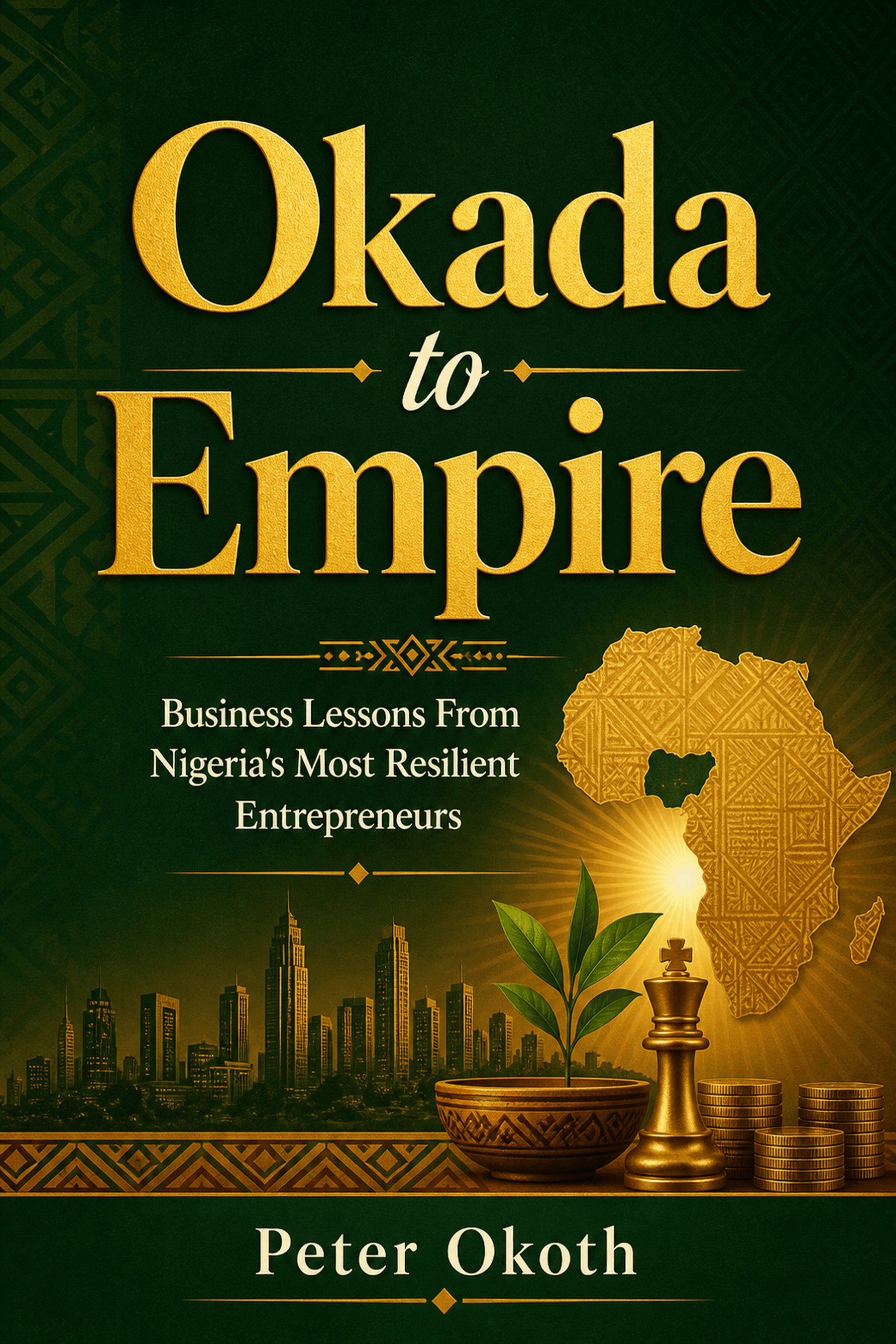
Okada to Empire
Business Lessons From Nigeria's Most Resilient Entrepreneurs
Read the first chapter in your browser. It's free, with no account and no email needed.
Free to read. No account required.
About this book
Nobody taught Musa how to run a business. He had an okada bought on hire-purchase, long hours in Kano, and the discipline to save. A bike became two, then a fleet. His story is not an exception. Across Nigeria, people start with almost nothing and build real businesses where infrastructure is unreliable and the naira can swing sharply.
Okada to Empire profiles eight entrepreneurs and pulls out the principles that actually work. You meet the okada fleet owner, a mama put who built a chain, a market trader who grew a stall into an empire, and a POS agent network builder. You will also meet a generator seller who pivoted to solar, an Instagram seller who moved into a warehouse, an agribusiness builder, and an estate developer.
The first chapter explains the Nigerian way of building, and the final one gathers the lessons into an empire playbook. It is not about hustling harder, but about the systems and decisions that resilient businesses share.
Look inside
Preface
Nobody taught Musa how to run a business. He did not go to business school. He did not read Rich Dad Poor Dad. He did not have a mentor with connections.
What Musa had was an okada – a motorcycle he bought on hire-purchase in 2016 for ₦180,000. He rode it twelve hours a day in Kano. He saved. He bought a second bike and gave it to his brother. Then a third. Then a fifth. By 2020, he had twelve bikes on the road, each one earning ₦3,000-5,000 per day. He was not riding anymore. He was managing.
By 2025, Musa had fifteen bikes, a spare parts shop, a mechanic on retainer, and a savings account at his cooperative with more money than most university graduates will see in a decade.
Musa is not an exception. He is a pattern.
Nigeria is full of Musas – people who started with almost nothing and built real businesses through resourcefulness, resilience, and systems that nobody in an MBA classroom would recognize but that work in the Nigerian context. Market women who turned a single stall into a supply chain. Mama put owners who turned one pot of jollof rice into three locations. POS operators who built agent networks across local government areas. Instagram sellers who now ship from warehouses.
This book profiles eight of them. Not to celebrate hustle culture – God knows Nigerians are tired of being told to hustle harder. But to extract the business-building principles that actually work in Nigeria's economy, where the infrastructure is broken, the regulations shift without warning, and the currency can lose 30% of its value in a year.
Who This Book Is For
- The side hustler who wants to turn a small income stream into a real business
- The small business owner who is stuck – making money but not scaling
- The employee planning their exit and looking for a business model that works in Nigeria
- The entrepreneur who needs strategies for the Nigerian context, not Silicon Valley
- Anyone who believes that building wealth from the ground up is possible – because these profiles prove it is
What You Will Walk Away With
Eight detailed profiles of Nigerian entrepreneurs who built empires from almost nothing, each with extracted strategies you can adapt to your own situation. Plus a final-chapter playbook that synthesizes the common principles across all eight – the Nigerian empire-building formula.
From ground zero to something. Na so e dey start.
The Nigerian Way of Building
There is a joke in Lagos that goes like this: give a Nigerian a broken generator, an empty shop, and a bag of cement, and by next month he will have a business with three employees and a WhatsApp Business page.
It is funny because it is true.
Nigeria has over 40 million micro, small, and medium enterprises. They are not in Silicon Valley pitch decks. They are in markets, under bridges, along expressways, in compounds, and in the DMs of Instagram. They sell everything from suya to solar panels, from phone accessories to frozen fish, from POS services to plots of land. They employ more Nigerians than the formal sector ever will.
And most of them were built by people who had no business plan, no startup capital from investors, no MBA, and no connections in government. They had an idea, a small amount of money, and an environment that – despite its many obstacles – rewards resourcefulness like almost no other country on earth.
This book tells the stories of eight Nigerian entrepreneurs who started with almost nothing and built real businesses. Not billionaires. Not tech unicorns. Ordinary people who used ordinary resources in extraordinary ways.
What You Will Learn
- Why Nigeria's informal economy is one of the world's most effective business schools
- The eight entrepreneur archetypes profiled in this book
- The common principles that every successful Nigerian business builder shares
- How to identify which archetype matches your situation and resources
Why Nigerian Entrepreneurs Are Different
The Reality
Nigerian entrepreneurs operate in conditions that would shut down most businesses anywhere else in the world. Consider the obstacles:
Power. Businesses generate their own electricity. The average Nigerian business spends 20-40% of operating costs on diesel or petrol for generators. In 2025, diesel prices exceeded ₦1,200 per litre. NEPA no dey, but the hustle must continue.
Infrastructure. Roads destroy vehicles. Ports delay cargo for weeks. Internet connectivity is inconsistent outside major cities. Water supply is unreliable.
Regulation. Multiple taxation – federal, state, and local government – can hit the same business from three directions. Permits and approvals require time, money, and often "facilitation."
Currency. The Naira has lost over 70% of its value against the dollar since 2020. Import-dependent businesses have watched their costs triple while their prices could only increase gradually.
Security. Depending on the region, businesses face theft, vandalism, kidnapping risk, and community levies that are not optional.
And yet – Nigerian businesses persist. They adapt. They innovate. They find workarounds that no business textbook covers. The mama put who charges per plate because her customers cannot afford a full meal. The POS operator who walks to customers because the customers will not walk to him. The market trader who prices in dollars mentally but transacts in Naira because the customer needs to feel the price is fair.
This resilience is not just survival. It is a competitive advantage. A Nigerian entrepreneur who can build a profitable business in Lagos can build one anywhere.
How It Actually Works
The Nigerian business-building model looks nothing like the startup model taught in business schools. Here is the comparison:
- Starting capital — Investor funding, loans, savings — Whatever is in your pocket, family contribution, ajo loan
- Business plan — 30-page document — Calculation on the back of a receipt, or just in your head
- Growth strategy — Scale fast, raise more funding — Grow with cash flow, reinvest profits, expand only when you can afford to
- Infrastructure — Assume electricity, internet, roads exist — Generate your own power, find workarounds for everything
- Legal structure — Register company on day one — Operate first, register when it makes sense
- Risk management — Insurance, legal counsel, compliance team — Diversify across multiple hustles, keep cash reserves, know people
Neither model is better. They serve different contexts. But the Nigerian model produces something the textbook model often does not: businesses that survive because they were built to survive.
The Eight Archetypes
Each of the next eight chapters profiles a different Nigerian business builder. Here is the map:
Chapter 2: The Okada Fleet Owner – Musa started with one motorcycle in Kano. He now manages fifteen bikes, a spare parts shop, and a mechanic. Strategy: build a fleet, not a ride.
Chapter 3: The Mama Put Chain – Amina started with one pot of food in Ikeja. She now has three locations and a catering arm. Strategy: standardize the recipe, multiply the pot.
Chapter 4: The Market Trader Empire – Iya Bisi started with a single stall in Balogun Market. She now controls a distribution chain supplying 200 retailers. Strategy: own the supply chain, not just the stall.
Chapter 5: The POS Network – Chukwuemeka started with one POS machine in his phone accessories shop. He now has 30 agents across two local government areas. Strategy: micro-franchise the machine.
Chapter 6: The Generator-to-Solar Pivot – Tunde ran a generator rental business in Ibadan. When diesel prices exploded, he pivoted to solar installation. Strategy: follow the market shift.
Quotes to share
Nobody taught Musa how to run a business.
Across Nigeria, people start with almost nothing and build real businesses where infrastructure is unreliable and the naira can swing sharply.
Free to read. No account required.