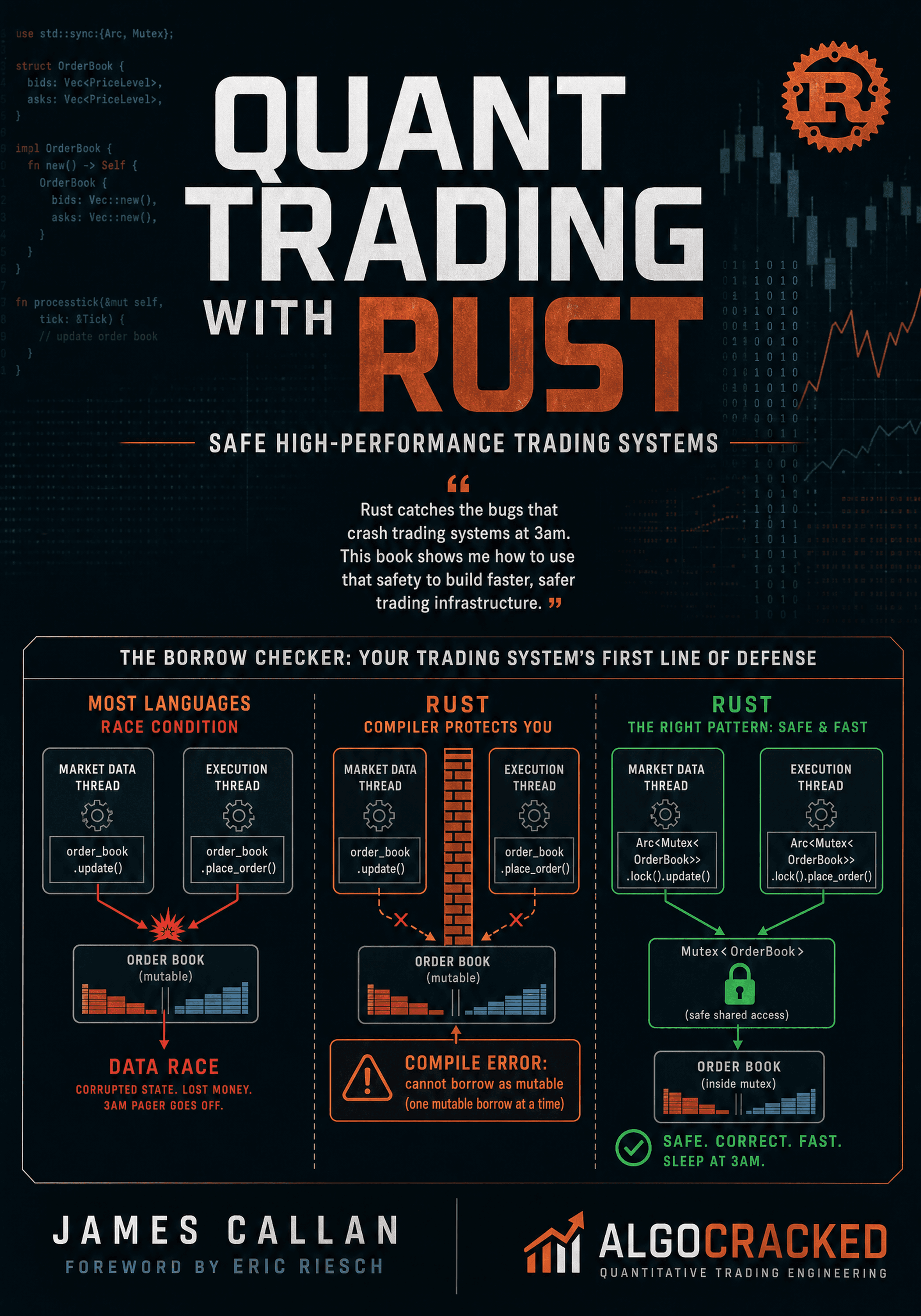
Free first chapter
Quant Trading with Rust
Zero-Cost Abstractions for High-Performance Trading Systems
Read the first chapter in your browser. It's free, with no account and no email needed.
Free to read. No account required.
About this book
Trading systems are unforgiving. A slow parser, a data race, or a missed edge case in an order book can cost you far more than a bug in an ordinary application. If you work in systems programming and want to build trading infrastructure that is both fast and safe, Rust is a natural fit, but the patterns have to fit the domain.
Quant Trading with Rust takes you from the language's value for trading systems through async I/O and market connectivity, then zero-copy data handling and parsing. You will understand and build market data pipelines, order books, and order management with clear execution state. Later chapters bring in strategy integration with risk controls, backtesting and simulation, and benchmarking and profiling.
Look inside
This book teaches you how to build safe, high-performance trading infrastructure in Rust without giving up the systems rigor or execution awareness demanded by trading. By the end, you will have a production-grade trading system: market data handling, order book, order management, strategy integration, risk engine, simulation, and deployment operations.
Who This Book Is For
You are a developer with systems-programming experience who wants to apply Rust to performance-critical trading infrastructure. You have experience in at least one systems language, basic Rust familiarity or willingness to learn quickly, understanding of markets and order flow, and comfort with concurrency concepts.
How This Book Is Organized
Chapters 1 through 3 establish Rust's value proposition, async I/O, and zero-copy data handling. Chapters 4 through 6 build the market data pipeline, order book, and order management system. Chapter 7 integrates strategy logic with risk controls. Chapters 8 and 9 add simulation and evidence-driven optimization. Chapter 10 closes with deployment and production hardening.
The book uses Rust's ownership model as a design tool throughout. Each chapter's traits and types are reused by later chapters.
How to Use This Book
Read linearly. The trait-based architecture means each chapter defines interfaces that subsequent chapters implement or consume. All code uses idiomatic Rust with tokio for async work. Work through the exercises to build confidence with ownership patterns in trading-system contexts.
Rust for Trading Systems
It is 2:31 PM Eastern on a Tuesday. A mid-frequency equity trading system, written in C++, is processing a burst of market data updates during a sector rotation. The feed handler allocates a temporary buffer for an incoming message, parses the fields, and passes a pointer to the order book update logic. The order book module stores that pointer for later use in a downstream risk check. By the time the risk module dereferences the pointer, the feed handler has already freed the buffer and reused the memory for a new message. The pointer now points to stale data — a price from a different instrument entirely.
The risk check passes. An order fires at a price that does not exist. The fill arrives 800 microseconds later, and the position is wrong by $2.4 million notional. The error does not crash the process. There is no segfault, no exception, no log entry. The system continues trading with corrupted state for eleven minutes before a human notices the position imbalance.
This is a use-after-free bug. It is one of the most common memory safety violations in systems-level trading code, and it is invisible to most runtime monitoring. In Rust, this program would not have compiled. The borrow checker would have rejected the code at build time, because the pointer's lifetime does not outlive its use. There is no runtime cost to this protection. The bug is eliminated before the binary is built.
This chapter explains why that difference matters for trading infrastructure, and what it costs.
- Identify the runtime failure modes that cause the most damage in trading systems
- Explain how Rust's ownership model prevents specific categories of production bugs
- Compare Rust, C++, and Python on safety, latency control, and development cost
- Describe how ownership and borrowing shape trading system architecture
- Map the components of a Rust trading system and their ownership boundaries
Why This Matters
Language choice in trading infrastructure is not an aesthetic preference. It is a risk decision. The language you build with determines which categories of bugs can reach production, how much latency variance you introduce, and how confidently you can modify the system under market pressure.
Most trading system failures do not come from bad strategies. They come from bad infrastructure: memory corruption that silently distorts state, race conditions that produce inconsistent fills, resource leaks that degrade performance across a trading session, and latency spikes from garbage collection pauses at the worst possible moment.
These failure modes have direct financial consequences. A memory bug that survives to production in a strategy research notebook is an inconvenience. The same bug in a live execution system is a loss event. The cost of finding and fixing infrastructure bugs rises steeply the later they are discovered — and in trading, "later" can mean "after the position is on."
This chapter builds the case for Rust as a trading infrastructure language. It does not argue that Rust is the only viable option, or that it makes trading easy. What it establishes is that Rust moves a specific set of dangerous failure modes from runtime to compile time, and that this shift has architectural consequences the rest of the book depends on.
Why Trading Systems Need Safety and Speed Together
Trading systems occupy an unusual position in software engineering. They must be both fast and correct, and the consequences of being wrong arrive in milliseconds. Most software domains let you choose: prioritize safety and accept slower delivery, or prioritize speed and accept more runtime failures. In trading, both matter simultaneously, and the feedback loop is merciless.
The Failure Modes That Matter
Consider the categories of runtime failure that cause real damage in production trading systems:
Memory corruption. Use-after-free, double-free, buffer overflows, and dangling pointers. These bugs do not always crash the process. In many cases, they silently corrupt state — a price, a quantity, a position count — and the system continues operating on wrong data. The chapter opener describes one such scenario. These bugs are difficult to reproduce because they depend on memory layout, allocation timing, and system load. They are the single largest source of silent data corruption in C and C++ trading systems.
Data races. When two threads access the same data without proper synchronization, and at least one of them writes, the result is undefined. In a trading system, a data race might mean that an order quantity is read as half-updated, or that a risk limit check runs against a position value that is in the middle of being modified by a fill handler. Data races do not produce error messages. They produce wrong numbers.
Stale state. A component holds a reference to data that has been logically invalidated. The order book module reads a price level that was removed two messages ago. The strategy engine evaluates a signal based on a market snapshot that no longer reflects reality. Stale state bugs are often caused by lifetime management errors — holding a reference longer than the data it points to remains valid.
Unpredictable latency. Garbage collection pauses, dynamic memory allocation on the hot path, and runtime type dispatch all introduce latency variance. In trading, it is not the average latency that kills you — it is the tail. A system that processes messages in 5 microseconds 99% of the time but occasionally stalls for 200 microseconds during a GC pause will miss the moments that matter most: the high-volatility events where speed determines fill quality.
Resource exhaustion. Memory leaks, file descriptor leaks, and connection leaks accumulate over a trading session. A system that performs well for the first hour of trading but degrades by the afternoon is unreliable in a way that is difficult to test for but easy to suffer from. In C++, resource leaks are common when exception handling paths skip cleanup code. In Python, the garbage collector handles memory but not external resources like sockets and file handles — those depend on the developer calling close() or using context managers correctly. Rust's ownership model ties resource cleanup to scope exit (the RAII pattern, enforced by the compiler), which makes resource leaks structurally harder to introduce.
Free to read. No account required.