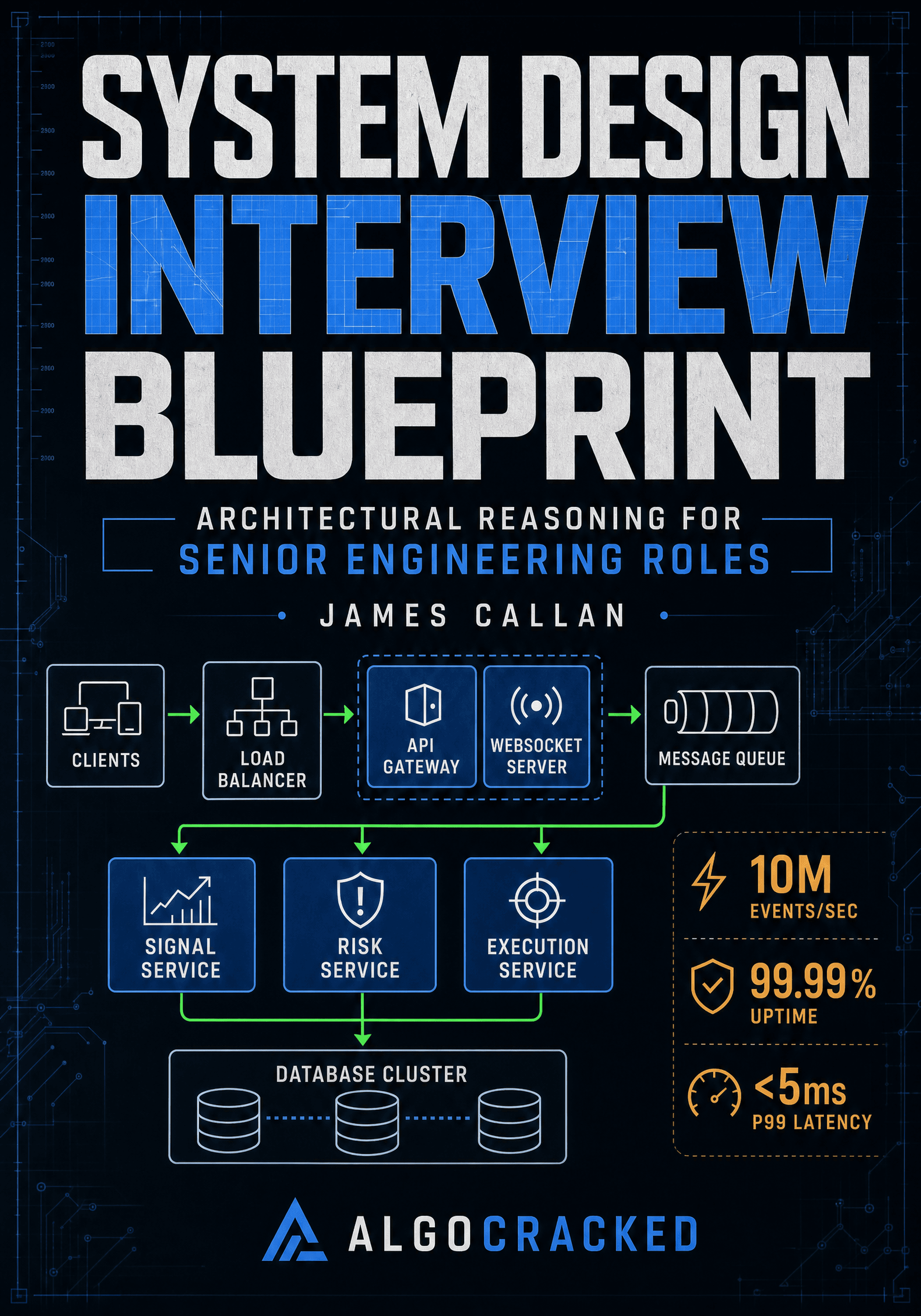
Free first chapter
System Design Interview Blueprint
Scalable Architecture Patterns for Staff-Level Interviews
Read the first chapter in your browser. It's free, with no account and no email needed.
Free to read. No account required.
About this book
You can build web systems, but a system design interview asks for something different: thinking out loud, making tradeoffs, and defending an architecture while the clock runs. This book gives you repeatable frameworks to do that with confidence.
System Design Interview Blueprint starts with how to run the interview and clarify requirements, then builds your estimation toolkit for capacity and performance budgets. You will understand how to reason about APIs and service boundaries, databases and data modeling, caching and CDNs, and queues and asynchronous workflows. From there you move to reliability, consistency, and failure modes, along with sharding, multi-region design, and how systems evolve.
Case studies for common interview systems let you practice the full approach.
Look inside
This book teaches you to reason through system design interviews using repeatable frameworks for requirements, scale estimation, tradeoffs, and architecture communication. By the end, you will have a personal design playbook with requirement templates, estimation habits, tradeoff matrices, and worked interview case studies.
Who This Book Is For
You are a mid-to-senior engineer preparing for system design interviews. You have professional experience with web systems, a basic understanding of APIs, databases, caching, and distributed systems terminology, and comfort discussing tradeoffs among latency, consistency, cost, and complexity.
How This Book Is Organized
Chapters 1 and 2 establish the interview framework and estimation toolkit. Chapters 3 through 6 cover core building blocks: services, storage, caching, and async communication. Chapters 7 and 8 address reliability and scaling. Chapter 9 applies everything through integrated case studies. Chapters 10 and 11 extend your range into specialized domains — trading systems and distributed consensus — that test whether you can reason outside the web-system comfort zone. Chapter 12 converts all of that knowledge into interview performance through mock interviews and communication practice.
Each chapter builds on the vocabulary and decision framework introduced by the preceding chapters. The progression moves from foundations through building blocks to specialized depth, with mock interviews as the capstone.
How to Use This Book
Read linearly on the first pass. After that, use the case studies in Chapter 9 as practice prompts and the framework from Chapters 1 and 2 as your opening playbook. Keep a personal design journal to track the tradeoffs and estimation shortcuts that work best for you.
Interview Framework and Requirements Clarification
A candidate sits down for a 45-minute system design interview. The prompt is straightforward: "Design a URL shortening service." Within thirty seconds, the candidate is sketching boxes on the whiteboard — a load balancer, an application server, a database, a cache layer. By the five-minute mark, the whiteboard is covered in arrows and component names. The architecture looks reasonable. The interviewer has not spoken a word.
At minute twelve, the interviewer asks: "How many URLs per day do you expect?" The candidate hesitates. "A lot?" The interviewer tries again: "Should shortened URLs expire? Do users need analytics on click counts? Is this a multi-tenant service?" The candidate realizes the architecture on the board assumes answers to all of these questions — answers that were never discussed. The load balancer is sized for traffic volumes that were never estimated. The database choice assumes a write pattern that was never defined. The cache strategy assumes a read-to-write ratio that was never established.
The candidate knew enough distributed systems to draw a plausible architecture. The interview failed because the first five minutes were spent on boxes and arrows instead of questions and constraints. This chapter gives you the process to get those first five minutes right.
- Distinguish functional requirements from non-functional requirements for any system design prompt
- Apply a structured question framework to narrow an ambiguous problem within the first five minutes
- Organize your whiteboard (or virtual document) so that requirements visibly drive architecture decisions
- Identify the signals interviewers look for beyond architectural correctness
- Compare weak and strong interview openings and explain what separates them
Why This Matters
System design interviews are deliberately underspecified. The interviewer gives you a one-sentence prompt — "Design a notification system" or "Design a distributed file storage service" — and expects you to turn that sentence into a concrete, defensible architecture within 35 to 45 minutes.
The underspecification is not sloppy question-writing. It is the test. The interviewer wants to see whether you can take an ambiguous problem and impose enough structure on it to make engineering decisions. Candidates who skip this step and jump to architecture are not demonstrating confidence. They are demonstrating that they do not know how real systems get built.
In production engineering, requirements gathering is where most costly mistakes originate. A database chosen before understanding the access pattern. A synchronous API designed for a workflow that needs to be asynchronous. A caching layer added to a system where the real bottleneck is write throughput. These mistakes are expensive to fix once the system is running. They are trivial to prevent if you ask the right questions before you start drawing.
The same principle applies in interviews, compressed into a shorter time frame. The requirements you surface in the first five minutes determine the quality of everything that follows. Get them wrong — or skip them — and you spend the remaining thirty minutes defending an architecture built on invisible assumptions.
This chapter introduces a repeatable framework for those first five minutes. The framework does three things: it narrows the problem to a tractable scope, it surfaces the constraints that will drive your design decisions, and it gives you a visible structure that makes your reasoning legible to the interviewer. Every subsequent chapter in this book assumes you can perform this step. Capacity estimation, API design, database selection, caching strategy — none of these make sense without the requirements context established here.
What Design Interviews Actually Test
Before you can perform well in a design interview, you need to understand what the interviewer is evaluating. The answer is not "draw the correct architecture." There is no single correct architecture for any open-ended design problem. What matters is how you arrive at your design and whether your reasoning is visible.
The Evaluation Axes
Most companies that run system design interviews evaluate candidates on four to six dimensions. The labels vary across organizations, but the underlying signals are consistent:
- Requirements gathering — Do you ask clarifying questions? Do you distinguish what the system must do from how well it must do it?
- Scope management — Can you identify what to include and what to defer? Do you make scope decisions explicitly?
- Technical depth — When you propose a component, can you explain how it works and why you chose it?
- Tradeoff reasoning — Do you acknowledge alternatives? Can you explain what you gain and what you give up with each choice?
- Communication — Is your thinking structured and legible? Can the interviewer follow your reasoning without asking for clarification?
- Iteration — Do you revisit decisions when new information emerges? Can you adapt your design under pressure?
The key idea is that requirements gathering and communication are evaluated from the moment you start talking. An interviewer who watches a candidate silently draw boxes for five minutes has already formed a negative impression — not because the architecture is wrong, but because the candidate demonstrated no process.
Architecture Correctness Is Necessary but Not Sufficient
A technically sound architecture presented without reasoning looks like memorization. Interviewers at experienced companies have seen the same URL shortener diagram hundreds of times. They cannot distinguish a candidate who understands the design from one who watched a YouTube video the night before — unless the candidate explains why each component is there and what constraints drove the choice.
In practice, the candidates who score highest are those who make the interviewer feel like a collaborator. They ask questions, propose alternatives, name tradeoffs, and adjust their design based on feedback. The interview feels like a working session, not a presentation. That collaborative dynamic starts in the requirements phase.
Do not treat the requirements phase as a formality to rush through before getting to the "real" design work. Interviewers notice when candidates ask perfunctory questions and then ignore the answers. If you ask "What is the expected scale?" but then design the same architecture regardless of the answer, the question did not help you — and the interviewer saw that it did not.
Free to read. No account required.