Free first chapter
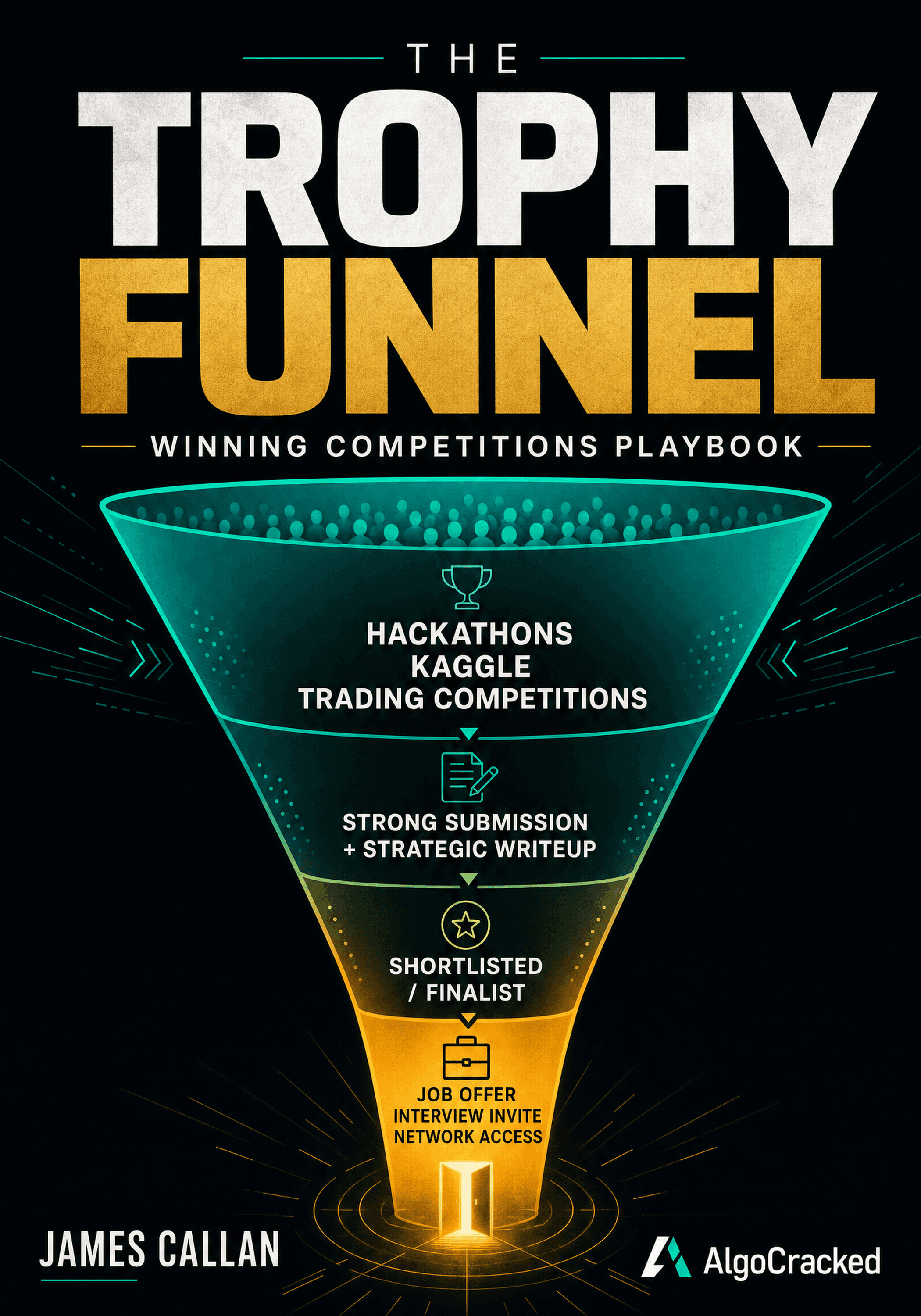
The Trophy Funnel: Winning Competitions Playbook
From Your First Kaggle Submission to the WorldQuant IQC Finals
Read the first chapter in your browser. It's free, with no account and no email needed.
Free to read. No account required.
About this book
You can code, you have tried a few Kaggle submissions, and your leaderboard rank refuses to move. Or you are a student without a powerful GPU or a network of grandmasters, and you want a result that opens doors. The Trophy Funnel argues that a verified leaderboard finish can carry more weight than a line on a CV.
This playbook covers the meta-game of competing. You will map the arenas, build your own competition system, and learn the ethics and rules you cannot bend. It goes deep on Kaggle, cross-validation discipline, feature engineering, and ensembling, then adds a lean approach to the LLM era. Further chapters cover Zindi, WorldQuant BRAIN and the IQC, Numerai, QuantConnect, hackathon pitching, and competitive programming from Codeforces to ICPC.
It also shows how to turn results into career opportunities and includes a chapter on the Kenya playbook. It ends with a capstone where you enter, finish, and publish.
Look inside
Preface
Who This Book Is For
This book is written for two learners at once — and it does not split the chapter structure to serve them separately.
The first reader is a Kenyan student or early-career builder: a university student at JKUAT, Strathmore, UoN, MMU, Dedan Kimathi, or Kenyatta, or a bootcamp graduate who has finished a foundation ML or CS path. You want your first Zindi medal, a UmojaHack Africa win, a WorldQuant IQC qualifier placement, or an ICPC Africa regional finish — and you want that result to function as a job pipeline, not just a hobby badge. You are operating without an H100 GPU, without a network of Kaggle Grandmasters, and often without a local community of people who have done this before. This book is written so that constraint is never an excuse.
The second reader is a global intermediate practitioner: you can code scikit-learn, you have run a few Kaggle submissions, and you are stuck. Your public leaderboard rank is hovering in the bottom third, you do not understand why your private score collapses, and you are tired of tutorials that re-explain XGBoost. You need the meta-game — the validation discipline, ensembling architecture, pitch craft, and career conversion playbook — not another library tour. This book is that meta-game.
Both readers are assumed to have completed intermediate Python, pandas and NumPy fluency, exposure to gradient-boosting libraries, and a foundation ML or data science course (SkillSaber machine-learning and data-science-foundations, or their AlgoCracked equivalents). The book does not re-teach supervised learning theory or core algorithms. It layers competition strategy on top of that foundation.
What the Trophy Funnel Is
The Trophy Funnel is a thesis about how technical careers compound. It rejects the conventional path of applying to jobs with a CV and hoping a keyword match surfaces you. Instead, it argues that in data science, quantitative finance, software engineering, and AI, a verified leaderboard entry — a Kaggle medal, a WorldQuant IQC finalist placement, a hackathon demo-day win — is more credible than anything you can write in a landing-page headline. The proof is public, permanent, and searchable.
The Funnel goes further. Each competition, properly run, produces not just a placement but a cascade of downstream assets: an open-source repository, a post-mortem blog post, a YouTube deep-dive, a build-in-public thread, a course module, a newsletter piece, a LinkedIn story, and a UTM-tracked profile that tells you exactly which platform drove the most career inquiries. One competition entry, done with the Trophy Funnel discipline, produces at least ten marketing assets that compound in search and social traffic long after the leaderboard closes.
This book teaches both halves: how to actually rank, and how to convert the rank into outcomes.
How to Read This Book
The book is organized into six parts plus a capstone.
Part I (Chapters 1–4) establishes the Trophy Funnel thesis, maps every competition arena in scope, describes the operational infrastructure every serious competitor builds once and reuses forever, and sets down the ethics rules you must know before entering anything. Read this part first regardless of which track you follow next.
Part II (Chapters 5–10) covers ML and data science competitions — Kaggle, Zindi, DrivenData — including cross-validation discipline, feature engineering at scale, ensembling and hill climbing, LLM-era GPU-poor strategies, and the African ML funnel anchored on the Zindi and UmojaHack platforms.
Part III (Chapters 11–14) covers quantitative competitions: WorldQuant BRAIN alpha anatomy, the IQC three-stage playbook, Numerai staking, and QuantConnect algorithmic trading competitions. This part depends on the CV and ensembling vocabulary from Part II.
Part IV (Chapters 15–19) covers hackathons: scope control, pitch architecture, demo polish, team roles, and the AI agent and LLM hackathon category that now awards prizes for harness engineering, not just prompt writing. This part is largely independent of Parts II and III and can be read after Part I alone.
Part V (Chapters 20–22) covers competitive programming: Codeforces rating progression, ICPC and ACPC team strategy, and the LeetCode weekly contest as an interview-signal instrument. Pure-ML readers can skip this part or read it last.
Part VI (Chapters 23–25) covers career conversion and content compounding: turning a leaderboard placement into an internship or consultant contract, building the founder narrative that earns front-page traction, and the Kenya-specific playbook for the Nairobi and East African competition ecosystem.
Choose a reading path based on your goal:
- Pure-ML reader: Part I → Part II → Part III → Part VI → Capstone.
- Builder / hacker reader: Part I → Part IV → Part VI → Capstone.
- Competitive-programming reader: Part I → Part V → Part IV (optional) → Part VI → Capstone.
- Kenyan cohort reader: Part I → Part II (Zindi emphasis) → Part III (IQC team formation) → Part IV (Nairobi events) → Part VI → Capstone.
How to Use the Capstone
Chapter 26 is not optional. The book's promise cannot be delivered on paper alone. During the capstone you will select one live competition from a provided shortlist, enter it, finish a submission, and run the full Trophy Funnel cycle — post-mortem blog, open-source repository, content thread or video, and a UTM-tracked profile set.
The capstone is graded against a rubric, not a leaderboard. A 187th-place finish with a complete funnel beats a rank-80 finish with no content. The goal is not a trophy. The goal is a compounding asset stack that works for you after the competition closes.
Read this book with a real competition in mind from the first page. The reader who enters while reading will finish with something the reader who waits will never have.
Why Competitions Compound
Two candidates apply for the same machine learning role at a Nairobi fintech. Their CVs are nearly identical — same Python stack, similar project descriptions, comparable years of experience. One candidate includes a line near the bottom: Zindi rank: top 4%, UmojaHack Africa 2022 finalist. Solution published on GitHub.
The hiring manager clicks the link. It goes to a real leaderboard with a real placement. There is a public write-up. There is a GitHub repo with 200 stars. The candidate did not just claim to be good at machine learning — they proved it in public, under competition conditions, against hundreds of other entrants.
The second candidate gets a polite rejection email.
This chapter is about why that link matters more than anything else on the page.
- Define the Trophy Funnel and its four stages in your own words
- Contrast Proof-of-Work Marketing with paid-channel marketing on cost, durability, and credibility
- Identify which of four reader archetypes best matches your starting position
- Set a 12-month Trophy Funnel target with a named platform, rank goal, asset count, and conversion goal
The Two Résumés Problem
In most industries, two equally skilled candidates face the same problem: a recruiter cannot tell them apart from their résumés. Both describe "strong machine learning skills." Both list Python and scikit-learn. Both mention "projects." The hiring process then relies on interviews, which are expensive, unreliable, and heavily filtered by gatekeepers.
Technical markets have one asymmetry. They are one of the few domains where a verifiable public signal exists — and that signal is systematically underused by most practitioners.
A leaderboard rank is not a claim. It is a measurement. When a candidate writes "competed in 12 Zindi challenges, top 5% in three, published solutions to all three," a hiring manager can verify every part of that sentence in under two minutes. The platform shows the handle, the rank, the date, the number of competitors, the score. Nothing on a résumé competes with that evidence density.
Free to read. No account required.