Free first chapter
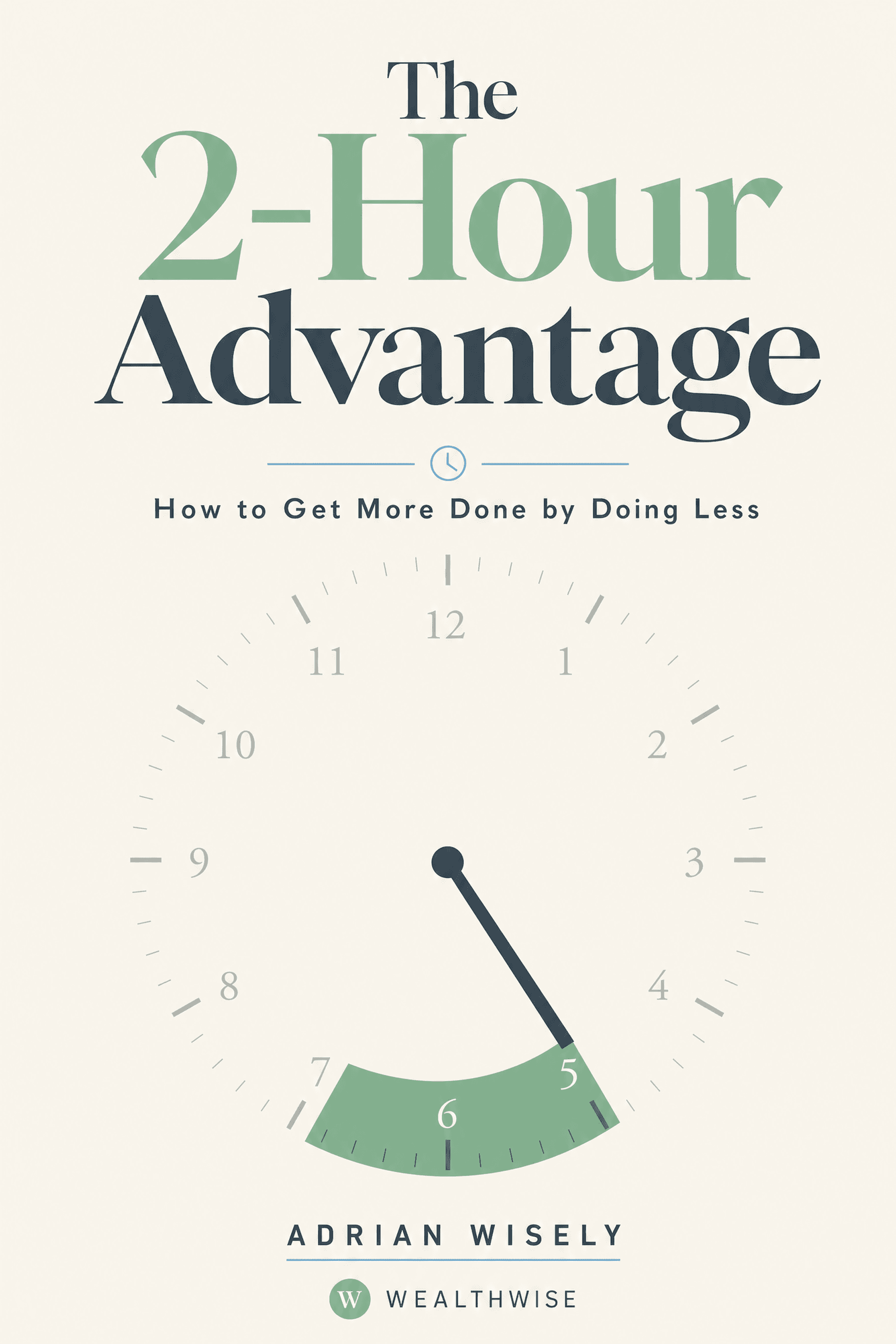
The 2-Hour Advantage
How to Get More Done by Doing Less
Read the first chapter in your browser. It's free, with no account and no email needed.
Free to read. No account required.
About this book
You have tried the apps, the color-coded calendars, the five a.m. alarms, and the productivity systems that lasted two weeks. You are still busy from morning to night and still unsure what you actually finished. Maybe the problem was never time. Maybe it is energy, and how much of your day is spent on things that never mattered.
The 2-Hour Advantage argues that you only get a few hours of truly focused work each day, so you should design everything around protecting them. You will learn to set up a two-hour block, run an elimination audit on the tasks and commitments that drain you, and practice single-tasking in a world built for interruption. Further chapters cover rest as part of performance, designing your environment, building a weekly rhythm, and what to do when life gets in the way.
It is a calm, practical approach to getting more done by doing less, without hustle culture.
Look inside
Preface
You do not have a time management problem. You have an energy management problem.
I know this because you have tried everything. You have read the productivity books. You have downloaded the apps. You have color-coded your calendar, built elaborate Notion dashboards, experimented with Pomodoro timers, and woken up at 5 AM because some podcast host told you that is what successful people do. And you are still drowning.
Here is what nobody told you: the problem is not that you are not doing enough. The problem is that you are doing too much — and almost none of it matters.
The research is clear. The average knowledge worker gets about 2 hours and 48 minutes of genuinely productive work done per day. Not per half-day. Per day. The rest is meetings, emails, context-switching, Slack threads, and staring at a screen while your brain quietly screams.
This book is built on a simple premise: if you are only going to get 2-3 hours of real output anyway, why not design your entire day around making those hours count — and stop pretending the other six hours at your desk are productive?
Who This Book Is For
- Knowledge workers who are exhausted, overcommitted, and producing less than they should be
- People who have tried every productivity system and abandoned all of them within two weeks
- Remote and hybrid workers who feel like they are always "on" but never actually getting anything done
- Anyone with ADHD or executive function challenges who needs a system that works with their brain, not against it
- Managers and team leads who want to model sane work habits instead of performative busyness
What This Book Is Not
This is not a hustle book. I am not going to tell you to wake up earlier, sleep less, or "outwork your competition." That advice is broken. It produces burned-out humans who are impressive on LinkedIn and miserable in real life.
This is also not a theory book. Every chapter gives you something to do on Monday. Not next quarter. Monday.
What You Will Walk Away With
A complete system for identifying your peak performance window, protecting it ruthlessly, eliminating the work that does not matter, and designing a sustainable rhythm that produces more output in fewer hours. Plus the science behind why it works — because understanding the "why" is what keeps you from abandoning the system in week three.
Let's fix this.
The Lie of More
Marcus is a 34-year-old project manager at a SaaS company in Austin. He is good at his job. His stakeholders like him. His Jira boards are immaculate. He works 10-hour days, answers Slack messages during dinner, and checks email one more time before bed — just in case. He maintains a color-coded productivity system in Notion that takes 45 minutes per day to update. He subscribes to three productivity newsletters. He has read Atomic Habits twice.
His last performance review said "meeting expectations."
His colleague Priya sits two desks over. Priya leaves at 4 PM most days. She does not have a Notion dashboard. She does not read productivity newsletters. She takes a real lunch break — away from her desk, outside, like some kind of radical. Last month, Priya got promoted.
Marcus is not lazy. Priya is not a genius. The difference between them is not effort, discipline, or talent. The difference is that Marcus optimizes for hours and activity. Priya optimizes for output during the hours that matter.
This chapter is about why Marcus's approach — the one that most of us default to — is scientifically bankrupt. And why doing less, on purpose, produces more.
What You Will Learn
- Why working more hours stops producing more output after a specific threshold
- The research on actual productive hours per day (spoiler: it is not eight)
- How the 8-hour workday was designed for a type of work most of us no longer do
- Why most productivity systems fail — and what predicts real output instead
The Myth of the 8-Hour Productive Day
Here is a question nobody asks: where did the 8-hour workday come from?
The answer is Henry Ford. In 1926, Ford Motor Company shifted from a 48-hour work week to a 40-hour work week — eight hours a day, five days a week. Ford did not do this because he was a nice guy. He did it because his own internal research showed that factory workers who worked more than 40 hours per week made more errors, had more accidents, and produced less output per hour. The sweet spot for assembly line labor was 8 hours.
Here is the part nobody mentions: Ford was measuring physical labor. Repetitive, structured, externally paced work. Screw goes here. Part goes there. Quality is binary — the widget is right or it is wrong.
That is not your job.
If you are reading this book, your job probably involves some combination of writing, analyzing, decision-making, problem-solving, communicating, and creating. Your output is not measured in widgets per hour. It is measured in the quality of your thinking — and your thinking has a very different fatigue curve than your hands.
What the Research Actually Says
In 2016, a UK study by Vouchercloud surveyed nearly 2,000 office workers and found that the average employee is productive for 2 hours and 23 minutes per day. Not per morning. Per day. The rest of the time is consumed by reading news, checking social media, chatting with coworkers, making food, and — this one is my favorite — "searching for new jobs."
You might dismiss that as a bad survey. So here is more:
The Draugiem Group, a Latvian company, used time-tracking software called DeskTime to study their highest-performing employees. The pattern was consistent: top performers worked in focused sprints of about 52 minutes, followed by 17-minute breaks. They did not power through 8-hour stretches. They oscillated — intense focus, then genuine rest. Their total focused work time was roughly 3 hours per day.
Anders Ericsson — the researcher behind the "10,000 hours" concept that Malcolm Gladwell popularized — studied violinists, chess players, and athletes. The best performers across every domain topped out at about 4 hours of deliberate practice per day. Beyond that, quality collapsed. These were elite performers at the peak of their fields. Four hours was their ceiling.
The Number to Remember
Elite performers: ~4 hours of focused output. Average knowledge workers: ~2.5 hours. And that is not a problem to solve — it is a biological constraint to design around.
But I Work Way More Than That
Yes. You are at work for way more than that. You are responding to emails, sitting in meetings, updating project trackers, waiting for someone to respond to your message, refilling your coffee, and toggling between 14 browser tabs. You are performing the theater of work for 8-10 hours. But the actual output — the stuff that moves your career, your project, your business forward — happens in a fraction of that time.
This is not a moral failing. It is not a discipline problem. It is how human cognition works. Your prefrontal cortex — the part of your brain responsible for complex thinking, planning, and focus — consumes enormous amounts of glucose and oxygen. It fatigues like any other muscle. Asking it to perform at peak capacity for 8 continuous hours is like asking someone to sprint for 8 hours. It does not matter how motivated they are. The body says no.
Quotes to share
Maybe the problem was never time.
Maybe it is energy, and how much of your day is spent on things that never mattered.
Free to read. No account required.