Free first chapter
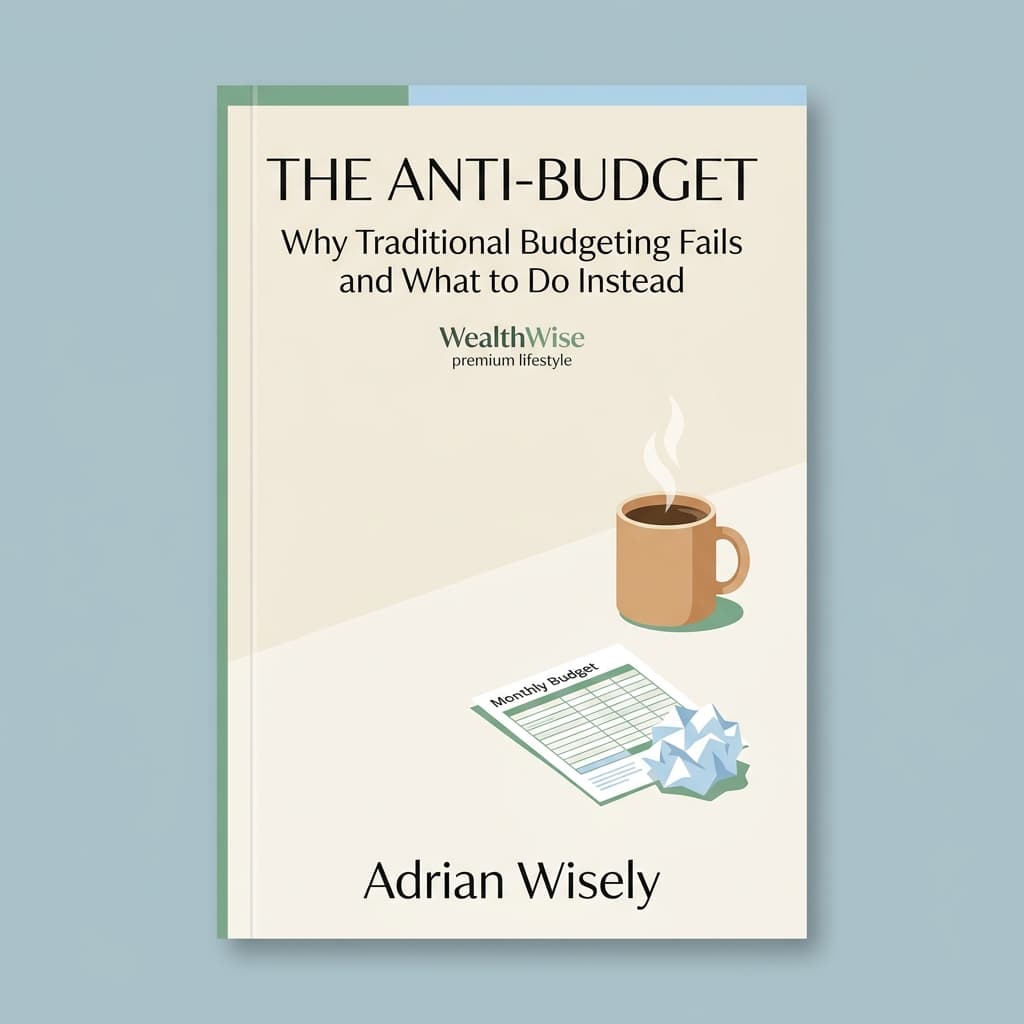
The Anti-Budget
Why Traditional Budgeting Fails and What to Do Instead
Read the first chapter in your browser. It's free, with no account and no email needed.
Free to read. No account required.
About this book
You have tried budgeting. Maybe it was an app, a spreadsheet, or a color-coded notebook, and each time it lasted a few weeks before life got in the way and you felt worse than when you started.
The Anti-Budget starts from a different idea: the tool is the problem, not you. Instead of tracking every dollar after you spend it, you build a system that sends money where it needs to go before you can spend it. This book looks at why budgets fail and how deprivation backfires, then walks you through a framework for automating the important things, from bills to savings and investing, on payday.
You will learn how to spend the rest without guilt, how to handle irregular expenses that wreck most plans, how to adapt the system to variable income, and how to set it up as a couple. It also covers what to do when things go wrong. The aim is a money setup that runs in the background, so your attention can go elsewhere.
Look inside
Preface
You have tried budgeting. It did not work.
I know this because you are reading a book called "The Anti-Budget," which means you are exactly the kind of person who downloaded YNAB, used it religiously for three weeks, felt great about yourself, and then stopped logging transactions because life happened and the whole thing collapsed and you felt worse than before you started.
Or maybe you tried the envelope system. Or Mint. Or a spreadsheet. Or a color-coded notebook from Target that is now buried under a pile of junk in your kitchen drawer.
Here is what nobody tells you: budgets have an 80% failure rate. Eight out of ten people who start a budget abandon it within 90 days. If a diet failed 80% of the time, we would call it a bad diet. If a medication failed 80% of the time, we would pull it from shelves. But when budgets fail, we blame the person, not the tool.
This book blames the tool.
Not because financial awareness is bad — it is essential. But because traditional budgeting is a fundamentally flawed approach to money management for most human beings. It requires daily willpower, creates a deprivation mindset, and turns every purchase into a moral judgment.
The Anti-Budget is the alternative. Instead of tracking every dollar after you spend it, you set up a system that puts money where it needs to go before you spend it. Bills, savings, and investing are automated on payday. Whatever is left is yours to spend however you want, no tracking required, no guilt attached.
Who This Book Is For
- Budget refugees who have tried and failed at traditional budgeting (probably multiple times)
- People who hate spreadsheets, tracking apps, and categorizing every coffee
- Anyone who wants their money managed without making it a part-time job
- People who have been told they are "bad at budgeting" and internalized it as "bad with money"
What You Will Walk Away With
A fully automated Anti-Budget system that handles your financial obligations without daily attention, weekly tracking, or monthly guilt. Your money will be managed. Your brain will be free.
Budgets Are Broken
Megan has a drawer in her kitchen. Not the organized one with the silverware. The other one. The junk drawer. And buried under the takeout menus, dead batteries, and a phone charger for a phone she no longer owns, there is a bullet journal.
It is a beautiful bullet journal. Washi tape borders. Color-coded spending categories. A monthly tracker with neat columns for Groceries, Transportation, Entertainment, Personal Care, and Savings. She bought it at Target for $14.99 after watching a TikTok video titled "The Budget System That Changed My Life."
It lasted four days.
Before the bullet journal, there was YNAB. The app that promises to give "every dollar a job." Megan gave every dollar a job for six weeks. Then she went on a bachelorette weekend in Austin, blew through three categories in two days, and the entire system collapsed under the weight of trying to reconcile reality with the spreadsheet.
Before YNAB, there was Mint. Before Mint, there was an Excel spreadsheet she found on Reddit. Before the spreadsheet, there was the cash envelope method her mom recommended — "just put cash in envelopes and when the envelope is empty, you stop spending." Megan ran out of the Groceries envelope on the 19th of the month and drove to Trader Joe's with her credit card.
Five methods. Five failures. Five rounds of "I'll start fresh next month" followed by five rounds of "what is wrong with me?"
Nothing is wrong with Megan.
Here is what Megan did not know — and what this chapter will teach you.
What You Will Learn
- Understand why budgets fail for 80% of people (and why it is the tool, not you)
- Identify the three structural flaws in traditional budgeting
- Recognize whether your brain is wired for tracking or for automation
- See the Anti-Budget alternative that replaces daily willpower with one-time setup
Why This Matters
Budgeting is the most commonly recommended personal finance tool in existence. Every financial advisor, every money book, every personal finance influencer starts with the same advice: "Make a budget."
And 80% of people who follow that advice fail within 90 days.
If any other tool in any other field had an 80% failure rate, we would stop recommending it. If a prescription drug failed 80% of the time, the FDA would pull it. If a teaching method failed 80% of students, we would develop a different method.
But when budgets fail, we do not blame the budget. We blame the person. "You were not disciplined enough." "You did not stick with it." "You need to try harder."
Screw that. You do not need to try harder. You need a different tool.
The Three Structural Flaws
The Reality
Traditional budgeting is built on three assumptions about human behavior. All three are wrong for most people.
Flaw 1: Budgets Require Daily Decisions
A traditional budget asks you to make a spending decision every time you open your wallet. "Is this in my budget? Which category does it come from? How much do I have left in this category?"
Each of these micro-decisions costs mental energy. Psychologists call this decision fatigue — the documented phenomenon where the quality of your decisions degrades the more decisions you make.
By 2 PM on any given day, you have already made roughly 35,000 decisions. Your brain is tired. And now it is supposed to carefully evaluate whether the $6 salad dressing at Whole Foods fits in your Groceries category? It is not going to do that. It is going to buy the salad dressing and deal with the budget later. Except "later" is the same brain in the same state of fatigue, and "deal with it" becomes "ignore it."
Flaw 2: Budgets Create Deprivation
When you assign every dollar a category and a limit, you transform every purchase into a moral event. The coffee is not just a coffee — it is a judgment call. "I should not buy this. The budget says I have $23 left in Coffee this month."
This is identical to the psychology of restrictive dieting. And the outcome is identical: restriction creates obsession, obsession creates craving, craving creates bingeing. The person who tells themselves "no coffee this week" thinks about coffee more than the person who just drinks coffee.
The budget-binge cycle is real: restrict for three weeks, feel deprived, snap and overspend, feel guilty about overspending, restrict harder next month, repeat forever.
Flaw 3: Budgets Are Backward-Looking
Traditional budgets track where your money went. After you spent it. The tracking itself is retrospective — you are categorizing transactions that have already happened. This creates the illusion of control without the reality of it.
Knowing that you spent $340 on restaurants last month is informative. But the spending already happened. The information arrives too late to change the behavior. And by the time you review last month's spending, you are already two weeks into this month making the same choices.
The Anti-Budget flips this: instead of tracking spending after it happens, it controls spending before it happens by moving money to where it needs to go on payday. What is left is what you spend. No tracking needed.
Common Trap: "I Just Need the Right App"
No, you do not. The app is not the problem. YNAB, Mint, Monarch, Copilot — they are all well-designed tools built on a fundamentally flawed premise for 80% of brains. Switching from one tracking app to another is like switching from one crash diet to another. The problem is the approach, not the implementation.
Free to read. No account required.