Free first chapter
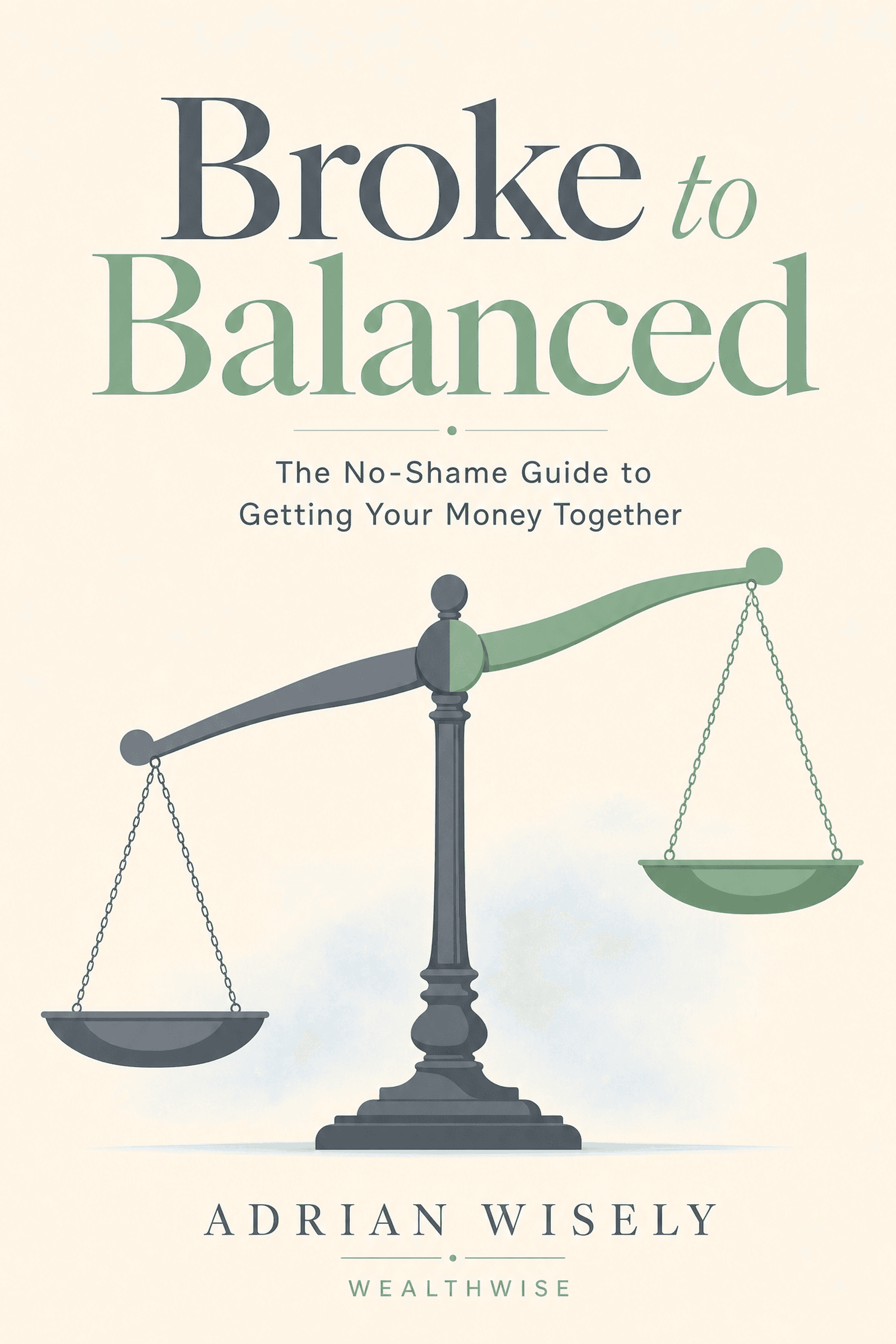
Broke to Balanced
The No-Shame Guide to Getting Your Money Together
Read the first chapter in your browser. It's free, with no account and no email needed.
Free to read. No account required.
About this book
You Googled "how to get my money together" and got a lecture about lattes or a pitch for the latest crypto. Meanwhile your paycheck still disappears faster than you can explain, and you are tired of feeling behind and ashamed about it.
Broke to Balanced is the no-shame guide to sorting out your finances. It starts from the idea that you are not bad with money, then shows you where your money actually goes and helps you build a simple system of automated decisions rather than a rigid budget. You will look at debt without moral judgment, put together a savings starter kit, and understand how credit scores really work. A chapter on investing is written for people who assume it is not for them, and others cover the income side, how money affects your relationships, and how to stay on track once the first burst of motivation fades.
Balanced does not mean perfect. It means the stress is manageable and the direction is right.
Look inside
Preface
Let me guess how you got here.
You Googled something like "how to get my money together" or "personal finance for beginners" or maybe just "why am I always broke." And every result was either a 47-year-old man in a suit telling you to stop buying lattes, or a 23-year-old on TikTok telling you to invest in cryptocurrency.
Neither of those people understand your life.
This book is different. This book assumes that you are smart, that you are doing your best, and that the reason your money is a mess is not because you are lazy or stupid. It is because nobody taught you this stuff, the system is designed to be confusing, and every piece of financial advice you have ever received came with a side of judgment.
We are done with that.
This is the no-shame guide. That means: no lectures about your daily coffee. No guilt trips about your Amazon spending. No condescending worksheets that assume you have $500 left over at the end of the month. (Who are these people? Where do they live? I have questions.)
Instead, this book meets you where you are — paycheck to paycheck, maybe carrying debt, probably confused about investing, definitely tired of feeling behind — and gives you a system that works with your actual life.
Who This Book Is For
- Paycheck-to-paycheck survivors who are not sure where the money goes but know it goes fast
- Debt carriers who are tired of the shame and ready for a strategy
- Money avoiders who know they need a plan but have been too overwhelmed to make one
- Anyone who was never taught personal finance and is tired of faking it
What You Will Walk Away With
A personalized money system — not a budget (unless you want one), but a set of automated decisions that move your money where it needs to go so you can stop thinking about it every damn day. Plus the confidence that you actually understand how money works, even if you never take a finance class.
Balanced does not mean perfect. It means the stress is manageable and the direction is right.
Let's get your money together.
You Are Not Bad With Money
Aisha had a secret.
At 28, she was a marketing coordinator at a mid-size agency in Chicago, making $52,000 a year. She had a degree from a good school, a decent apartment in Logan Square, and a social media presence that made her life look reasonably put together. Her coworkers thought she was doing fine. Her mom thought she was doing fine. Her Instagram followers definitely thought she was doing fine.
Aisha was not doing fine.
She had $24,000 in student loans from a degree she finished in 2020. She had $3,800 on a credit card she opened "for emergencies" that had slowly become her lifestyle float — the thing she swiped when her checking account was low, which was most of the time. She had $340 in a savings account she had not touched since depositing her tax refund eight months ago.
Every month, the math was roughly the same: money in, money out, nothing left. Sometimes less than nothing. Sometimes the credit card covered the gap. Sometimes it covered DoorDash on a Thursday night when she was too exhausted to cook and too broke to care.
Last Tuesday, she Googled "how to budget." She opened four tabs. The first was a 47-year-old man explaining that millennials would be rich if they stopped buying lattes. The second was a subreddit where people bragged about living on $12,000 a year. The third was a TikTok where a 23-year-old explained his crypto portfolio from the passenger seat of a rented Lamborghini. The fourth was a blog post titled "Why You Are Bad With Money and How to Fix It."
She closed all four tabs.
Because here is the thing nobody in those tabs understood about Aisha: she was not bad with money. She was never taught money. And those are not the same thing.
Here is what Aisha did not know — and what this chapter will teach you.
What You Will Learn
- Understand why you struggle with money — and why it is not because you are broken
- Identify the money myths that keep you stuck and replace them with reality
- Recognize the money messages you inherited from your family
- Define what "balanced" actually means (spoiler: not perfect, not rich, not Instagram-worthy)
Why This Matters
Sixty-three percent of Americans live paycheck to paycheck. Not just low-income workers — 40% of people earning over $100,000 live paycheck to paycheck too. This is not a character epidemic. This is a system that never taught people how money works and then blamed them for not knowing.
Only 23 states require any personal finance education in high school. Twenty-three out of fifty. That means more than half the country sends young adults into a world of credit cards, student loans, rental leases, and tax returns with zero formal education in how any of it works.
Then we wonder why people are "bad with money."
You are not bad with money. You are uninformed about money. And starting today, we fix that.
The Financial Literacy Gap
The Reality
Think about everything the American education system teaches you before age 18: the mitochondria is the powerhouse of the cell, the quadratic formula, what happened in 1066, how to analyze a Shakespearean sonnet.
Now think about what it does not teach you: how credit cards work, what a 401(k) is, how to file taxes, what interest rates mean, how to read a lease, how student loan repayment plans work, or what a FICO score is and why it controls half your adult life.
This is not an accident. Financial literacy is not a priority because financially illiterate people are more profitable. People who do not understand interest rates accept worse ones. People who do not understand credit cards carry balances longer. People who do not understand investing keep their money in savings accounts earning 0.01% while banks lend it out at 7%.
This is the water you have been swimming in your entire life. And the first step to getting your money together is understanding that the confusion is by design, not by your deficiency.
How It Actually Works
The financial literacy gap hits different groups differently:
- First-generation college students often have the double burden of student debt AND parents who cannot advise them on navigating it.
- Women are less likely to have been taught about investing — not because of ability, but because financial education is still gendered in most families.
- Black and Latino Americans face compounded disadvantages: the racial wealth gap means less family wealth to fall back on, less access to financial mentorship, and more predatory financial products targeted at their communities.
- Immigrants and first-generation Americans navigate an entirely new financial system with no roadmap.
None of these are about individual failure. All of them are about structural gaps.
Your Move
Forgive yourself for what you do not know. Seriously. Right now. If nobody taught you how compound interest works, you are not dumb for not knowing how compound interest works. You are just someone who has not learned it yet.
You are about to learn it.
The Myths That Keep You Stuck
The Reality
Before we build anything, we need to tear down some garbage advice that is probably taking up space in your brain.
Free to read. No account required.