Free first chapter
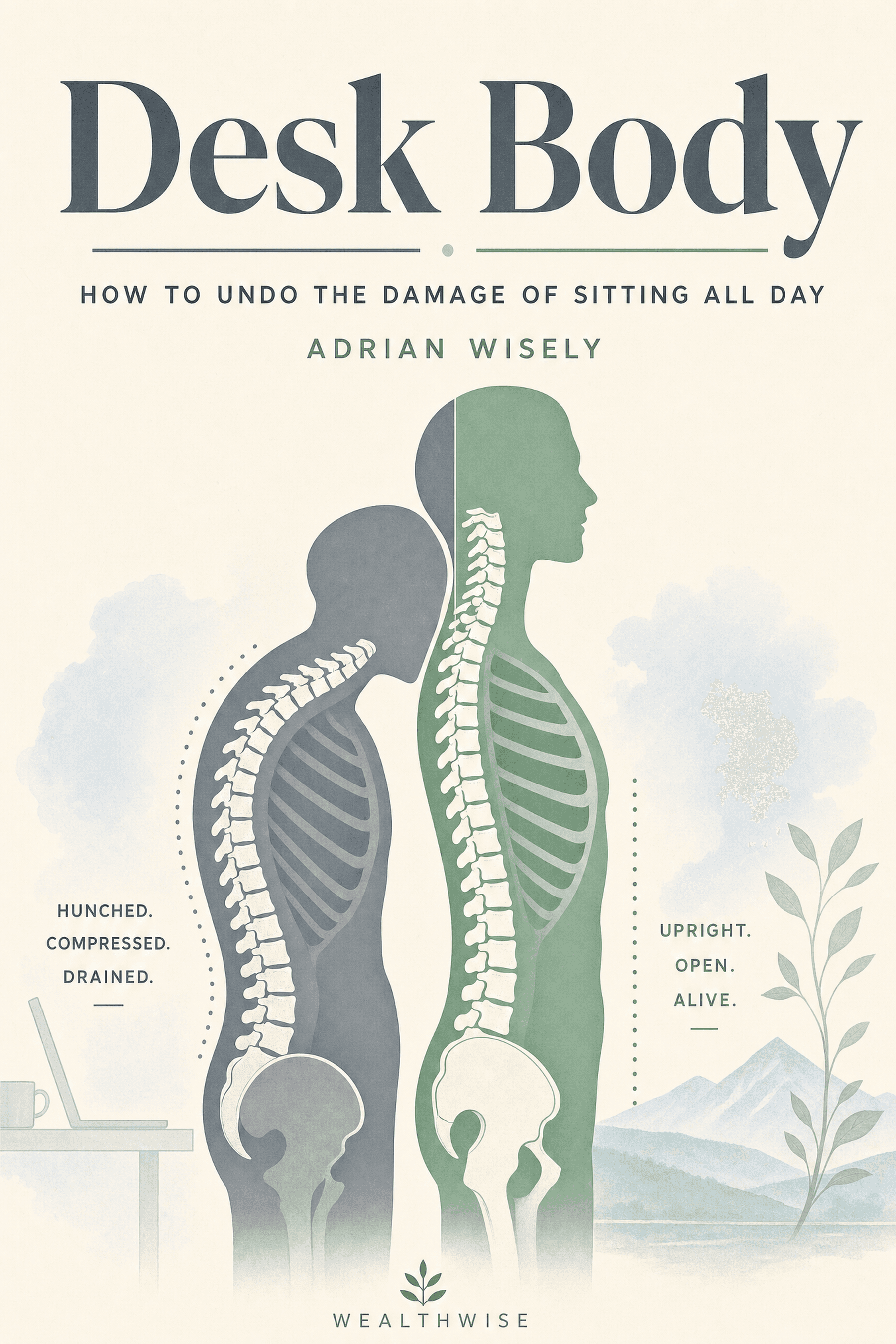
Desk Body
How to Undo the Damage of Sitting All Day
Read the first chapter in your browser. It's free, with no account and no email needed.
Free to read. No account required.
About this book
By mid-afternoon your lower back is stiff, your neck aches, and your hips protest every time you stand up. Your shoulders curl forward, and the headache that shows up from nowhere probably starts in your neck. Sitting for most of your waking life has a cost, and you feel it daily.
Desk Body is a practical maintenance manual for people who work in chairs. It starts with a short desk reset routine you can use right away, then goes part by part: what is really going on with your back, how to deal with neck tension and a forward head position, and how to get your hips working properly again. You will get an honest look at standing desks, ideas for fitting movement into your day in small bursts, and a clear guide to setting up your workspace.
The book ends with a 30-day plan to put it all together. It is not a gym program, just simple habits to help your body cope with the desk.
Look inside
Preface
Your body was not designed for a chair.
That statement sounds dramatic, but it is the kind of dramatic that is backed by 10,000 years of evolutionary biology. The human body evolved to walk, squat, climb, reach, carry, and rest on the ground. Sitting in a chair for 8-10 hours a day is an experiment your species has been running for about 150 years — and the results are in. They are not good.
If you work at a desk, there is a very good chance you are experiencing at least one of the following right now:
- Lower back pain or stiffness
- Neck pain that gets worse as the day goes on
- Tight hips that ache when you stand up after sitting for a long time
- Rounded shoulders that you notice in photos and immediately try to correct
- Headaches that seem to come from nowhere (they come from your neck)
- A general sense that your body feels 20 years older than it should
These are not random ailments. They are predictable, well-documented consequences of spending most of your waking life in a seated position. And the good news — the reason this book exists — is that most of them are reversible.
Who This Book Is For
- Remote workers who went from commuting (some walking) to zero movement in 2020 and never recovered
- Office workers who sit 8+ hours at a desk and then sit in a car and then sit on a couch
- Anyone with back pain, neck pain, or hip tightness who suspects their desk job is the cause (it probably is)
- People over 30 who are starting to feel the cumulative effects of years of sitting
- Anyone who has been told to "fix your posture" without being told how
What This Book Is Not
This is not a fitness book. I am not going to give you a gym program or tell you to train for a marathon. This is a body maintenance book — the minimum effective dose of movement, stretching, and habit change required to undo the specific damage that desk work causes.
Think of it as physical therapy meets user manual for the desk-bound body.
What You Will Walk Away With
A clear understanding of what sitting does to your specific body parts (back, neck, shoulders, hips), a daily routine that takes 10-15 minutes, an ergonomic setup guide that does not require buying a $2,000 chair, and a 30-day fix program. No gym required. No equipment beyond a floor and a wall.
Your body adapted to the chair. Now teach it to un-adapt.
What Sitting Does to You
Tyler is a 36-year-old software engineer in San Francisco. Before 2020, his daily routine included a 15-minute walk to the BART station, a 10-minute walk from the station to his office, several trips up and down stairs during the day, a walk to lunch, and the reverse commute home. Without trying, he was getting 7,000-8,000 steps per day and spending maybe 6 hours sitting.
Then the world went remote.
Tyler now wakes up, walks 14 steps to his home office, sits down, and does not stand up for meaningful periods of time until the workday ends. His commute is gone. His stair climbs are gone. His lunch walks are gone. His daily step count dropped to under 2,000. His total sitting time — desk, car, couch, meals — is north of 13 hours per day.
In 2021, his lower back started hurting. Not dramatically — just a dull ache that showed up around 3 PM and disappeared by bedtime. He bought a lumbar support cushion. It helped for a week.
In 2022, his neck joined the party. Stiffness on the right side, tension headaches twice a week, a grinding sensation when he turned his head to check his blind spot while driving.
In 2023, he started going to the gym. Three days a week, religiously. Deadlifts, squats, bench press. He figured that would fix it. It did not. The back pain continued. The neck got worse.
In 2024, he threw out his back picking up his 3-year-old daughter from her car seat. He was in bed for four days. He is 36. He exercises regularly. And his body is failing him.
Here is the part Tyler does not understand: the gym is not protecting him. Three hours of exercise per week cannot undo the structural damage of 65+ hours of sitting per week. His problem is not a lack of fitness. His problem is that his body has physically adapted to a chair — and that adaptation is breaking things.
What You Will Learn
- The five specific structural changes that prolonged sitting causes in your body
- Why exercise alone does not counteract all-day sitting
- The "active couch potato" phenomenon — and why it matters
- Why "just sit up straight" is useless advice
The Sitting Inventory
Before we talk about what sitting does, let's establish how much sitting we are talking about.
The average American adult sits for approximately 10 hours per day. That number includes desk work, commuting, meals, and evening screen time. For remote workers, the number climbs to 12-13+ hours — because the incidental movement of commuting and office life has been eliminated.
Here is a typical day for a remote knowledge worker:
- Morning routine (breakfast, coffee, phone) — 30-45 min
- Work block 1 — 3-4 hours
- Lunch (at desk or table) — 30-45 min
- Work block 2 — 3-4 hours
- Commute (if hybrid) / transition to couch — 0-60 min
- Dinner — 30-45 min
- Evening (TV, phone, reading) — 2-3 hours
- Total — 10-14 hours
For historical context: pre-industrial humans sat for an estimated 3-4 hours per day, and most of that sitting was squatting — a position that maintains hip mobility — not chair sitting. The modern office chair is approximately 150 years old. Your body has had 150 years to adapt to a position it was not designed for. Anatomically, you are still built for the 3-4 hour squatting model.
Your body does what it always does with environmental pressure: it adapts. The question is whether you like what it adapts into.
The Five Structural Changes
Sitting for extended periods does not just make you stiff. It physically reshapes your musculoskeletal system. Here are the five changes that happen, in roughly the order most people notice them.
Change 1: Your Hip Flexors Shorten
Your hip flexors are a group of muscles at the front of your hip — primarily the iliopsoas and rectus femoris. When you sit, these muscles are held in a shortened position. Hold any muscle in a shortened position for 8-10 hours a day, every day, for months and years, and something predictable happens: the muscle adaptively shortens. The fibers literally restructure to be shorter at rest.
Shortened hip flexors pull the front of your pelvis downward — a condition called anterior pelvic tilt. This tilt exaggerates the curve in your lower back (hyperlordosis), compressing the lumbar discs and straining the muscles and ligaments of the lower back.
If you have lower back pain that gets worse throughout the workday and eases when you walk around, there is a high probability that shortened hip flexors are the primary driver. Not a "bad back." Not a disc problem (though that can develop later). Tight hip flexors pulling your pelvis out of alignment and making your lower back do work it was not designed for.
Free to read. No account required.