Free first chapter
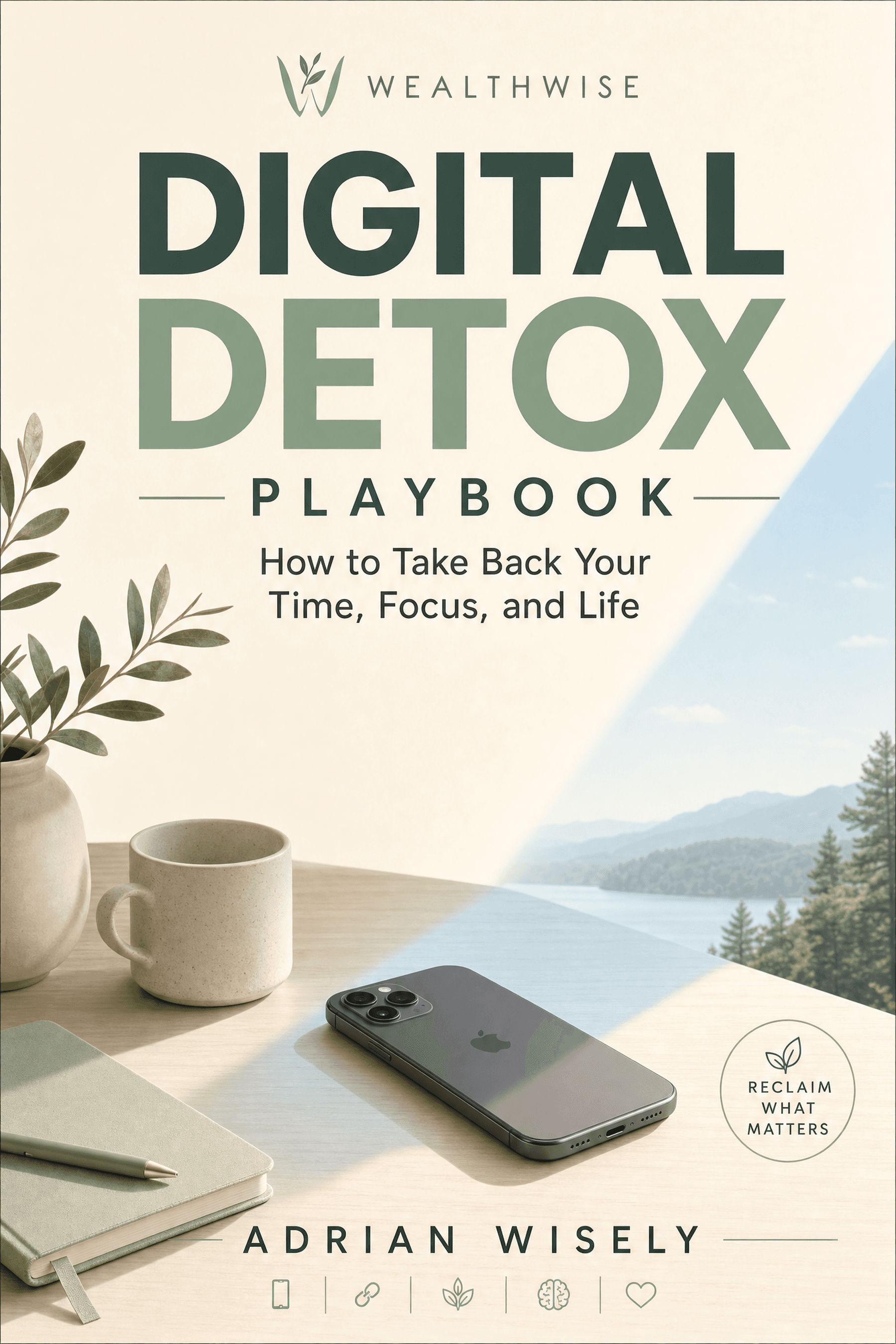
Digital Detox Playbook
How to Take Back Your Time, Focus, and Life
Read the first chapter in your browser. It's free, with no account and no email needed.
Free to read. No account required.
About this book
You pick up your phone to check the time, and twenty minutes later you are somewhere you never meant to be. If that sounds familiar, the problem is not weak willpower. The apps on your screen were built to hold your attention.
The Digital Detox Playbook is a practical, non-preachy plan for building a saner relationship with technology. It does not ask you to throw your phone away. You start with a phone reset, then work through social media without the spiral, taking control of email and notifications, and reclaiming your evenings. You will set clearer digital boundaries at work, and look at how screens affect family life, including how to talk about them with kids.
Everything builds toward a structured 30-day detox protocol, followed by a plan for living with technology on purpose rather than by reflex. Keep the tools that genuinely help, cut the ones that drain your time and focus, and get your attention back for the people and things that matter to you.
Look inside
Preface
Last Tuesday, I picked up my phone to check the time. Twenty-three minutes later, I was watching a video of a golden retriever being surprised by its owner coming home from deployment. I had no memory of how I got there. I never did find out what time it was.
If that sounds familiar, you are not alone. The average American picks up their phone 144 times per day and spends over 4 hours on it — not counting work use. That is 28 hours per week. 60 full days per year. Staring at a rectangle.
This is not a willpower problem. The most talented engineers and behavioral psychologists on the planet designed your phone and its apps to be as addictive as possible. You are not fighting your own weakness. You are fighting a multi-billion-dollar industry whose entire business model depends on capturing and holding your attention.
This book is not about smashing your phone or moving to a cabin in Vermont. It is a practical playbook for building a sane relationship with technology — keeping the parts that genuinely improve your life and cutting the parts that steal your time, your focus, and your ability to be present with the people you care about.
Who This Book Is For
- Anyone who has ever said "I should really spend less time on my phone" and then spent more time on their phone
- Knowledge workers whose jobs require screens but who feel chained to them outside of work
- Parents worried about their own screen habits and their kids' screen habits
- People with anxiety or sleep issues that are worsened by constant connectivity
- Anyone who feels like their attention span has gotten shorter and wants to do something about it
What This Book Is Not
I am not anti-technology. I am not going to tell you that screens are evil or that the internet is destroying civilization. Technology is a tool. Like any tool, it is neutral — what matters is how you use it and how much it uses you.
This book is also not preachy. I am not writing from some enlightened digital-free mountaintop. I still use my phone. I still have social media accounts. I still get sucked into YouTube rabbit holes sometimes. The difference is that now it is a choice, not a compulsion.
What You Will Walk Away With
A complete, personalized plan for reducing your screen time, reclaiming your attention, setting digital boundaries at work and home, and building a relationship with technology that serves you instead of the other way around. Plus a 30-day protocol if you want to go deep.
Your attention is the most valuable thing you own. Let's stop giving it away for free.
The Attention Heist
Sophie is a 33-year-old UX designer in Portland, Oregon. She knows how apps are built. She understands user psychology. She has literally designed features meant to increase engagement. She knows all the tricks.
She is still on her phone 4 hours and 17 minutes per day.
Sophie discovered this number on a Monday morning when, on a whim, she checked her Screen Time report for the previous week. She had guessed she spent maybe 90 minutes a day on her phone — an hour of useful stuff plus some scrolling before bed. The actual number hit her like a wall.
4 hours and 17 minutes. Daily average. Her top app was Instagram at 1 hour 22 minutes per day. Her second was Twitter — sorry, X — at 47 minutes. Her phone pickups averaged 152 per day. She picked up her phone, on average, once every 6.3 minutes of her waking life.
The worst part? She could not remember most of it. The 4 hours did not feel like 4 hours. There was no continuous block where she sat down and scrolled for an hour. Instead, it was hundreds of micro-sessions — a 45-second check here, a 3-minute scroll there, a 12-minute rabbit hole she fell into while "quickly checking one thing." Each session was too small to notice. Added together, they consumed a quarter of her waking day.
Sophie is not weak. She is not stupid. She is a trained designer who understands exactly how these platforms manipulate user behavior — and they got her anyway.
This chapter explains how.
What You Will Learn
- How the attention economy turns your eyeballs into a product sold to advertisers
- The four psychological mechanisms that keep you scrolling
- Why willpower is the wrong tool for this fight
- The real cost of phone addiction — and it is not just time
You Are the Product
Here is a question that will reframe how you think about your phone: why is Instagram free?
Instagram has over 2 billion monthly active users. It employs thousands of engineers, designers, and data scientists. It runs massive server infrastructure across the globe. Operating a platform at that scale costs billions of dollars per year.
And you pay nothing.
The answer, which you probably already know but have not fully internalized, is that you are not Instagram's customer. You are Instagram's product. Instagram's actual customers are advertisers — companies that pay Instagram to put their content in front of your eyeballs. The more time you spend on Instagram, the more ads you see, the more money Instagram makes.
This is the attention economy. Your attention is a finite resource, and some of the most powerful companies in human history are competing to capture as much of it as possible.
The numbers are staggering. Global digital advertising revenue exceeded $600 billion in 2025. Meta (which owns Facebook and Instagram) generated over $160 billion of that. Google generated over $200 billion. These are not technology companies in any traditional sense. They are attention harvesting companies that happen to use technology as the harvesting tool.
Every feature on your phone — the infinite scroll, the push notifications, the algorithmic feed, the autoplay video, the "people you may know" suggestions — exists because it was A/B tested and proven to increase the amount of time you spend on the app. Not because it improves your life. Because it improves their revenue.
The Design Intent
Former Google design ethicist Tristan Harris described it this way: "The problem isn't that people lack willpower. The problem is that there are a thousand people on the other side of the screen whose job it is to break down the self-regulation you have." You are not fighting your own weakness. You are fighting a multi-billion-dollar machine.
The Four Hooks
Your phone does not just passively wait for you to pick it up. It actively pulls you in using four psychological mechanisms that are so effective, they are the same ones used in slot machines — the most addictive devices ever designed.
Hook 1: The Slot Machine (Variable Ratio Reinforcement)
Open Instagram. Scroll. Most posts are mildly interesting. Then — a post from your best friend's wedding. Dopamine hit. Scroll more. A few mediocre posts. Then — a reel that makes you laugh out loud. Dopamine hit. Scroll more. Nothing good for a while. Then — a post that makes you genuinely angry. Dopamine hit (anger triggers dopamine too).
This pattern — unpredictable rewards scattered among unrewarding content — is called variable ratio reinforcement. It is the most powerful reinforcement schedule in behavioral psychology. It is the exact mechanism that makes slot machines addictive: pull the lever, and you might get a reward. You never know which pull will pay off, so you keep pulling.
Free to read. No account required.