Free first chapter
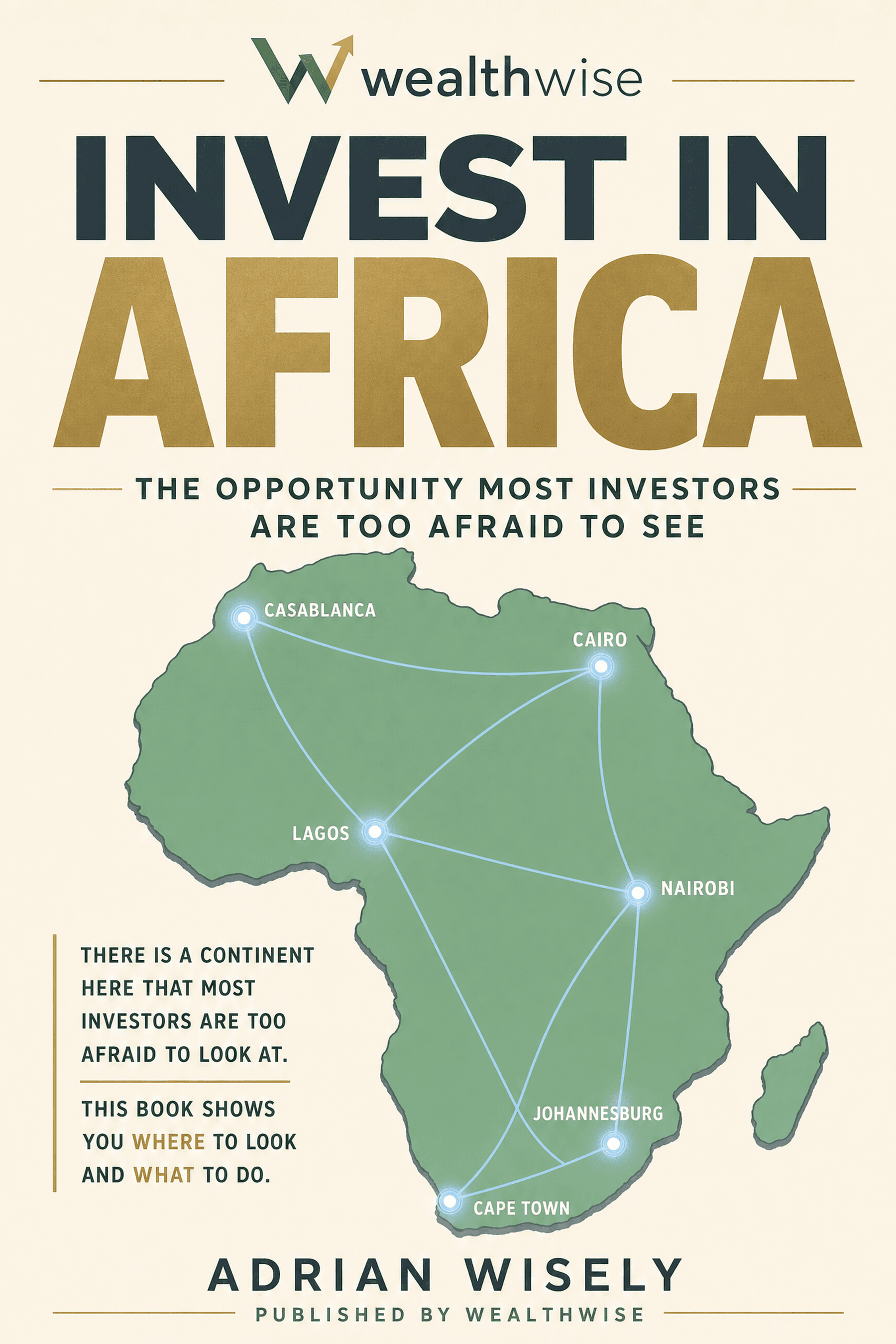
Invest in Africa
The Opportunity Most Investors Are Too Afraid to See
Read the first chapter in your browser. It's free, with no account and no email needed.
Free to read. No account required.
About this book
Africa is often the market that investors skip, even though some of its companies have become global headlines. If you invest in the US, UK, or Europe and have little knowledge of African markets, it is hard to know where to begin, what to trust, and how to judge the risks.
Invest in Africa is a practical guide for evaluating the continent with the same rigor you apply anywhere else. It starts by challenging common assumptions, then maps the investment landscape and looks at what the numbers actually say. You will go market by market, explore the sectors that matter, and take a close look at fintech as the continent's breakout sector. Further chapters explain how to actually invest and how to manage risk in African markets, including currencies, regulation, and political exposure.
The book finishes with a framework for building your own Africa portfolio. It focuses on investment mechanics and judgment rather than development theory or charity, and makes no promises about returns.
Look inside
Preface
In 2022, a Stripe acquisition put a Nigerian startup on the front page of every business publication in the world. Paystack — founded in Lagos, built for African merchants, dismissed by every major Silicon Valley fund — sold for over $200 million. The investors who had said "we don't invest in Africa" earned nothing. The investors who had looked, evaluated, and positioned earned multiples.
That story is not an exception. It is a pattern. And this book exists because the pattern keeps repeating while most Western investors keep missing it.
What this book is: A practical investment guide for Western investors who want to evaluate, access, and profit from Africa's fastest-growing markets. It covers the macro story, the country-by-country detail, the sector analysis, the investment mechanics, and the risk management frameworks you need to invest with the same rigor you apply everywhere else.
What this book is not: A development economics textbook. A political science primer. A charity case for "helping Africa." This book is about returns — and how to position yourself to earn them.
Who This Book Is For
This book is written for Western investors — US, UK, and EU-based — with $10,000 to $500,000+ to deploy, standard investment literacy, and zero Africa-specific knowledge. If you know what an ETF is, understand risk/return tradeoffs, and have access to a brokerage account, you have the prerequisites.
You do not need to have ever been to Africa. You do not need to speak Swahili or understand the CFA Franc zone. This book will teach you what you need to know.
What You Already Know
This book assumes:
- You understand basic investment concepts: stocks, bonds, ETFs, diversification, risk/return
- You have capital to deploy and access to a brokerage account
- You can transfer funds internationally via wire
- You are familiar with standard financial reporting and annual reports
This book does not assume:
- Any prior knowledge of African markets, economies, or institutions
- Familiarity with African currencies, stock exchanges, or regulatory frameworks
- Knowledge of African politics beyond what appears in mainstream Western media
What You Will Be Able to Do
After completing this book, you will be able to:
- Evaluate any African market using a consistent framework: GDP growth, demographics, regulatory environment, currency risk, and exit liquidity
- Identify the five to seven African markets most accessible to Western investors and explain why
- Access African equities, bonds, and alternative investments from a Western brokerage account
- Assess currency risk and political risk without defaulting to stereotypes
- Evaluate African fintech, real estate, agriculture, and infrastructure as investment sectors
- Structure an Africa allocation within a diversified portfolio
- Avoid the most common mistakes Western investors make in African markets
How to Use This Book
Reading front to back: The chapters are sequenced intentionally. Chapters 1–3 reset your frame and provide the macro context. Chapters 4–6 go market-by-market and sector-by-sector. Chapters 7–9 give you the mechanics, risk management, and portfolio construction tools. Reading in order gives you the complete picture.
Using it as a reference: Each chapter is self-contained. If you already have a target market in mind, you can read Chapter 4 for country profiles, Chapter 7 for access mechanics, and Chapter 8 for risk management without reading the earlier chapters first. The cross-references will point you back to relevant context.
The exercises: Each chapter includes exercises at three levels — Core (essential practice), Stretch (deeper analysis), and Challenge (independent construction). Do the exercises. The difference between reading about Africa and investing in Africa is the same as the difference between reading about swimming and getting in the pool. The exercises are the pool.
The worksheets and checklists: Several chapters include fill-in frameworks — macro scorecards, position sizing tables, implementation checklists. These are designed to be used. Print them, fill them in, update them quarterly.
A Note on Data Currency
Africa moves fast. Interest rates change. Currencies fluctuate. Regulations shift. All data in this book is verified as of March 2026, and the verification date is noted wherever relevant. Before acting on any specific figure — a yield, an exchange rate, a regulatory rule — verify it against current sources. The analytical frameworks in this book are durable. The specific numbers are a snapshot.
The Comparable Books
Three books shaped the thinking behind this one:
- The Fastest Billion by Charles Robertson (2012) — the original data-driven Africa investment thesis. Prescient in its analysis, now dated in its specifics. This book updates the thesis for 2026.
- Africa's Business Revolution by Acha Leke et al. (McKinsey) — corporate-focused, B2B lens. Excellent for institutional strategy. Not written for individual investors. This book fills that gap.
- Frontier by Siddharth Kara — academic rigor applied to frontier markets. This book takes a more practitioner-focused approach with actionable steps.
The Investment Case in One Paragraph
Six of the world's twenty fastest-growing economies are in Africa. The continent's median age is 19 — it is entering the same demographic transition that powered Asia's economic expansion over the past thirty years. Eight hundred million mobile money accounts process $800 billion in transactions annually. The digital infrastructure is built. The companies are generating revenue. The markets are accessible from a Western brokerage.
The perception that Africa is too risky to invest in is wrong. It is a narrative, not an analysis. This book gives you the analysis.
Invest in Africa: A Practical Guide for Western Investors Looking at Africa's Fastest-Growing Markets
Data verified: March 2026. Consult current sources before investing.
Everything You Think You Know Is Wrong
In 2015, a partner at a prominent San Francisco venture capital firm sat across from a young Nigerian founder pitching a payment processing platform for African businesses. The founder's name was Shola Akinlade. His company was called Paystack. He was asking for $1.3 million.
The partner listened politely. He asked about market size. He asked about regulatory risk. He asked about "exit paths." Then he delivered his verdict: "We don't invest in Africa. The risk profile doesn't work for our fund."
Paystack raised its seed round elsewhere. It grew. In 2020, Stripe — one of the most valuable private companies in the world — acquired Paystack for over $200 million. It was the largest startup acquisition in Africa's history at the time.
That San Francisco fund had $2 billion under management. Its returns from African markets: zero. Not because Africa was too risky. Because the fund did not look.
This is not a story about one missed deal. It is a story about the most expensive misconception in global investing: the belief that Africa is too risky, too unstable, too "developing" to be worth serious capital allocation.
That misconception has a cost — and it is paid by the investors who hold it.
What You Will Learn
- Challenge five common Western assumptions about African markets with data
- Explain why Africa's demographic profile is an investment thesis, not a development story
- Distinguish between "Africa risk" (real, measurable, manageable) and "Africa fear" (narrative-driven, unjustified)
- Evaluate Africa as an investment frontier using the same analytical framework you apply to any emerging market
The Numbers Nobody Shows You
Let us start with facts. Not narratives, not anecdotes, not development reports. Numbers.
Six of the world's twenty fastest-growing economies are in Africa. Not in a good year. Consistently. The IMF's projections for 2025-2030 place Ethiopia, Côte d'Ivoire, Rwanda, Tanzania, Senegal, and Kenya among the global growth leaders. Growth rates of 5-8% annually — two to three times the US or European rate.
Quotes to share
Africa is often the market that investors skip, even though some of its companies have become global headlines.
Free to read. No account required.