Free first chapter
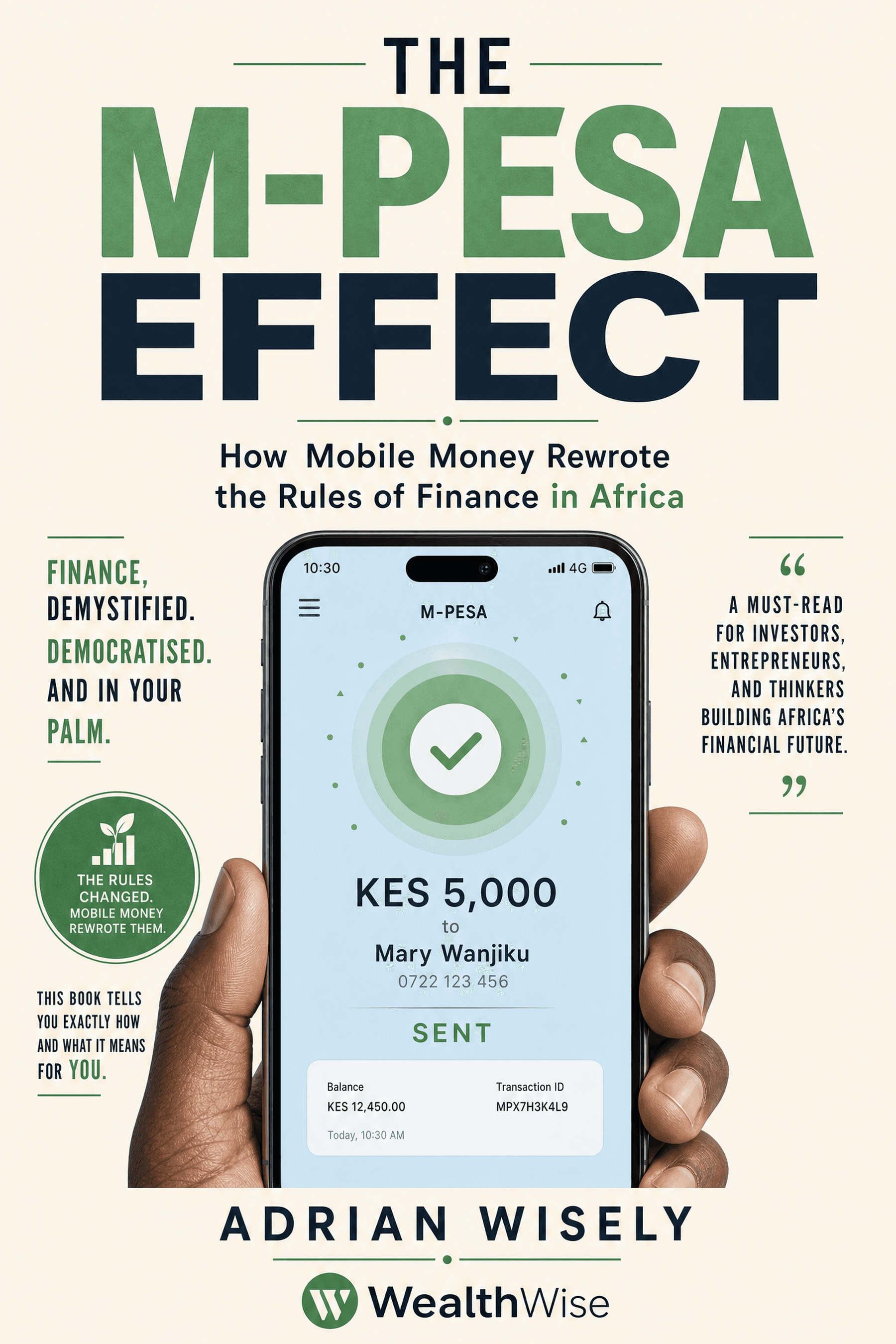
The M-Pesa Effect
How Mobile Money Rewrote the Rules of Finance in Africa
Read the first chapter in your browser. It's free, with no account and no email needed.
Free to read. No account required.
About this book
In 2007, a service launched in Kenya that let people send money using basic phones, with no bank account and no branch visit. Within a few years, it had changed how a whole country moved money. Why did it happen there, and what does the rest of the world miss about it?
The M-Pesa Effect tells the story from the start, including the pilot that took an unexpected turn. You will see why Kenya, and not California, became the home of mobile money, and how the system works behind the simple menu. The book looks beyond M-Pesa to the wider African fintech explosion, and examines what regulation got right.
It then draws five lessons for Western finance, explores what comes after mobile money, and ends by showing you how to apply the M-Pesa lens to your own world, whether you work in finance, tech, policy, or simply want to understand how money is changing.
Look inside
Chapters
This book is organized into nine chapters, each building on the last.
Part I: The Revolution (Chapters 1–3)
The first three chapters establish the story, the scale, and the structural explanation for why Africa's mobile money revolution happened where and when it did.
Part II: The Machine (Chapters 4–6)
The middle three chapters explain how mobile money works — the technology, the ecosystem, and the regulation.
Part III: The Lessons (Chapters 7–9)
The final three chapters extract lessons and provide tools for applying them.
The Phone That Became a Bank
On March 6, 2007, Safaricom launched a service that let Kenyans send money to each other using basic Nokia phones. No smartphone required. No internet connection. No bank account. No credit check. No branch visit. Just a SIM card, a menu accessed by dialing a short code, and a four-digit PIN.
The service was called M-Pesa. The "M" stood for "mobile." "Pesa" is the Swahili word for money.
It was not supposed to be this.
The original concept was developed through a pilot funded by the UK's Department for International Development (DFID) and managed by a small team at Vodafone. The architect of the pilot on the Vodafone side was Nick Hughes, a commercial director in Vodafone's International Division, who had been searching for ways that mobile phones could deliver development benefits. His collaborator in Kenya was Susie Lonie, a Vodafone project manager who moved to Nairobi in 2005 to run the pilot on the ground. Together, they designed a system for one specific purpose: let microfinance borrowers repay their loans from their phones instead of traveling to an office to deliver cash.
The mechanics were deliberately simple. A borrower would visit a partner agent — a local shopkeeper — and hand over the repayment in cash. The shopkeeper would use a phone to credit the borrower's account. The microfinance institution would see the repayment in its system in real time. No paper. No travel. No lost cash on a matatu journey.
Hughes and Lonie ran the pilot in partnership with Faulu Kenya, a microfinance institution serving small entrepreneurs and market traders in urban and peri-urban Kenya. The pilot enrolled a few thousand customers. What it found upended the entire premise.
The Pivot That Changed Everything
During the pilot, something unexpected happened. The borrowers started using the system to send money to each other. Not loan repayments. Personal transfers. A worker in Nairobi sending money to his mother in Kisumu. A teacher sending school fees to a relative in Meru. A market trader paying a supplier in Nakuru. The peer-to-peer transfer volume dwarfed the loan repayment volume within weeks.
The pilot team had built a loan repayment tool. The users had discovered a payment platform.
This is a critical lesson that gets lost in the celebratory telling of the M-Pesa story: the innovation was not a product of institutional foresight. It was a product of listening to users. Hughes and Lonie did not design a remittance platform. The users of their pilot showed them what the market actually needed. The design team was smart enough to see what was happening and change course.
Safaricom — Kenya's dominant mobile network, partially owned by Vodafone — recognized what the pilot data was showing and pivoted. On launch day, M-Pesa was marketed not as a lending tool but as a money transfer service. The tagline was "Send money home."
Three words. They named the exact need — remittances from urban Kenya to rural Kenya — that the banking system had completely failed to address. Kenya had 19 million mobile phone users and 4 million bank accounts. Fifteen million people had phones but no banks. M-Pesa gave them a bank on their phone.
The response was immediate.
Within the first month, 20,000 customers registered. Within six months, 1.1 million. Within two years, M-Pesa had more users than all Kenyan bank accounts combined. Within five years, it processed more domestic money transfers than Western Union processed globally — in a single country, using basic feature phones and USSD menus.
What You Will Learn
- The origin story of M-Pesa — and why it matters beyond Kenya
- The current scale of mobile money in Africa — numbers that rival or exceed Western financial systems
- Why this is not a "developing world" curiosity but a genuinely superior financial innovation
- The question this book exists to answer: why Kenya and not California?
The Numbers That Should Humble Silicon Valley
Let us put M-Pesa's success in context before we proceed.
PayPal launched in 1998 with the backing of Silicon Valley's most connected entrepreneurs — Peter Thiel, Elon Musk, Reid Hoffman. It had US-based regulatory clarity, the world's deepest venture capital ecosystem, and a mature internet infrastructure. It took PayPal 15 years to reach 150 million active users globally.
M-Pesa launched in 2007 in a single country of 38 million people with no venture capital, no app store, and no smartphones. It reached 50 million active users — in a continent where most of them access the service through basic feature phones using USSD menus (those *123# codes that look ancient to Western eyes but work on any phone made in the last 20 years).
But M-Pesa is no longer the whole story. It was the spark. What followed is a revolution.
Across Sub-Saharan Africa, mobile money has become the dominant financial infrastructure:
- 700+ million registered mobile money accounts — more than twice the number of traditional bank accounts in the region
- $1 trillion+ in annual transaction value — a figure that has doubled every 3-4 years
- 85+ billion transactions per year — more than Visa and Mastercard combined in Sub-Saharan Africa
- 14+ million mobile money agents — more than all bank branches, ATMs, and post offices on the continent combined
- In Kenya, 97% of adults have used mobile money — the highest penetration rate of any financial service in any country on Earth
These are not "alternative" banking numbers. These are THE banking numbers for a continent of 1.4 billion people. Mobile money is not a supplement to traditional banking in Africa. It IS the financial system.
The scale comparison with Western platforms is instructive. Apple Pay — backed by the world's most valuable company, available in 70+ countries, marketed aggressively for a decade — had an estimated 500 million users globally by 2025. Africa's mobile money ecosystem, confined to a single region and primarily running on feature phones over USSD, had 400 million active accounts. The comparison is not designed to diminish Apple Pay. It is designed to make visible something that should not require explanation but apparently does: Africa built one of the world's largest financial platforms, and almost no one in the West is paying attention.
What This Is Not
Let us be clear about what we are discussing.
This is not a "cute technology for poor people" story. The condescension that sometimes accompanies Western coverage of African innovation — "look what they can do with so little!" — misses the point entirely. M-Pesa is not interesting because it serves poor people. It is interesting because it solved a problem that the world's most sophisticated financial institutions could not. Western banks had centuries of experience and billions in capital. They did not bring financial services to hundreds of millions of previously excluded people. Safaricom did. That is the story.
Free to read. No account required.