Free first chapter
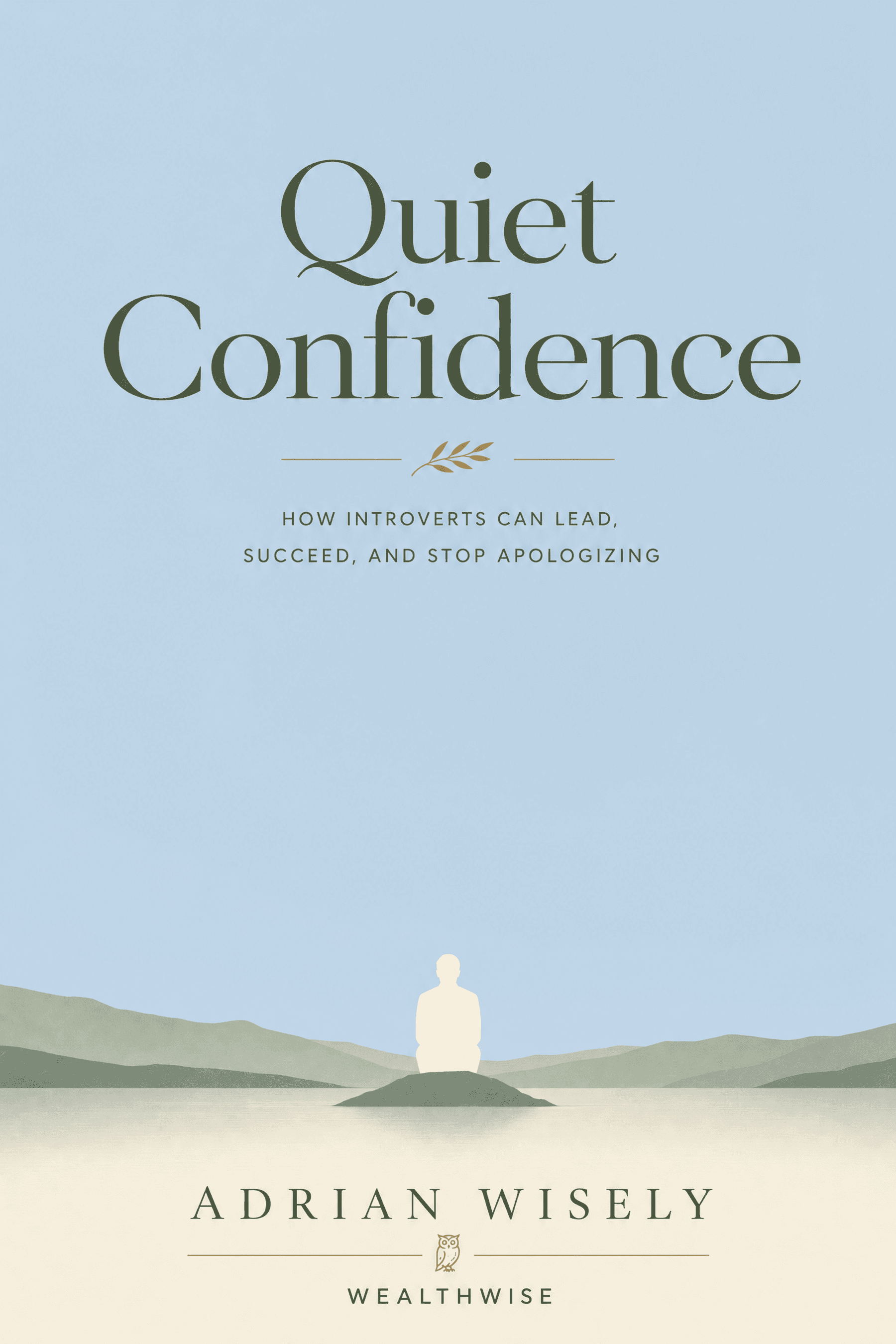
Quiet Confidence
How Introverts Can Lead, Succeed, and Stop Apologizing
Read the first chapter in your browser. It's free, with no account and no email needed.
Free to read. No account required.
About this book
You have been told to speak up more, network harder, and be more visible. Meanwhile you have a habit of apologizing for needing quiet, space, and time to think. There is nothing wrong with you. You are an introvert in a world built around extroverts.
Quiet Confidence is not about fixing who you are. It starts by dismantling the extrovert ideal and showing you where introverts have real strengths. From there it gets practical. You will learn networking without the awkwardness, ways to make your voice count in meetings, and what leading looks like when you are not the loudest person in the room.
The book also covers how to manage your energy, how introversion plays out in close relationships, and how to break the apology habit that quietly undermines you. By the end, you will have ideas for building a career and a life that fit the way you actually work best, without pretending to be someone else.
Look inside
Preface
I need to tell you something, and I need you to hear it clearly: there is nothing wrong with you.
You are not too quiet. You are not too sensitive. You are not lacking in confidence, ambition, or leadership potential. You are an introvert in a world that was designed by and for extroverts, and the fact that you have made it this far while constantly being told to be louder, more outgoing, more visible, and more "out there" is a testament to a strength that most extroverts cannot even imagine.
This book is not about fixing your introversion. There is nothing to fix. This book is about using it — leveraging the quiet power that introverts bring to leadership, relationships, creativity, and career building, while also developing the skills to navigate an extrovert-biased world without apologizing for who you are.
Because that is the real problem, is it not? Not the introversion itself. The apologizing. The "sorry, I need to recharge." The "sorry, I'm not great at small talk." The "sorry, I don't have anything to add to this meeting." The constant low-grade guilt of being a person who needs space in a culture that treats solitude as a deficiency.
We are done apologizing.
Who This Book Is For
- Introverts who know their introversion is a strength but are tired of the world treating it like a weakness
- Quiet professionals who are overlooked for promotions because they do not self-promote
- Introverted leaders (or aspiring leaders) who wonder if leadership requires being loud
- Anyone who has been told "you need to speak up more" and wanted to say "you need to listen more"
What You Will Walk Away With
Strategies for leading, networking, speaking up, and succeeding as an introvert — without pretending to be an extrovert. Plus the confidence to stop apologizing for needing quiet, space, and time to think.
Introversion Is Not a Problem to Solve
Nadia's annual review lasted 45 minutes. For 40 of those minutes, her manager, Greg, told her that her work was excellent. Her data analyses had identified a supply chain inefficiency that saved the company $2.3 million. Her documentation was the best on the team. Her clients praised her thoroughness and accuracy.
Then Greg leaned forward and said the five words that undid all of it: "You need to be more visible."
More visible. At a company where she had just saved $2.3 million. In a role that required deep, uninterrupted analytical work. From a person whose single greatest professional strength was the ability to focus deeply for hours without needing to perform that focus for an audience.
"Speak up more in meetings," Greg continued. "Build your personal brand. Network more with other departments. I want people to know who you are."
Nadia nodded. She always nodded. That was the thing about being an introvert in a corporate environment — you spent half your energy doing the work and the other half pretending to be the kind of person who does the work loudly.
She went home that night and Googled "how to be more outgoing at work." The results were predictable: Smile more! Ask questions! Introduce yourself to three new people every week! Join committees! Volunteer for presentations!
She closed the laptop and stared at the ceiling.
Here is the thing about Nadia that Greg did not understand: she was not shy. She was not lacking confidence. She was not avoiding people because she was afraid of them. She was quiet because that is how her brain works. She processed deeply, spoke carefully, and preferred one meaningful conversation over ten superficial ones. She was an introvert. And her introversion was not the problem Greg thought it was. It was the reason she saved the company $2.3 million.
Here is what Nadia did not know — and what this chapter will teach you.
What You Will Learn
- Understand what introversion actually is (stimulation preference, not social deficit)
- Separate introversion from shyness, social anxiety, and arrogance
- Recognize the cost of pretending to be an extrovert
- Claim your introversion as a professional asset, not a limitation
Why This Matters
One-third to one-half of the population is introverted, depending on which study you reference. That is 100-170 million Americans whose brains are wired to prefer lower stimulation, deeper processing, and solitary recharging.
And nearly all of them have, at some point, been told there is something wrong with how they operate. Speak up. Be louder. Network more. Put yourself out there. Stop being so quiet. Why do not you want to go to the happy hour?
This feedback is so constant and so universal that most introverts internalize it. They believe they are deficient. They believe the extroverted way is the correct way, and their natural mode is a bug to be fixed.
It is not a bug. It is a feature. And this chapter is about seeing it clearly — perhaps for the first time.
What Introversion Actually Is
The Reality
Introversion is a temperament — a stable, biologically-rooted orientation toward stimulation. Introverts are not anti-social. They are differently-social.
How It Actually Works
The distinction comes down to one thing: where you get your energy.
Extroverts gain energy from external stimulation — social interaction, busy environments, group activities. After a two-hour networking event, an extrovert feels charged up.
Introverts expend energy on external stimulation and recover through solitude or low-stimulation environments. After that same networking event, an introvert feels drained — not because they did not enjoy it, but because it cost them energy.
This is not metaphorical. Brain imaging studies show that introverts have higher baseline activity in brain regions associated with internal processing. Their brains are already busy. External stimulation adds to an already active system, which is why it becomes draining faster.
Think of it as a noise floor. Extroverts operate with a low internal noise floor — they need external input to feel engaged. Introverts operate with a high internal noise floor — external input adds to a system that is already humming. Both are normal. Both are functional. One is not better than the other.
What Introversion Is NOT
Introversion is not shyness. Shyness is a fear of social judgment. Introverts are not afraid of people — they are drained by prolonged social stimulation. A shy extrovert wants to be at the party but is afraid of being judged. A non-shy introvert is perfectly comfortable at the party but will need to leave at 10 PM to recharge.
Introversion is not social anxiety. Social anxiety is a clinical condition involving intense fear and avoidance of social situations. If social events cause panic attacks, physical symptoms, or severe avoidance, that is a mental health concern, not a temperament. Please see a therapist.
Introversion is not arrogance. Being quiet is not the same as being aloof. Introverts are often perceived as cold, distant, or "too good" for the group because they do not fill silence with chatter. This is a misread that costs introverts professionally and socially.
Introversion is not antisocial behavior. Introverts like people. They like specific people, in specific doses, in specific settings. The preference for depth over breadth is not a rejection of humanity. It is a different way of connecting.
The Cost of Pretending
The Reality
Most introverts have spent years performing extroversion. Smiling when they want to be quiet. Making small talk when they want to think. Attending events they would rather skip. Volunteering for presentations they dread.
Free to read. No account required.